
Perfect themes
I purchased Reign theme from Wbcom Designs, the support team was very helpful and I got the perfect website what I was looking for. Good work Wbcom Designs
For startup founders / accelerators
Give each batch its own private space, put mentors in a searchable Listora directory with their expertise, list office hours and demo days in Eventonomy, and build the alumni network before the first batch ends. The mentor directory saves your team from being the switchboard for every introduction. Reign gives the programme one login and one design.
Accelerators use a CRM, a chat workspace and a static programme site, so there is no central directory of mentors and alumni lose touch.
Reign + BuddyNext + WB Gamification for an accelerator community: founder profiles, a mentor directory, an alumni network and a space for each cohort. Both plugins install free.
Founder profiles, a mentor directory and a space per cohort, free to install. You buy the Reign theme; BuddyNext, WB Gamification and Listora are ours and install free.
Screens from the live demos, with sample content. Open any of them and click around.
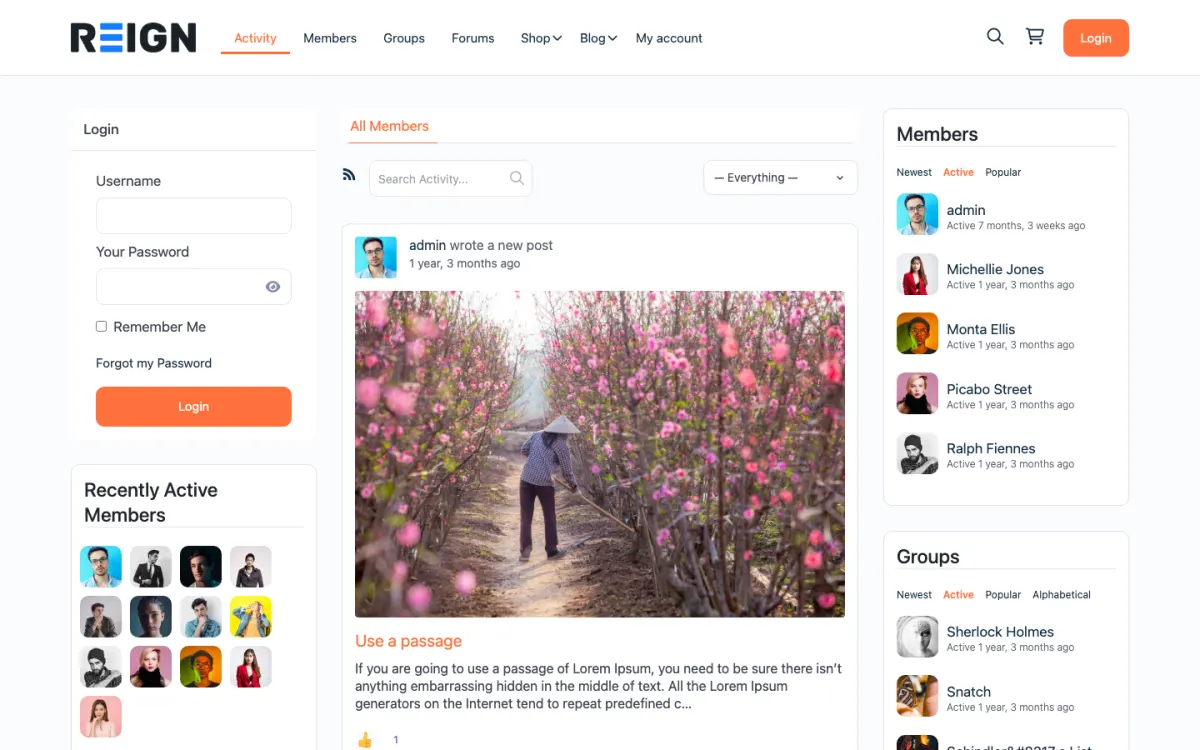
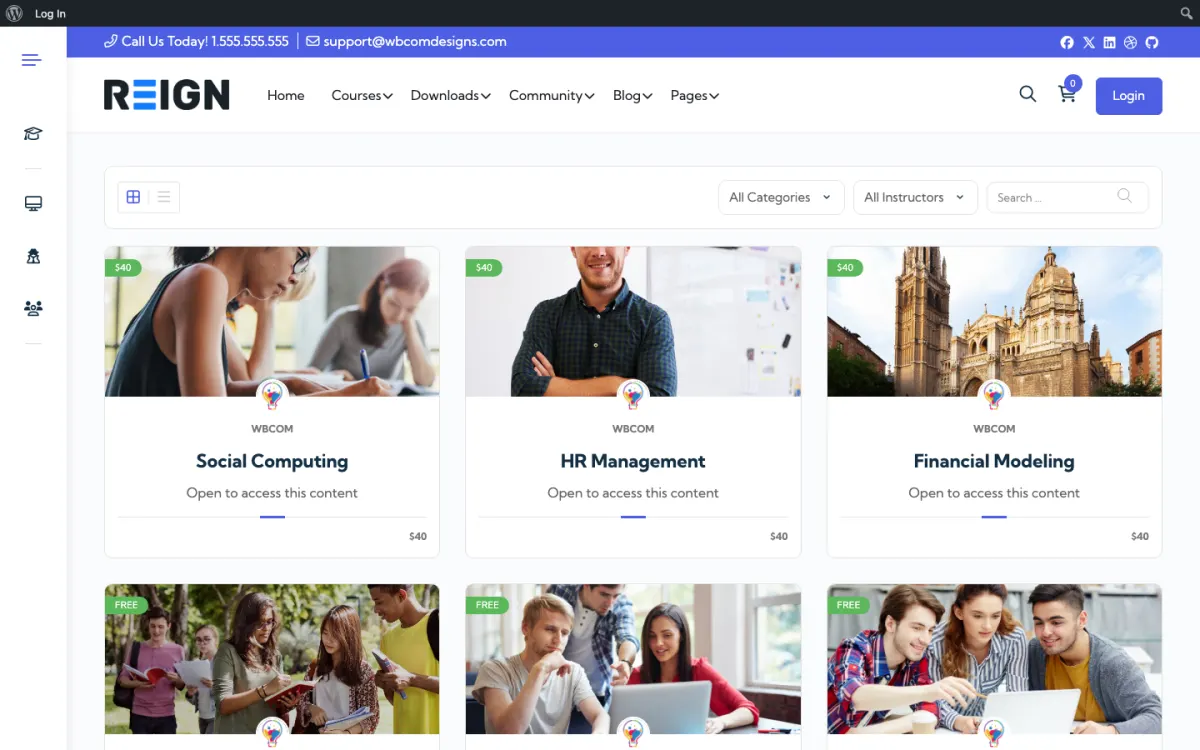

Founder profiles with fields for company stage, sector and current ask.
Mentor directory in Listora with availability and expertise filters.
An alumni group that spans all cohorts, so mentoring carries on.
You launch with cohort or batch groups, a mentor directory, an events calendar and a resource library. Each batch gets its own space, mentors have profiles founders can search, and events carry office hours and demo days. For an accelerator the mentor directory is often the most used feature, because matching is the service being sold.
A founder joins with their batch, uses the resources and attends events, and the real value arrives through mentor introductions. Batch groups are intense for a few months and then quieten, which is the natural rhythm. Alumni is where the long-term network lives, and programmes that build that layer end up with something far more valuable than the batch itself.
Accelerators usually fund this as programme infrastructure rather than revenue, replacing separate community, events and directory tools. Where it earns directly it is alumni membership, paid workshops or sponsorship from service providers wanting access to founders. The case internally is consolidation and keeping the alumni network in your own hands.
Underinvesting in alumni. The batch is intense and then it ends, and a founder with nowhere to go is a relationship you spent months building and then dropped. Alumni is also where your next batch's referrals come from, so it pays for itself.
Reign is the WordPress theme for building a complete community site: social network, courses, member directory, marketplace and job board on one install. An accelerator uses the social network, the directory and the events.
BuddyNext supplies founder profiles with searchable fields, spaces per batch and notifications. Listora, free, powers the mentor directory with listings, search, filters and contact forms on each profile. Eventonomy lists office hours, demo days and workshops with RSVPs. WB Gamification adds recognition for engagement, with no paid tier. If you run short courses, Learnomy can host them.
The BuddyPress Community Bundle kit is the packaged route and the enterprise intranet build guide covers private, role-based sites. The plugins page shows the split, and Reign is a flat theme licence.
Set up the structure before the batch arrives. Retrofitting separation means untangling months of mixed discussion.
Install WordPress with Reign, BuddyNext, Listora and Eventonomy. The start page lists the order.
Create roles for founders, mentors, staff and alumni, and decide who can see what. Test as each.
Build the mentor directory with expertise, sector, stage experience and availability fields. Ask each mentor to review their own profile.
Create a private space for the first batch and a shared alumni space. Write what each is for.
Add the programme calendar: office hours, workshops and demo day, with RSVPs.
Decide how introductions are requested and how mentors accept them, so the programme team stops being the switchboard.
A founder in the batch checks the calendar, books an office hour, searches the mentor directory for someone who has dealt with their problem and posts an ask in the batch space. They attend a workshop and post what they learned.
Mentors check requests, accept or decline and reply to a few questions in the space. They appreciate a light touch: clear requests, short asks and no admin.
The programme team uses the site to see who is engaged and who has gone quiet, to post updates and to prepare for demo day. Batch groups are intense for a few months and then quieten, which is the natural rhythm.
The alumni network is the long-term asset. Founders who leave a batch and have somewhere to go stay in touch, mentor the next batch and refer others. Programmes that build this layer end up with something far more valuable than a single batch.
Growth in the mentor pool improves matching, which improves the founder experience. Keep profiles current, ask mentors to say what they will not help with and track which introductions led to something.
Revenue, where it exists, comes from alumni memberships, paid workshops or sponsorship from service providers who want access to founders. Many programmes fund the site as infrastructure and justify it through consolidation.
A programme team has to justify the site to whoever funds it, and vanity numbers will not do that. Choose a few measures that connect to what the programme is for, and look at them every month. Keep the list short enough that you will actually read it.
Start with introductions. How many mentor requests were made, how many were accepted and how many led to a second conversation? That chain is the heart of the service. If requests are made but not accepted, mentors are overloaded or the profiles are unclear. If they are accepted but go no further, the matching is weak.
Then look at participation by batch. Which founders have posted, attended an office hour or answered a question from another founder? Founders who are active tend to get more from the programme, and the ones who have gone quiet are the ones to call.
Alumni deserve their own measure. Track how many graduates still log in each quarter, how many have answered a current founder's question and how many have mentored. This is the layer that compounds, and a rising number tells you the network is becoming an asset.
Share a short summary with your funders each term. Use plain statements about what happened and what you learned, and avoid inflated claims. A funder who sees honest, steady reporting trusts the next request more than one who sees a polished but thin story.
Underinvesting in alumni is the main one. The batch is intense and then it ends, and a founder with nowhere to go is a relationship you built and then dropped.
Letting the team be the switchboard is the second. If every introduction goes through staff, the programme does not scale. Give mentors profiles and let founders request directly.
Third, do not mix batches in one space. Cohort conversations are different, and mixing them dilutes both.
If you are an informal founder group without staff, the indie hackers page is lighter. If your offer is a paid peer group, see the mastermind groups page.
If you need a full CRM and application management for your programme, keep that in a dedicated system and link the community to it.
Through a separate sync plugin or a custom integration, not out of the box. Decide which system is the record of truth for founder data before you connect anything.
Yes, a private group per batch so conversations do not bleed across cohorts, with a shared alumni space they graduate into. Set that structure up before the first batch, because retrofitting it means untangling months of mixed discussion.
A searchable mentor directory with profiles and availability, plus messaging or a booking plugin for office hours. The directory saves the programme team from being the switchboard for every introduction, which is usually where their time disappears.
Alumni, and it is the part most programmes underinvest in. A founder who leaves the batch and has nowhere to go is a relationship you spent months building and then dropped. The alumni network is also where your next batch's referrals come from.
Yes, through a booking plugin tied to their profile, which stops the programme team being the switchboard for every introduction. It is usually the single biggest time saving for staff.
Slack handles the live chat well. What it does not do is the mentor directory, the events, the resource library or the alumni network, which are the things that outlast the batch.
BuddyNext, WB Gamification and Listora cost nothing to install, and each has its own Pro plan for later. Running the third-party stack instead? The BuddyPress Community Bundle kit is the packaged route. Or have the Wbcom team set either one up for you.
One theme, the whole site
Reign is the WordPress theme for building a complete community site: social network, courses, member directory, marketplace and job board on one install. Start with one, add the others when you need them, and keep one login for every member. Open a live demo, or launch a sandbox and get a fresh WordPress site to click through in about a minute.
Profiles, activity feed, spaces, messages and moderation on your own domain. Powered by BuddyNext.
Lessons, quizzes, certificates and memberships, on the same login as the community. Powered by Learnomy.
Listings, search, maps and reviews that members can add themselves. Powered by Listora.
Sell services or products from many sellers, with orders, reviews and commissions. Powered by WP Sell Services.
Employers post jobs, members apply, and you run the board from one dashboard. Powered by WP Career Board.
Reign with BuddyPress, ready in one click, or browse every demo by site type.
Add more when you need it
Tell us what you want members to do on your site. We will tell you which Reign setup, plugins and kit fit, before you buy anything.
I purchased Reign theme from Wbcom Designs, the support team was very helpful and I got the perfect website what I was looking for. Good work Wbcom Designs
WBComDesigns is amazing. The WP plugins and themes are of top notch quality with lots of features and updated very frequently. Supports are very responsive and helpful. I use Reign with TutorLMS, and the experience is surprisingly smooth. The recently launched BuddyNext Pro and MediaShield Pro are…
Love this company. Loved the REIGN product. They were there the entire time helping me set things up; and when things went wrong? They were quick to take action and help find a solution.
I am using the REIGN theme and several plugins from Wbcom Designs on my website. The theme is beautifully designed, and the plugins are user-friendly. Everything works smoothly, and the features are perfect for building professional websites and communities. What impressed me most is their…
I only have positive experience with wbcom. My journey started a lot of years back with the free buddyx theme. during my learning of wordpress and futher websites ideas I found a match with their Reign job mate theme. Always there to help, always open to explore ideas, always kind replyes even if I…
Swift and expert coding by Kerit to apply a personalised display adjustment on the Reign Theme for a media plugin that was not fully supported at the moment.
WBCOM Designs has constantly updated and supported their plugins and themes. Recently the new BuddyNext project is Amazing! - and the new line of addons like Mediaverse, Jetonomy, Mediashield, and Listora.. are likewise Amazing! - and very well built. Today their online Chat solved a download…
We’ve hosted a number of Wbcom Designs clients on Levamo, and our experience with their products has been very positive. Their plugins and themes are well built, their support has been reliable, and they seem to be very innovative and constantly launching cool new products.
I have worked with Wbcom Designs on several custom development requests for my WordPress platform, and my experience has been excellent.
After 16 years of buying WordPress themes and plugins, I know exactly what bad support looks like and Wbcom Designs is the polar opposite. My setup was a nightmare: multiple tools, deep integrations, custom configurations that required real back-and-forth. Most vendors would've pointed me to a…