Reign for local restaurant directories. Local restaurant directory and reviews.
Build the directory one neighbourhood at a time: Listora for listings, map search, member reviews and owner claims, BuddyNext for the people who write the reviews, and accurate hours above everything. Add the first listings yourself, then invite owners to claim them. Reign gives the listing pages and the map a clean, food-friendly layout.
Local food bloggers run a WordPress homepage, review embeds and Instagram, with no submission flow, no income from the site and listings that are hard to update at scale.
Reign + Listora + BuddyNext for a community-submitted restaurant directory with member reviews and featured-listing monetization. Both plugins install free. GeoDirectory is the alternative for directories already built on it.
Listings, search, maps, reviews, claims and member submissions, free to install. Paid listings, Google Maps and verification badges are the Listora Pro upgrade. You buy the Reign theme; Listora and BuddyNext are ours and install free.
Fifty accurate listings in one area beat five thousand stale ones. Wrong opening hours lose a visitor for good.
Member reviews, which require an account, are what make a local directory trustworthy and hard to spam.
Make claiming free and easy, then sell prominence and not corrections.
Listora installs free; featured paid plans are its Pro upgrade. Pricing covers the theme licence.
What it looks like on Reign
Screens from the live demos, with sample content. Open any of them and click around.
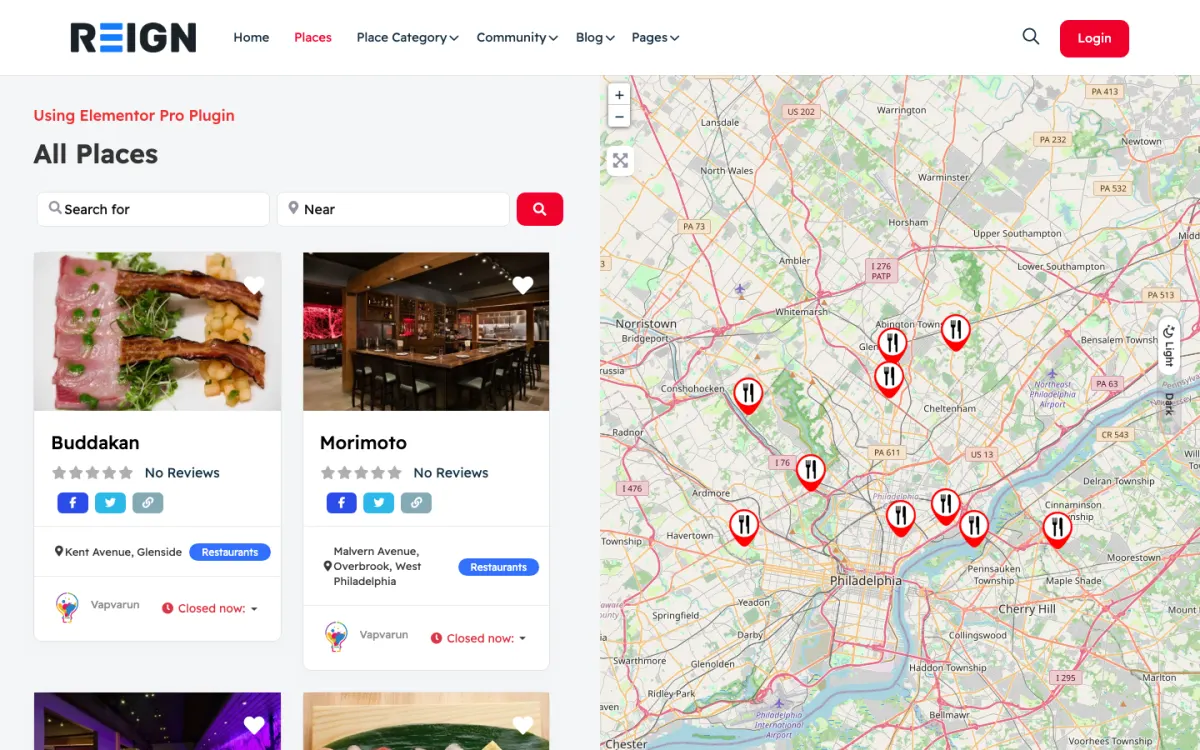
Listings beside a map, with search by keyword and location. Open the demo
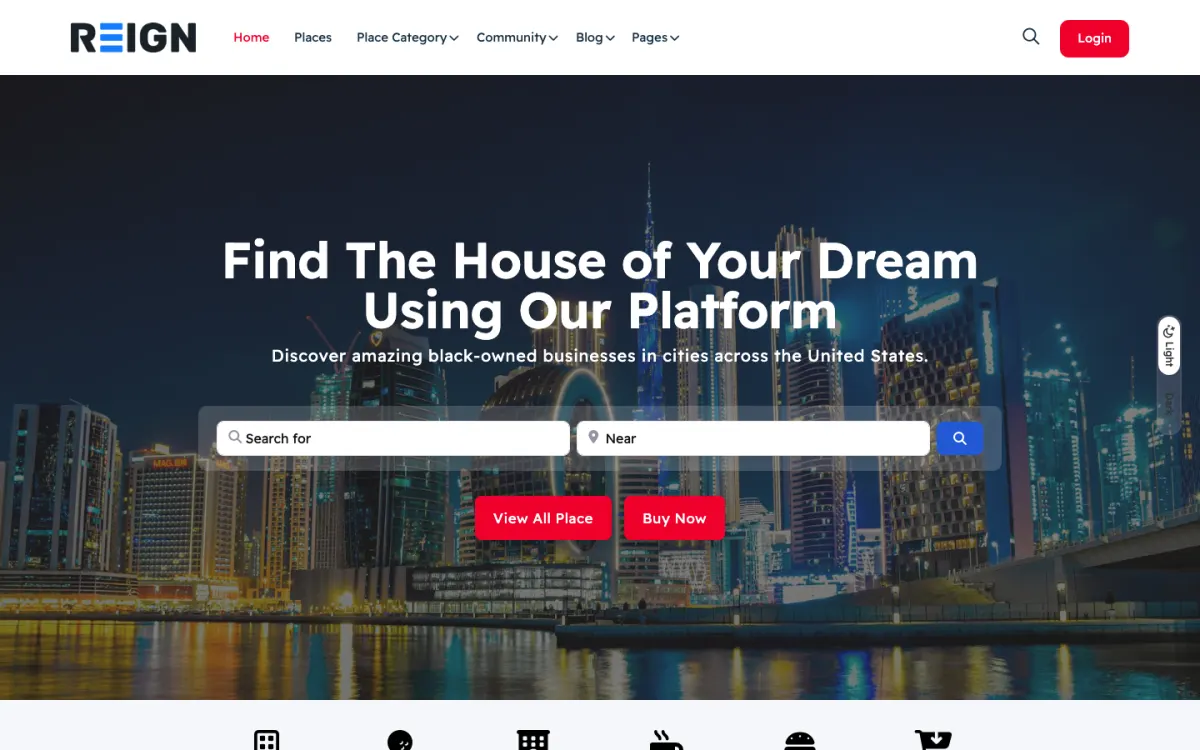
A directory home page with search up front. Open the demo
Three highlights for local restaurant directories.
01
Member-submitted listings with a review system.
02
Featured placement for restaurants through Listora Pro paid plans, or GeoDirectory pricing on that stack.
03
BuddyNext profiles for members: food bloggers and reviewers.
What the site looks like on day one.
You launch with restaurant listings, map search, member reviews and a submission form so owners can claim or add their own entry. Listings carry hours, cuisine, price range and photos; the map is how most people actually browse. Reviews from members rather than anonymous visitors are what make a local directory trustworthy and hard to spam.
What a member actually does.
A visitor searches for a cuisine or an area, opens two or three listings, and maybe leaves a review afterwards. Regulars come back when the directory has coverage they trust. Restaurant owners engage when claiming a listing is easy and they can see it brings people in. The hard part is the first hundred listings, which you usually add yourself.
How this usually makes money.
Featured listings are the main model, sold as a monthly slot for prominence, plus banner advertising once traffic supports it. Some directories charge for claiming a listing with enhanced fields. Reviews must never be for sale; a directory that charges to hide bad reviews destroys the trust it depends on.
The mistake to avoid.
Padding the directory with scraped listings. Five thousand stale entries with wrong hours is worse than fifty accurate ones, because the first wrong closing time costs you the visitor permanently. Build one neighbourhood properly and expand from a base people trust.
Which Reign setup fits a restaurant directory
Reign is the WordPress theme for building a complete community site: social network, courses, member directory, marketplace and job board on one install. A restaurant directory uses the directory and the community halves.
Listora is our directory plugin. The free version gives you listings, search, Leaflet maps, member submissions, reviews with owner replies, business claims with admin approval and a contact form on every listing that saves enquiries as leads. Pro adds paid listing plans, credits and coupons, Google Maps, verification badges and richer reviews. BuddyNext adds profiles for food bloggers and regular reviewers.
Accuracy beats volume. Launch where you can personally check the details.
01
Pick one neighbourhood or town. Walk it, or at least call each place, and compile name, address, hours, cuisine and price range.
02
Install WordPress with Reign, Listora and BuddyNext. The start page lists the order.
03
Create the listing type with fields for cuisine, price range, dietary options and opening hours. Add good photos for every venue.
04
Switch on member reviews with an account requirement and write your policy on negative reviews before you get one.
05
Turn on claims, approve them yourself at first and email each owner to tell them their listing is live and how to update it.
06
Share the directory with a local audience that already cares about food, such as a food group or a neighbourhood forum, and ask for first reviews.
What diners and owners do week to week
A diner searches for a cuisine or an area on a Thursday evening, opens two or three listings and checks hours and photos. If the place is good, they might leave a review afterwards. Regulars come back when the directory has the coverage they trust.
An owner logs in rarely: to update holiday hours, add a new photo of a dish or reply to a review. They return more when they can see the listing brings enquiries. Show them the number of enquiries and views, since that proves the value of the listing.
Your week is accuracy and moderation. You chase changed hours, approve claims, check reviews that were reported and add new venues as they open. Anything that makes wrong information visible should be fixed quickly, because the first wrong closing time costs you the visitor.
How a restaurant directory grows
Growth comes by expanding from a base people trust. Once one neighbourhood is complete, move to the next. Each new area brings new diners, and each diner who finds one accurate answer is likely to use you again.
Niche positioning helps. A directory for vegan food, late-night eating or places that welcome dogs is easier to promote than a general one, and local owners in that niche are more willing to claim and maintain a listing.
Revenue follows trust. Featured listings for prominence come first, banner advertising once traffic supports it, and enhanced claimed profiles later. Reviews must never be for sale, since a directory that charges to hide bad reviews destroys the trust it depends on.
How to keep listings accurate month after month
Accuracy is what a restaurant directory sells, and it decays quietly. A kitchen changes its hours, a chef leaves, a menu is reprinted, and your listing is wrong until somebody says so. The work is to build a rhythm that finds the changes before your visitors do.
Make owners your first line. Once a restaurant claims its listing, it can update hours, photos and menus itself. Send each owner a short reminder every quarter that asks them to check their entry, and make the link go straight to the edit screen.
Add your own sweep. Once a month, check the listings that have not been touched for a while, starting with places most visited. A phone call or a look at the venue's own page is enough. Mark the date of the last check so visitors can see it.
Use visitors as a signal. Give reviewers a simple way to report that a place has closed or changed hours, and treat those reports as urgent. A visitor who reports a closure and sees it fixed within a day becomes a loyal reader.
Retire entries honestly. When a restaurant closes, mark it closed and keep the page, so anyone searching for it learns what happened. Deleting it leaves a dead link, and keeping it as if it were open is the mistake that costs you trust.
Mistakes specific to restaurant directories
Padding the directory with scraped listings is the main one. Stale entries with wrong hours are worse than no entries. Build with data you checked.
Charging owners to correct information is the second. It annoys the people you need most. Keep claiming free and charge for promotion.
Third, do not aggregate reviews from other platforms. It is usually against their terms and adds nothing your members trust. A smaller number of moderated reviews from your own members is worth more.
If you are a single restaurant, you need a good website with a menu and a booking link, not a directory.
Local restaurant directory-specific questions.
Can a local restaurant directory compete with the big review sites?
The big review sites are strong on reach and sheer volume. A local directory does better on focus and trust: one neighbourhood covered properly, a clear niche such as vegan, late-night or dog-friendly, and reviews from members your visitors can see are real.
How do restaurants claim a listing?
Through a claim flow that verifies ownership, usually by email or phone against the listing details, then hands them a dashboard to update hours, photos and menus. Make claiming free and upselling optional; charging to correct wrong information annoys exactly the people you need.
Can members leave reviews?
Yes, and member reviews rather than anonymous ones are the point. Requiring an account reduces spam dramatically and makes moderation manageable. Decide your policy on negative reviews before you get one, because deciding under pressure usually goes badly.
How do I get the first listings?
You add them. Scrape nothing; compile a solid list for one area, add good photos and correct hours, then invite owners to claim. A directory with fifty accurate listings in one neighbourhood beats one with five thousand stale entries across a city.
How do I keep hours accurate?
Make claiming free and easy so owners maintain their own, and prompt for a review of details periodically. Wrong opening hours is the failure that loses a visitor permanently, so it is worth chasing.
Should I aggregate reviews from elsewhere?
No. Reproducing reviews from other platforms is usually against their terms and adds nothing your members trust. Your own member reviews, moderated, are worth more even if there are fewer.
Buy the theme. Add the plugins free.
Listora and BuddyNext cost nothing to install, and each has its own Pro plan for later. Running the third-party stack instead? The Reign GeoDirectory kit is the packaged route. Or have the Wbcom team set either one up for you.
Reign is the WordPress theme for building a complete community site: social network, courses, member directory,
marketplace and job board on one install. Start with one, add the others when you need them, and keep one login
for every member. Open a live demo, or launch a sandbox and get a fresh WordPress site to click through in about a minute.
Member or business directory
Listings, search, maps and reviews that members can add themselves. Powered by Listora.
WBComDesigns is amazing. The WP plugins and themes are of top notch quality with lots of features and updated very frequently. Supports are very responsive and helpful. I use Reign with TutorLMS, and the experience is surprisingly smooth. The recently launched BuddyNext Pro and MediaShield Pro are…
Hoang Phan · VN ·
Love this company
Love this company. Loved the REIGN product. They were there the entire time helping me set things up; and when things went wrong? They were quick to take action and help find a solution.
Fable Fortitude · CA ·
Excellent Theme, Powerful Plugins and Outstanding Support
I am using the REIGN theme and several plugins from Wbcom Designs on my website. The theme is beautifully designed, and the plugins are user-friendly. Everything works smoothly, and the features are perfect for building professional websites and communities. What impressed me most is their…
S W Malcolm · US ·
I only have positive experience!
I only have positive experience with wbcom. My journey started a lot of years back with the free buddyx theme. during my learning of wordpress and futher websites ideas I found a match with their Reign job mate theme. Always there to help, always open to explore ideas, always kind replyes even if I…
Oskar Hanborg · SE ·
Swift and expert coding!
Swift and expert coding by Kerit to apply a personalised display adjustment on the Reign Theme for a media plugin that was not fully supported at the moment.
Russell · GB ·
Perfect themes
I purchased Reign theme from Wbcom Designs, the support team was very helpful and I got the perfect website what I was looking for. Good work Wbcom Designs
Monika Singh · IN ·
Outstanding Service and Exceptional Support from Wbcomdesigns Team
I have already purchased themes and plugins worth over ₹65,000 from wbcomdesigns, and my experience has been nothing short of amazing. Their support is exceptional. Both Shivani Kashyap and Camilia Scott provide incredibly fast responses and have resolved any issues I encountered with my website…
Tushar Garg · IN ·
These guys are absolutely amazing
These guys are absolutely amazing. Such a quick turn around. Their support is second to none.
Miss Decades · GB ·
Fast response for a customisation request
Fast response (1 weekday day) for a simple customisation from Camilia, thank you very much!
Stephanie · AU ·
Quick and helpful support
Quick and helpful support The supporters, i.e Manuzza Zaidi, have been very helpful and provided some css code even for other plugins.