
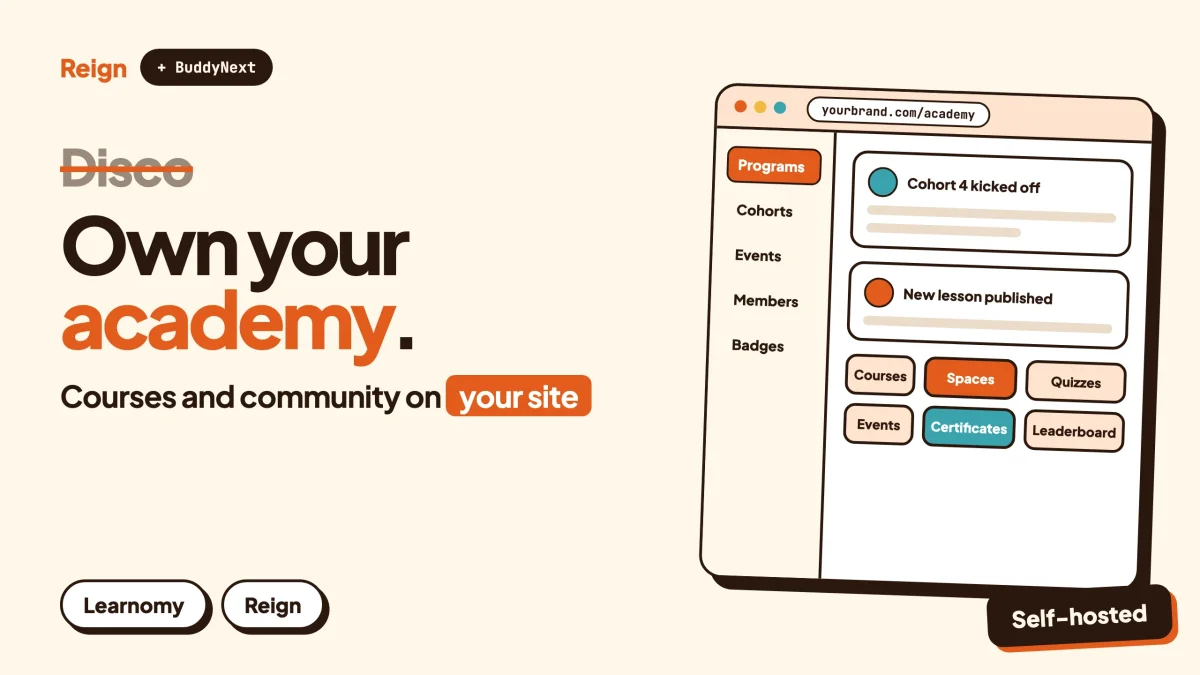
The closest Disco alternative for a self-owned learning community is BuddyNext, the community engine from Wbcom Designs, paired with Learnomy for courses and the Reign theme for the design. Together they run on your own WordPress site, so you keep the members, the content and the billing. Wbcom makes all three, so read this as a vendor view and check each claim on the product pages. Disco is still the better pick for some teams, and the next section says which.
Disco is a hosted platform for building branded learning academies. It joins programs, a member community, events, chat and a set of AI tools in one product, and it is aimed at training businesses, customer education teams and company learning departments. It is well made. The question is whether renting it is the right shape for what you are building.
Details about Disco were read from its public site in November 2026. Where its pages state no detail, this post says so and leaves the point out rather than guessing.
When is Disco the better pick?
Disco is the better pick when you want a finished, managed learning product and you would rather pay a vendor than run a website. That is a legitimate choice, and for several kinds of team it is the right one.
It fits best if three things are true at once.
First, your business is training, and the community is a supporting act. Disco builds its pitch around learning programs, with the community and chat attached to each program. Its home page frames the product as academies that “weave together” learning, community and AI.
Second, you want AI built into the platform on day one. Disco lists AI program generation, a quiz generator, AI narration for lessons, transcripts and chapters for video, a member-facing “Ask AI” assistant, suggested replies and engagement nudges. If your team will use those every week, that is a real reason to stay. A WordPress stack does not copy that list one for one, and pretending otherwise would be unfair to you.
Third, nobody on your side wants to touch hosting, updates or a theme. Disco is software as a service. You sign in, build, and the company runs the servers.
If that describes you, stop reading here and look at Disco’s own pages. The rest of this post is for the people it does not describe.
What does Disco actually include?
Disco is a hosted learning and community platform that bundles programs, events, chat, groups, gamification, automations and AI features into one subscription. Here is what its public pages state.
| Area | What Disco’s public pages say |
|---|---|
| Learning | Self-paced and cohort-based programs, a content editor for lessons, assignments and quizzes, learning pathways with auto-enrolment and certificates, prerequisites, bookmarks, surveys |
| Community | Groups and subgroups, member profiles and a directory, live events and chat inside each program |
| Engagement | Leaderboards, an engagement score, push notifications through a mobile app |
| AI | Program generation, quiz generation, image generation, writing help, AI narration, video transcripts and summaries, Ask AI for members, smart nudges, suggested replies |
| Operations | Automations, reporting and insights, bulk actions, API and webhooks on the higher plan |
| Money | Courses and memberships with payments, with Stripe listed as a native integration |
| Integrations | Native links for Slack, Zoom, Stripe, Zapier, Google Analytics, Google Tag Manager and Facebook Pixel; many other tools embed; SCORM listed as an embed |
| Branding | White-label academy with your logo, colours and domain, a custom email sender, and branded iOS and Android apps |
Two details matter for planning. Disco’s pricing page shows two plans, called Create and Scale. The Create plan lists 250 active members and one branded academy, while Scale lists active members and academies “sized to your plan”, plus single sign-on, API and webhooks, branded mobile apps and migration support. The page is dated October 2026 and publishes its own figures, so check the pricing page for numbers rather than trusting a blog post, including this one.
The second detail is the trial. The pricing page offers a seven-day trial and says no credit card is required. That is enough time to test a program build, not enough to judge a year of running a community.
Why do people look for a Disco alternative?
People look for a Disco alternative for four practical reasons: cost that grows with membership, a platform built for training rather than for a general community, ownership of the data and the domain, and the limits of a closed product. None of these is a flaw in Disco. They are the normal trade-offs of renting a platform.
The plan is tied to active members
Disco prices by tier, and the tiers cap active members and academies. That is fair for a vendor who pays for hosting and video. It also means your costs follow your audience. A community that grows from a few hundred to a few thousand members will be asking for a different plan at some point, and the larger plan is quoted on a setup basis.
On WordPress the bill looks different. You pay for hosting and for the plugins you choose, and neither BuddyNext nor Learnomy charges per member or takes a cut of your sales according to their product pages. Check each product page for licence terms before you commit.
It is a learning platform first
Disco’s solution pages are titled for training businesses, customer education and employee training. That focus is why its program tools are polished. It is also why it is a narrower fit if your community is the main product and courses are one feature among several.
If you run a creator community, an alumni network, a membership with a forum, a directory of members or an events calendar, you will want a feed, spaces, a member directory and a proper way to run events. Some of that exists in Disco. A WordPress stack lets you add a job board, a directory or a services marketplace later without changing platform. The brand community use case is covered in what is a brand community.
You do not own the stack
Disco lets you point your own domain at your academy and send email from your own address. That is real white-labelling. But the software, the database and the release schedule stay with the vendor. If a feature changes, a plan is retired or the company is acquired, your options are whatever it offers.
A self-hosted community has a different risk. You are responsible for backups, updates and hosting quality. Owning the stack means owning the chores as well.
The look is the platform’s look
Disco gives you colours, logos for light and dark mode, a favicon and custom labels. That covers brand basics. It does not give you a theme. If you want the learning area to share a header, navigation and layout with the rest of your marketing site, a theme-level approach is simpler.
What does the WordPress alternative look like?
The WordPress alternative to Disco is a stack of three layers: BuddyNext for the community, Learnomy for the courses, and Reign as the theme that ties them together. All three run on a WordPress site you host, and each can be added or skipped on its own.
BuddyNext is the community engine
BuddyNext is the self-hosted community plugin from Wbcom Designs. It gives you the shared space that Disco calls the community: an activity feed with reactions, threaded comments, @mentions and polls; Spaces that are public, private or secret, with nested sub-spaces, roles, auto-join and invite links; member profiles with custom fields and member types; a member directory; and an onboarding wizard for new joiners.
For a cohort programme, Spaces are the closest match to Disco’s groups and subgroups. You can give each cohort its own private Space, put the cohort leader in as a moderator, and keep the main feed for everyone. The tutorial on running a cohort programme on your own site walks through the setup.
It also covers the safety side that training teams ask about. BuddyNext has a moderation system with reports, strikes, suspensions, appeals, banned words and a front-end queue, along with personal-data export and erase tools. Direct messages are powered by WPMediaVerse. A mobile app is in development, so BuddyNext does not offer a branded native app today. It does ship as a progressive web app, which members can add to a phone home screen.
One honest note on speed. By default the BuddyNext feed checks for new activity every few seconds rather than pushing it instantly. Instant delivery needs a paid add-on and a server of your own. For most learning communities that is fine, and a chat-heavy one should plan for it.
Learnomy handles the programs
Learnomy is Wbcom’s course plugin. Its product pages describe courses with no cap on how many you create, sections and lessons, quizzes with timers, progress tracking, certificates with public verification links, direct checkout and memberships. Certificates are covered in more depth in course certificates on WordPress.
Live sessions work differently from Disco. In Learnomy you paste a Zoom, Google Meet or Teams link onto a live lesson, and the lesson shows a start time, a duration, a countdown and a Join button. Learnomy does not create the meeting for you. Disco lists Zoom as a native integration, so that part of the workflow is smoother there.
Drip scheduling and cohorts need a paid licence, so check the Learnomy product page for what your plan includes. If you plan to take payments, selling courses on WordPress with Stripe shows the full flow.
Reign is the design layer
Reign is the WordPress theme that both plugins sit in. It has a dark mode toggle, RTL stylesheets, a mobile drawer menu, 27 block patterns and 8 style variations, plus a demo library with an installer. It styles BuddyNext directly, along with BuddyPress and BuddyBoss Platform. That gives you one header, one colour system and one navigation across the marketing pages, the feed and the course area, which is the thing a hosted platform struggles to do. Reign has been on WordPress for 13 years.
Moving from a platform theme to Reign does not change your content, which is explained in changing your community theme without losing members.
Other modules fill the gaps
Disco’s gamification maps to WB Gamification, which awards points, badges and ranks from member activity. The post on points, badges and leaderboards with Reign shows how it looks in a community.
For live events with RSVPs, capacity and waitlists, Eventonomy provides RSVPs, recurring events, calendar views, ICS files and reminders. Compare calendar choices in the event calendar roundup. For a question-and-answer area where learners help each other, Jetonomy adds forums and Q&A with accepted answers. Every one of these runs standalone, so add only what your community needs.
What the stack does not have
The gaps are worth stating plainly. The Wbcom stack has no equivalent of Disco’s AI program generator or its Ask AI assistant on the product pages checked for this post. It has no native branded mobile app today. And it needs someone to look after the site, which Disco does for you. If any of those three decide the matter, Disco wins.
How do Disco and a WordPress stack compare side by side?
Disco and a BuddyNext, Learnomy and Reign stack differ most on ownership, AI and mobile apps. The table below stays with what each side’s public pages state.
| Question | Disco | BuddyNext + Learnomy + Reign |
|---|---|---|
| Where it runs | Hosted by the vendor | Your own WordPress site |
| Main focus | Learning academies with community | Community first, courses as a module |
| Own domain | Yes, custom domain on its pages | Yes, it is your site |
| Who owns the database | The vendor hosts it | You do |
| AI program and quiz generation | Listed as features | Not on the product pages checked |
| Cohorts and groups | Groups and subgroups | Private Spaces and sub-spaces; Learnomy cohorts need a paid licence |
| Live sessions | Zoom listed as a native integration | Paste a Zoom, Meet or Teams link into a lesson |
| Quizzes and assignments | Yes | Learnomy has quizzes with timers; check the product page for assignments |
| Certificates | Yes, with pathways | Learnomy certificates with public verify links |
| Gamification | Leaderboards and an engagement score | WB Gamification: points, badges, ranks |
| Branded mobile app | Listed on the higher plan | Progressive web app; native app in development |
| Single sign-on and API | Listed on the higher plan | BuddyNext has a REST API; check the product page for the rest |
| Site look | Brand colours, logos and labels | A full theme with header layouts and patterns |
| Upkeep | Vendor handles it | You handle hosting, backups and updates |
| Pricing | Published on its pricing page, October 2026 | Check each product page |
Which other Disco alternatives are worth a look?
Several other platforms compete with Disco, and which is best depends on whether you care more about courses, community or creator tools. Disco’s own comparison page names Circle, Mighty Networks, Kajabi, Thinkific, Teachable and NovoEd as the products it compares itself with, so those are the usual shortlist.
Circle and Mighty Networks lean to community, and Kajabi, Thinkific and Teachable lean to course selling. NovoEd targets enterprise learning programs. Each of them is hosted, so the ownership trade-off is the same as with Disco.
If you want to see how the WordPress route compares with each, the series has posts for Circle, Mighty Networks and Kajabi. If you are weighing self-hosted course engines more broadly, read the self-hosted course platform roundup, which sets out the options and what each asks of you. For company training specifically, the corporate training LMS list is closer to your case.
A fair verdict: if your need is a managed LMS with AI authoring and nothing else, a dedicated LMS may suit you better than either Disco or WordPress. If your need is a community that also teaches, the self-hosted route has more room.
How do you move an academy off Disco?
You move an academy off Disco by rebuilding the structure on WordPress first, moving content second, and switching members last. Treat it as a staged project rather than a weekend job, and keep Disco running until the new site is proven.
- Take stock of what you have. List every program, pathway, event series, group and certificate. To confirm you have it all, check the admin area against your member-facing navigation.
- Ask what Disco can export. Disco’s public pages do not describe an export tool for programs or members. Its pricing page lists migration support on the higher plan, which suggests the vendor handles migrations, so ask support in writing what your plan covers. To confirm, get the answer in an email before you plan around it.
- Set up WordPress and install Reign. Use the demo installer to get a working layout, then change the colours to match your brand. The guide to installing Reign and importing a demo covers this step. To confirm it worked, open the site on a phone and a laptop.
- Install BuddyNext and create your Spaces. Match each Disco group to a private Space. Build the profile fields you need during onboarding. To confirm, join with a test account and walk through the welcome wizard.
- Rebuild programs in Learnomy. Create courses, sections and lessons, then recreate quizzes and add certificates. Video you host elsewhere can be embedded. To confirm, enrol a test learner and finish one lesson.
- Move members. Export a member list from Disco, import it into WordPress and send an invitation email. Passwords cannot be carried across in plain form, so members set a new one. To confirm, log in as three test members with different roles.
- Run both for a short overlap, then redirect. Announce the date, point your custom domain to the new site and keep the old academy read-only for a few weeks.
The broader pattern is the same as in the guide for moving a Facebook group to WordPress: announce early, move the people who care first, and keep the old home open until the new one has momentum.
One reality check. Rebuilding AI-assisted content, such as generated quizzes, means someone doing it by hand or with an AI tool of their own. Plan hours for that.
Who should pick what?
Match the tool to the team rather than to the feature list. Four rough profiles cover most readers.
A training business with no technical staff. Stay with Disco, or look at another hosted LMS. You are paying for not having to run a site, and the AI authoring tools save real time.
A company learning team that needs single sign-on and a dedicated contact. Disco’s higher plan lists single sign-on, API access, migration support and a named customer success manager. That is a package a WordPress stack will not match without extra work.
A creator, association or school that wants the community to be the main event. This is where BuddyNext with Learnomy and Reign fits. The feed, Spaces and directory are the front door, and courses sit inside the same site.
An agency or developer building for a client. WordPress gives you hooks, a REST API and a theme you can restyle. You can hand over a site rather than an account on someone else’s product.
Some teams will straddle two of these. If you do, a pilot is the safest test: build one program on the WordPress side, invite a small group, and compare the effort against what Disco gave you.
How big is the case for owning your platform?
WordPress is used by 39.5 percent of all websites, according to W3Techs, as of 5 November 2026, which is 58.2 percent of the sites whose content management system is known. That figure matters here because it means hosting, developers, agencies and migration tooling are easy to find. It does not say WordPress is the best fit for your academy. It says you will not be short of help if you choose it.
Questions people ask
Is there a no-cost Disco alternative?
There is no no-cost route that matches Disco feature for feature. WordPress software can be downloaded without a licence fee, but you still pay for hosting, and some modules need a paid licence. Check each Wbcom product page for licence terms, and expect to pay for hosting either way.
Can WordPress match Disco’s AI features?
Not on the same terms. Disco lists AI program generation, Ask AI and nudges as part of the platform. On WordPress you can bring your own AI tools or plugins for drafting, but the Wbcom stack described here does not list those features on its product pages. If AI authoring is central to your plan, weigh that gap seriously. The list of WordPress LMS options with AI features covers what is available.
Can I keep my own domain and email with Disco?
Yes. Disco’s white-label page describes a custom domain and a custom email sender set up through DNS records, along with separate logos for light and dark mode. The difference with WordPress is that the whole site is yours, not only the domain and the sender address.
Does BuddyNext have a mobile app like Disco?
Not a native one yet. A mobile app for BuddyNext is in development. Today it works as a progressive web app, which members can add to their home screen. If a branded app in the App Store is a hard requirement, Disco lists that on its higher plan.
Is it hard to run a WordPress community myself?
It is not hard, but it is ongoing. You need decent hosting, a backup routine and regular updates. Our guide to hosting for community websites covers what to look for. Most small teams handle this with a managed WordPress host and a monthly check.
Related reading
- How to run a cohort programme on your own site
- Best self-hosted online course platforms
- Best WordPress LMS for course creators building learning communities
- How to create a paid online course community with WordPress
- Circle alternative for WordPress
- Kajabi alternative for WordPress
- Reign theme and BuddyNext
- Moodle alternative for WordPress
If you decide to build the owned version, start with the Reign theme, add BuddyNext for the community, and bring in Learnomy when you are ready to publish your first program. You can see BuddyNext in action on its live demo before you install anything.