

A department head asks for a way to onboard forty new hires without another spreadsheet tracking who finished what. A training company that has run workshops in person for a decade gets asked by a client to put the same program online, with proof that every employee actually completed it. Both are the same underlying question: what is the best LMS for corporate training in 2026, once the buyer is not one learner but an organization, and the answer needs to satisfy HR, a training budget, and sometimes an auditor.
This guide covers both sides of that question in one place, because in practice they overlap more than the marketing pages suggest. An internal L&D manager buying seats for their own staff and a training company reselling a course to five client companies need almost the same things from a platform: a way to sell or assign access by organization rather than by individual, reporting that holds up when someone asks for proof, and certificates an employer can actually verify. We compare Learnomy, LearnDash, Tutor LMS, LifterLMS, TalentLMS, and Docebo against that shared need, not against a generic course-creator checklist.
The overlap runs deeper than it looks at first. An L&D manager training two hundred employees on a new compliance policy and a training company delivering that same policy course to twenty client companies are both, functionally, selling or assigning training by organization rather than by person. Both need a roster that resets cleanly when someone leaves the company. Both need a certificate a third party can trust without a phone call. And both eventually need to answer for a trainer or an internal subject-matter expert getting paid or credited for building the course in the first place. Treating these as one buying decision, rather than two separate markets, is what this guide does differently.
In this guide
- What corporate training actually needs from an LMS
- How we evaluated these platforms
- The quick comparison
- 1. Learnomy: the complete learning platform for corporate training
- 2. LearnDash
- 3. Tutor LMS
- 4. LifterLMS
- 5. TalentLMS
- 6. Docebo
- Buying criteria by company size
- Common mistakes when choosing a corporate training LMS
- Frequently asked questions
- The real question
What corporate training actually needs from an LMS
Consumer course platforms and corporate training platforms solve different problems, even when they are built on the same underlying software. A coach selling a course to individuals cares about conversion on a sales page. An L&D manager or a training company selling to organizations cares about something closer to procurement: who gets access, who is responsible for the invoice, and who can prove afterward that the training actually happened.
That difference shows up in four places worth checking before a single course gets built.
- Seats, not just logins. A company buying training for its staff wants to purchase a block of access and manage its own roster, adding and removing employees as people join and leave, rather than an admin on your side creating one account at a time.
- Structured paths, not a pile of courses. Onboarding a new hire or running a compliance program means sequencing content in a defined order, with a way to see who is on track and who has stalled halfway through.
- Certificates that survive an audit. A screenshot of a completion page does not satisfy a compliance officer or a client asking for proof of training. A certificate needs to be checkable by someone outside your organization, ideally without emailing you to confirm it is real.
- Reporting that answers the question before it is asked. Completion rate by cohort, time to finish, and who has not started are the numbers an HR director or a client account manager asks for, and pulling them by hand from a spreadsheet does not scale past a handful of employees.
Every platform in this guide can host a course. The gap between them opens up on those four points, and it opens up faster for a training company managing several client rosters at once than it does for a single company training its own staff.
How we evaluated these platforms
We judged each option against the same six questions, in this order, rather than a generic feature count.
- Team and seat management. Can a company buy a block of seats and manage its own roster, or does every employee need an account created one at a time?
- Learning paths and cohorts. Is there a way to sequence courses into a structured program with visibility into where each cohort stands?
- Certificates and compliance. Are completion certificates independently verifiable, and is there a record an auditor could actually use?
- Reporting. Does the platform surface completion, progress, and enrollment data without a manual export and spreadsheet formula?
- Who owns the platform. Is this software your organization runs and owns, or a hosted subscription where your training data lives on someone else’s infrastructure?
- Whether trainers get paid automatically. If more than one instructor or trainer delivers the content, does the platform handle splitting revenue between them, or is that a manual reconciliation every month?
No fabricated review scores or star ratings appear anywhere in this guide. What follows is a structural comparison: what each platform is built to do, and where it asks you to bring in something else.
The quick comparison
Before the detail on each platform, here is the shape of all six side by side for a corporate training buyer specifically.
| Platform | Deployment | Team/B2B seats | Certificates | Trainer revenue sharing | Best fit |
| Learnomy | Self-hosted WordPress, one platform you own | Company buys a seat pack, manages its own roster | Signed, QR-verifiable public verify page | Built in, Udemy-style splits | L&D teams and training companies who want one owned platform for selling, certifying, and paying trainers |
| LearnDash | Self-hosted WordPress plugin | Groups feature, group leader can track a cohort | Native, template-based | Via a separate marketplace add-on or manual process | Teams already invested in WordPress and comfortable adding tools around the core plugin |
| Tutor LMS | Self-hosted WordPress plugin | Course bundles and enrollment by group in Pro | Native certificate builder | Multi-instructor marketplace mode in Pro | A single training team building courses with a frontend, page-builder-style editor |
| LifterLMS | Self-hosted WordPress plugin | LifterLMS Groups add-on for team seats | Native, engagement-triggered | Manual, no native split | Membership-driven training programs with automation between lessons and engagement |
| TalentLMS | Hosted SaaS, subscription billed by active user | Branches for separating departments or client audiences | Native, downloadable | Not applicable, single-organization model | A department that wants a working portal within a day, without hosting a platform itself |
| Docebo | Hosted SaaS, enterprise contract | Extended enterprise features for training external partners and customers | Native, with API access | Not applicable, single-organization model | Large enterprises with a dedicated L&D function and budget for an enterprise contract |
Read this as a starting filter. A department already running on TalentLMS with no complaints is not obligated to move platforms just because a newer option folds in more of the stack. What the table is meant to surface is which of the six evaluation questions each platform answers on its own, and which ones it leaves for you to solve separately.
1. Learnomy: the complete learning platform for corporate training
Learnomy is not positioned as another LMS plugin with a corporate add-on bolted on. It is a complete learning platform for WordPress, courses, quizzes, certificates, checkout, memberships, and instructor payouts built by one team as a single system, and the corporate training use case sits on top of that same foundation rather than as a separate product.
Start with the assessment layer, because it is what makes a training program defensible rather than a formality. Learnomy supports six quiz types with partial credit instead of all-or-nothing scoring, question banks so a retake is not the same fifteen questions, tab-switch tracking that flags when a learner leaves the quiz window mid-attempt, and an inbox built specifically for grading essay or open-ended answers by hand. For a compliance course or a certification program, that combination is the difference between a quiz that looks thorough and one that actually holds up if someone questions a result.
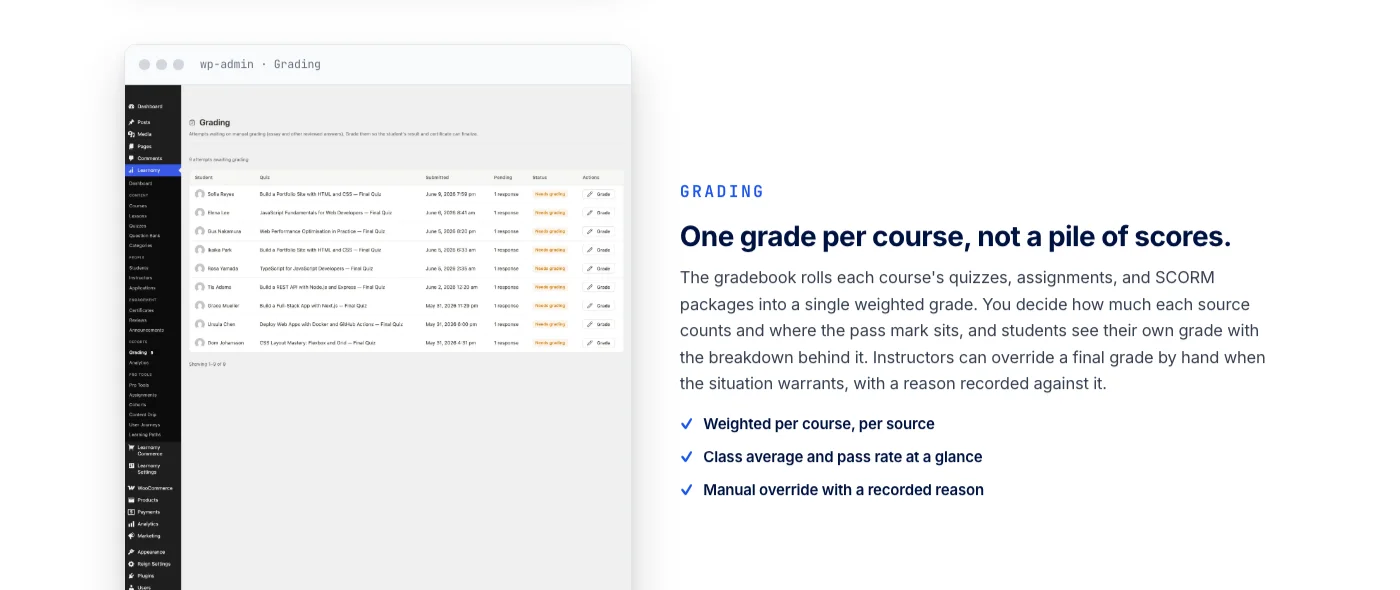
Grading rolls up into a single weighted score per course rather than a scattered list of quiz attempts. An administrator decides how much each quiz, assignment, or SCORM package counts toward the final grade and where the pass mark sits, learners see their own breakdown, and an instructor can override a final result by hand when a situation calls for it, with the reason recorded against that override. For an HR team that has to answer for a training decision later, having that reason on record rather than relying on someone’s memory is the entire point.
Certificates follow the same standard of holding up to scrutiny. They are cryptographically signed, checkable by anyone through a public verify page reached with a QR code, shareable to LinkedIn, and built with a visual certificate designer rather than a static template. That distinction is exactly what a compliance-driven buyer needs: an employer or a client’s HR department can confirm a certificate is genuine on their own, without a phone call to your support team.
Team seats and B2B training
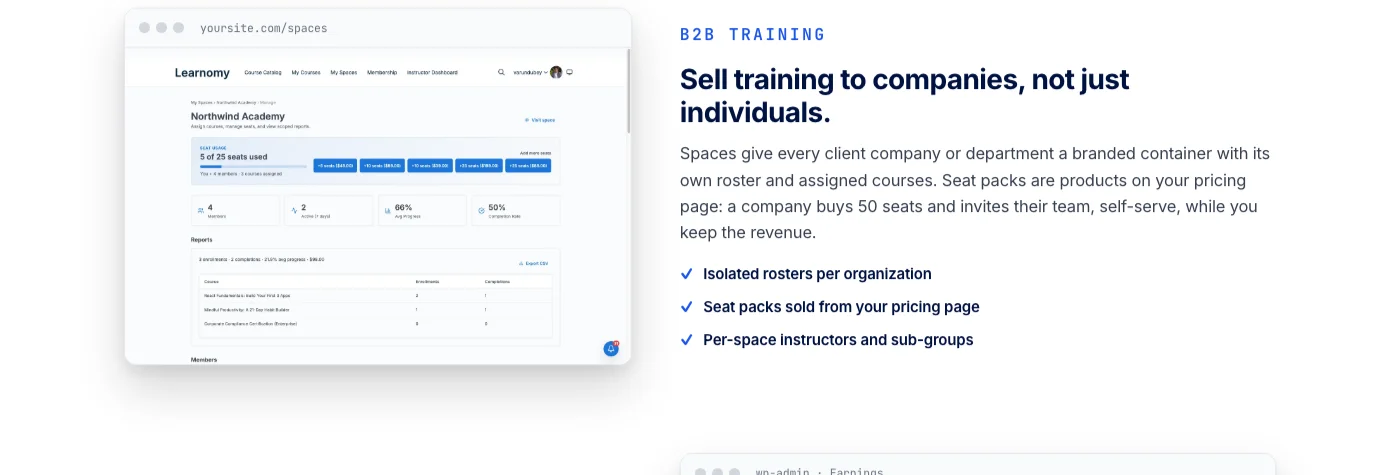
This is the part of the platform that answers the seat problem directly. A company or department gets its own branded space with an assigned roster and its own set of courses, sold as a seat pack rather than one account at a time. A client buys fifty seats, invites their own team, and manages who is active without emailing you every time someone joins or leaves. For a training company serving several client organizations, each client’s roster stays isolated from the others while running on the same underlying courses, and each space can have its own instructors and sub-groups where a program needs that level of structure.
Structured learning paths sit on top of that same seat system, sequencing courses into an onboarding program or a certification track rather than leaving a new hire to guess which course to take first. A learning path can carry its own completion certificate at the end, which is the shape most corporate compliance programs and onboarding curricula already expect.
Team seats, learning paths, verifiable certificates, and trainer revenue sharing, in one platform your organization owns.
Built for training companies, too
Everything above describes a single company training its own staff. A training company selling courses to multiple client organizations runs the same platform differently, and Learnomy’s business layer is what makes that viable without a second piece of software. Checkout runs directly through Stripe and PayPal, with a WooCommerce adapter for a training company that already runs a store, and there is no platform fee sitting on top of what a client pays. Memberships come with trial periods and an automatically generated pricing page, useful for a training company selling ongoing access rather than a one-time course.
When a training company runs more than one trainer, instructor revenue sharing handles the part that normally turns into a manual spreadsheet: Udemy-style splits, instructor applications, and a dashboard where each trainer can see their own earnings. Adding a second or third trainer to a growing training business does not mean rebuilding the payment logic by hand each time someone new joins.
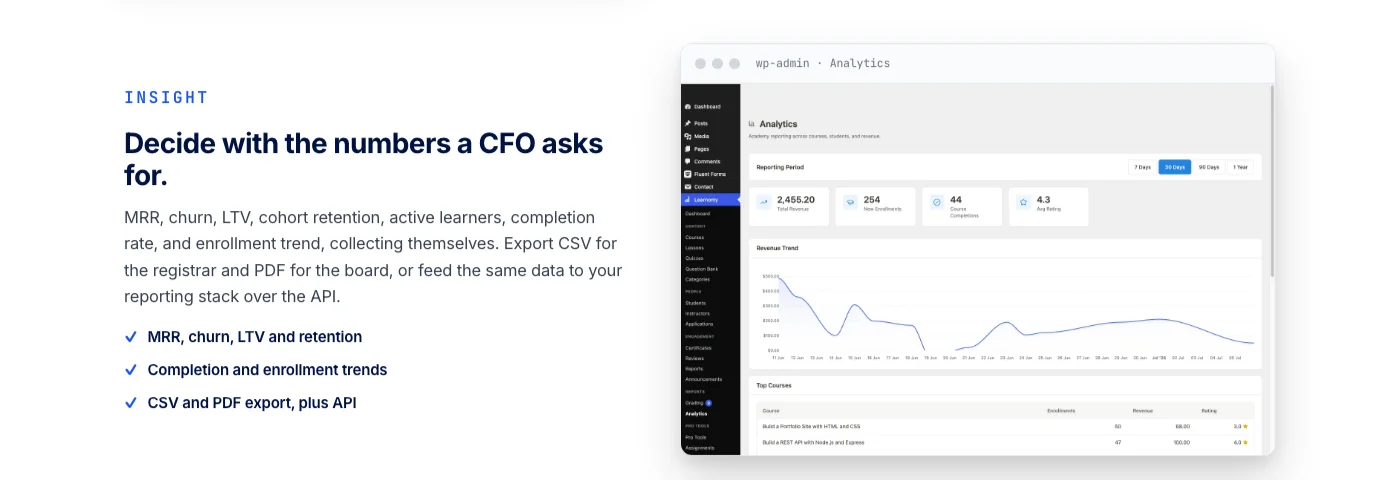
Reporting closes the loop for whoever has to answer for the program, an L&D director reporting up to leadership or a training company sending a client their quarterly numbers. Enrollment trend, completion rate, and active learner counts are visible without a manual pull, and reports export to CSV for a registrar’s records or feed into an existing reporting stack over the API when that is how a client wants the data delivered.
Learnomy does not stop at the course and the certificate either. A learning community around the training program, discussion boards and Q&A alongside the courses, gamified learning with points and badges for staff working through a curriculum, and even a job board for graduates of a training program are all part of the same platform, from the same team. None of that requires assembling a separate plugin stack to get there. And when it is time to leave an existing plugin behind, a migration wizard moves courses, lessons, and enrollments in from LearnDash, Tutor LMS, or LifterLMS specifically, rather than a manual rebuild.
2. LearnDash
LearnDash is the plugin most people picture when they picture an LMS on WordPress, and for corporate training specifically it has a real answer to the seat problem: Groups, a native feature that lets a group leader be assigned to a cohort of employees and track their progress through assigned courses. For a company that already runs WordPress and wants to keep training on the same site as everything else, that native Groups feature is a genuine starting point rather than a workaround.
The friction shows up around the edges of that core structure. Selling seats at scale generally means pairing LearnDash with WooCommerce or a membership plugin to handle the commerce side. Deeper reporting, the kind an L&D director needs for a board update, typically means a separate reporting add-on rather than something built into the base plugin. And if more than one trainer needs to be paid a share of what a course earns, that split is not something LearnDash handles on its own. None of this makes LearnDash a poor choice, it has a long track record and a large ecosystem of add-ons built around exactly these gaps, but a buyer comparing it against an all-in-one platform should count the additional pieces before comparing headline features. Anyone who has already run into these limits is worth pointing to a fuller look at the LearnDash alternatives worth considering for a course business generally, not just the corporate training slice of it.
3. Tutor LMS
Tutor LMS is built around a frontend course builder that lets a training team assemble a course without leaving the public side of the site or reaching for a separate page builder. For a training company producing a lot of course content quickly, that editing experience is a real advantage over plugins that keep everything behind the wp-admin screen.
For the corporate training case specifically, Tutor LMS Pro adds course bundles and group-style enrollment that can approximate a seat pack, along with a multi-instructor marketplace mode that supports more than one trainer selling through the same site. What is missing compared to a platform built around B2B training from the start is a dedicated, isolated roster per client organization. A training company running several clients through Tutor LMS is more likely to be managing enrollment groups manually than handing each client a self-service space to manage on their own. Certificates and content drip are native to the plugin, which covers the basics of a structured program, but deeper compliance-grade tracking, tab-switch detection or a public certificate verification page, is not part of the core feature set.
4. LifterLMS
LifterLMS built its reputation on membership sites and engagement automation, triggering emails, unlocking content, and awarding badges based on a learner’s behavior. That automation engine is genuinely useful for a training program that wants to nudge employees who have stalled halfway through a course, something most corporate LMS conversations eventually need.
The corporate seat question has a direct answer here too: LifterLMS Groups, a dedicated add-on that lets an organization purchase a block of seats and assign a group leader to manage the roster, which is the same basic pattern a training-focused buyer is looking for. Where LifterLMS asks for more assembly is on the trainer-payment side. There is no native way to split course revenue between multiple instructors, so a training company running several trainers through one LifterLMS install is handling those payouts manually rather than through the platform. Certificates and engagement triggers are strong out of the box, but a public, independently verifiable certificate page is not a standard feature, which matters if a client specifically needs employer-side verification rather than a downloadable PDF.
5. TalentLMS
TalentLMS is a hosted platform built specifically for corporate training rather than a general-purpose course plugin, and it shows in how quickly an L&D team can get a working portal running. There is no server to configure and no theme to select, an administrator signs up, uploads content, and invites employees the same day.
Branches, TalentLMS’s mechanism for separating audiences into their own sub-portals with independent branding and reporting, is a genuinely useful answer to the multi-client problem, and it is one reason training companies and franchises with several distinct audiences reach for TalentLMS specifically. The structural tradeoff is the one every hosted platform makes: billing is subscription-based and scales with the number of active users, your training data and your learners live on TalentLMS’s infrastructure rather than yours, and there is no path to owning the platform outright the way a self-hosted plugin allows. There is also no instructor revenue-sharing model, because TalentLMS is built around one organization training its own audience or its branches, not a marketplace of independent trainers being paid a split.
6. Docebo
Docebo sits at the enterprise end of hosted corporate LMS platforms, built for organizations with a dedicated L&D function, a formal procurement process, and a budget that matches. Its signature capability for the training-company angle of this guide is extended enterprise: the ability to train external partners, resellers, and customers through the same platform an organization uses for internal staff, with separate branding and access per audience.
That scale comes with real complexity. Implementing Docebo well typically involves integration work with an existing HR system, a formal enterprise sales process rather than a self-serve signup, and an administrative learning curve that a five-person training team is unlikely to need. Like TalentLMS, it is a hosted subscription rather than something an organization owns outright, and there is no instructor revenue-sharing feature because Docebo’s model assumes one organization delivering training, not a marketplace of independently paid trainers. For a large enterprise with the budget and the internal team to run it, that complexity buys genuine depth. For a mid-size training company, it is often more platform than the situation calls for.
Buying criteria by company size
The right platform on this list changes with the size and shape of the buyer more than it changes with any single feature. Here is how the priorities shift.
Small team or single department
Under roughly fifty employees, the priority is speed to a working program without a procurement cycle. A hosted option like TalentLMS gets a portal running the same day, and a lighter self-hosted option like LearnDash or Tutor LMS works fine if the site is already on WordPress and the training content is simple onboarding material rather than a compliance program with audit requirements.
Mid-size L&D department
Once a company is running structured onboarding, ongoing compliance training, and reporting up to leadership, the priorities shift toward learning paths, cohort visibility, and certificates that hold up if a regulator or a client audits the program. This is where Learnomy’s learning paths and verifiable certificates, or LifterLMS Groups with its engagement automation, start to earn their place over a simpler plugin.
Training companies serving multiple clients
Here the deciding factor is almost always isolation and ownership: can each client get its own branded roster without the client organizations seeing each other’s data, and does the platform split revenue automatically when more than one trainer delivers the content. Learnomy’s per-space rosters combined with instructor revenue sharing address both directly. TalentLMS Branches addresses the isolation half of that question on a hosted platform, without a trainer-payout mechanism attached to it.
Enterprise organizations
At enterprise scale, the questions change again: single sign-on with an existing identity provider, integration with an established HR information system, and a dedicated implementation team become the deciding factors more than any single feature on this list. Docebo is built specifically for that conversation, and the tradeoff is a procurement process and hosted infrastructure that a smaller buyer does not need to take on.
Common mistakes when choosing a corporate training LMS
Most bad LMS decisions for corporate training trace back to a handful of avoidable assumptions, not to picking the wrong platform outright.
- Assuming “certificate” means the same thing everywhere. A downloadable PDF and a certificate with a public, QR-verifiable page are different claims, even when both platforms call the feature a certificate. Confirm which one a compliance program actually requires before committing.
- Buying per-seat pricing without checking how seats are managed. A platform that charges per active user but forces an admin to add every employee by hand does not save the time the pricing model implies.
- Ignoring who owns the training data. A hosted platform is a reasonable tradeoff for many teams, but it is worth deciding deliberately whether training records living on someone else’s infrastructure is acceptable, rather than discovering the answer during a vendor audit.
- Skipping a test run with a real cohort. A pilot group of ten employees going through the full flow, enrollment, course, quiz, and certificate, surfaces problems that a demo account never will.
- Underestimating trainer payouts as an afterthought. A training company that starts with one trainer and grows to three without a platform-level revenue split ends up reconciling payments by hand every month, a cost that is invisible until it is already a recurring headache.
- Choosing the platform before deciding who the audience actually is. A platform built for one company training its own staff and a platform built for a training company reselling to many clients solve different problems. Getting this backwards is the single most common reason a corporate training LMS gets replaced within the first year.
Frequently asked questions
What is the best LMS for corporate training in 2026?
It depends on whether you are a single company training your own staff or a training company selling to multiple client organizations. Learnomy covers both cases in one owned platform with team seats, learning paths, verifiable certificates, and trainer revenue sharing. TalentLMS and Docebo are strong hosted options if a subscription model and someone else’s infrastructure fit your organization better than owning the platform.
Can I sell training seats to a company instead of individual employees?
Yes, on several of these platforms. Learnomy sells seat packs through Spaces, with each company managing its own roster. LifterLMS offers this through its Groups add-on, and TalentLMS handles it through Branches. LearnDash and Tutor LMS support cohort-style groups but generally need more manual setup to reach the same result.
Do employees or clients need proof their training certificate is real?
For compliance programs and client-facing training, yes, this comes up regularly. A certificate with a public verify page reachable by QR code, which Learnomy provides, lets an employer or a client’s HR team confirm a certificate independently. A downloadable PDF certificate, which several of the plugins on this list default to, does not offer that same independent check.
Is a self-hosted LMS or a hosted SaaS platform better for corporate training?
Self-hosted platforms like Learnomy, LearnDash, Tutor LMS, and LifterLMS mean your organization owns the software and the training data outright, with a one-time setup rather than an ongoing per-user subscription. Hosted platforms like TalentLMS and Docebo trade that ownership for a faster setup and no server to manage. Neither is universally better, the right choice depends on whether your organization already runs WordPress and whether data ownership matters to your compliance requirements.
How do training companies pay multiple trainers on the same platform?
Learnomy handles this natively through instructor revenue sharing, with Udemy-style splits, trainer applications, and a dashboard showing each trainer’s earnings. Tutor LMS offers a similar model through its multi-instructor marketplace mode in Pro. LearnDash, LifterLMS, TalentLMS, and Docebo do not include a native revenue-split feature, so a training company on those platforms is typically reconciling trainer payments manually.
Can I migrate an existing LearnDash, Tutor LMS, or LifterLMS site to Learnomy?
Yes, Learnomy includes a migration wizard specifically for LearnDash, Tutor LMS, and LifterLMS, moving courses, lessons, and enrollments into the new platform in a structured way rather than a manual rebuild. As with any migration, test it on staging with a non-critical course first before running it against a live program with enrolled employees.
What reporting does an L&D manager actually need from a corporate LMS?
At minimum, completion rate, enrollment trend, active learner counts, and a way to export that data as a CSV for a compliance record or a client report. Learnomy surfaces these numbers directly in its analytics dashboard with CSV export and API access. LearnDash and Tutor LMS generally need a reporting add-on to reach the same depth, and hosted platforms like TalentLMS and Docebo build reporting into the subscription.
Is pricing the main difference between these platforms?
No, and this guide deliberately avoids leading with price tags because they change and because the structural differences matter more. What separates these platforms is who owns the training data, how seats and rosters are managed, whether certificates are independently verifiable, and whether trainer payouts are automatic. Pricing specifics belong on each platform’s own product page, not folded into a comparison.
Key takeaways
- Corporate training buyers, whether an internal L&D team or a training company serving clients, need seats and rosters managed by organization, not one login at a time.
- Learnomy covers team seats, learning paths, verifiable certificates, analytics, and instructor revenue sharing in one owned platform.
- LearnDash and Tutor LMS handle course structure well but typically need added plugins or a Pro tier to reach corporate-grade seat management and reporting.
- LifterLMS Groups and TalentLMS Branches both solve the seat and audience-isolation problem, on a self-hosted plugin and a hosted SaaS platform respectively.
- Docebo is built for enterprise scale and external partner training, with the procurement process and complexity that comes with it.
- A migration wizard exists from LearnDash, Tutor LMS, and LifterLMS specifically, not from TalentLMS or Docebo.
The real question
Every platform in this guide can host a course and issue a certificate at the end of it. That was never the hard part. The real question for corporate training is whether the platform treats seats, rosters, structured paths, verifiable certificates, and reporting as one connected job, or as separate problems you solve with a different plugin, spreadsheet, or manual process for each one.
There is no single right answer for every organization. A department already running smoothly on TalentLMS or an established LearnDash site with a working Groups setup has little reason to switch on a whim. But for an L&D team or a training company that keeps hitting the same wall, another add-on needed for the reporting that should already be there, or another month spent reconciling trainer payouts by hand, it is worth asking whether the fix is one more tool, or one platform built to already include it. Understanding what that ownership actually costs and saves over time is also worth a closer look at what course platform fees actually look like once training moves from a pilot group to a company-wide program.
Stop managing corporate training with a spreadsheet and three plugins.
Team seats, learning paths, verifiable certificates, reporting, and trainer revenue sharing, in one connected platform your organization owns.