
Updated September 2026.
You have an idea for a course that people should not just buy and forget. You want a group that starts together, shows up together, and finishes together. That is a cohort programme.
Maybe you have run this as a live workshop before, or you have watched a self-paced course you built sit at a low completion rate while the refund requests trickle in. Either way, you are thinking about running a cohort: a fixed group, a start date, a defined end.
Here is the part nobody tells you before you pick a platform. A cohort is not a course with a calendar bolted on. It is a different product, with different economics, different failure modes, and different software needs.
If you set it up like an evergreen course with some dates added, you will spend six weeks fighting your own tools instead of teaching.
This article is about how to actually run one: the decisions that come before you touch any software, the minimum you need to make it work, how to get people through the first week (the week that decides whether they finish), how to keep the room alive without living inside it, and what to do with the group once the programme ends.
You will also see, honestly, where cohorts go wrong, because they do, often in predictable ways. None of this requires you to be technical. It requires you to make decisions before you shop for software, not after.
In this guide
- What makes a cohort different from a course
- Decide the shape of the cohort programme before you touch any software
- The minimum viable stack, in plain terms
- Enrolment needs an actual close
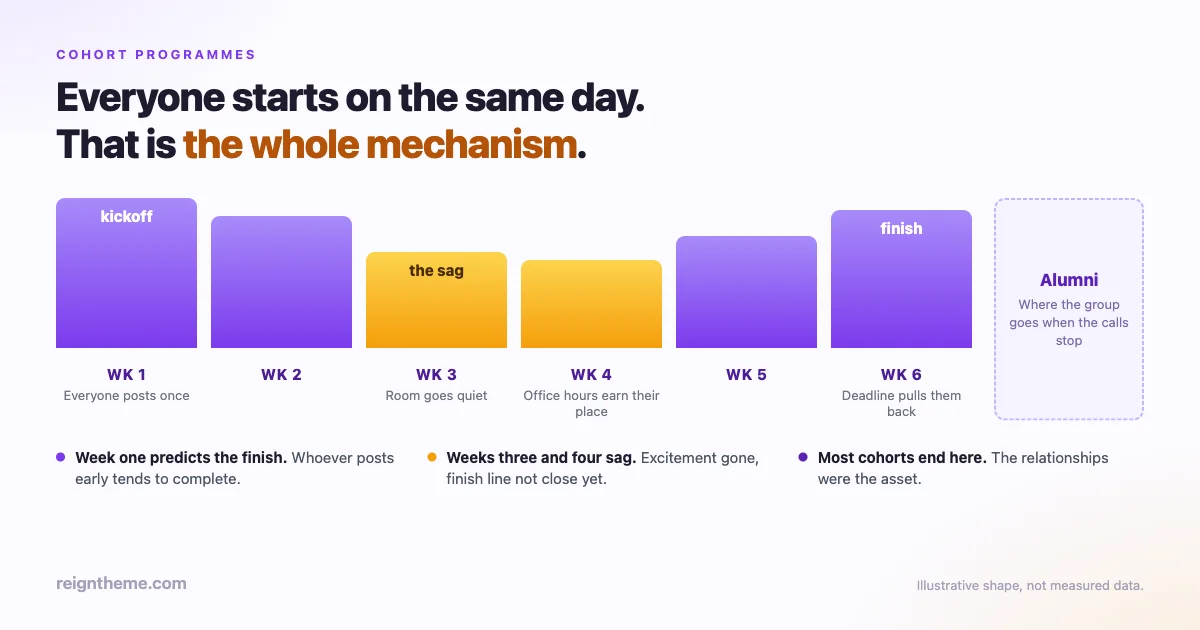
- The first week decides who finishes
- Running it week to week
- What to do about the people who fall behind
- The end, and what happens to the group
- Pricing and the economics of a cohort programme
- Where cohort programmes actually go wrong
- A format that suits certain kinds of teaching especially well
What makes a cohort different from a course
An evergreen course is content. Someone buys it, works through it whenever they like, and you never know if they finished. A cohort is a group experience that happens to include content.
The lessons might be identical. What is different is that a specific set of people started on the same day, has a deadline in front of them, and can see each other working through the same material at the same time.
That is the mechanism that makes cohorts finish at higher rates than self-paced courses: peer pressure, shared deadlines, and a live conversation that is actually happening right now, not a forum thread from eighteen months ago.
Take any one of those three away and you are running an evergreen course with a start date attached, which is not the same thing and will not behave the same way.
The deadline part is not folk wisdom. A 2002 study on procrastination and precommitment found that people do willingly set costly deadlines for themselves, that those self-set deadlines genuinely help, but that they are not as effective as deadlines imposed from outside. A cohort start date is an outside deadline you did not have to negotiate with yourself, which is exactly why it works better than the one you promised yourself in January.
This is worth sitting with because it changes what you are actually selling. You are not selling access to eight videos. You are selling a room full of people moving through something hard, together, with you in the room. The videos are the excuse for the room to exist.
Be honest with yourself about the tradeoff before you commit. A cohort is more work per person than an evergreen course. It does not scale the way a downloadable product scales, because your time in live sessions and in the discussion thread is fixed, whether you have twelve people or forty.
And a cohort with too few people in it is worse than no cohort at all, because the entire mechanism depends on there being enough people that the room actually feels alive. Six people scattered across time zones who never post is not a cohort. It is a support queue with a start date.
A complete learning platform built for WordPress gives a cohort a real close date, scheduled lesson drips, and a built-in checkout with no per-seat platform cut.
Decide the shape of the cohort programme before you touch any software
The biggest mistake you can make is opening a course platform and starting to build before you have answered five questions about the shape of the programme.
Software choice is a downstream decision. If you get the shape wrong, the best tool in the world will not save you, and if you get the shape right, almost any reasonable tool will work.
Answer these in order, on paper, before anything else:
- Length in weeks. Four weeks is tight and intense. Twelve weeks needs real structure to avoid a mid-programme sag. Six to eight is the range most first-time cohort runners land on, long enough to build momentum and short enough that you and the group can sustain the pace.
- How many live sessions. A weekly call is the default. Decide now whether sessions are mandatory (recorded as backup) or genuinely optional, because that changes how you word the sales page and how you plan your own week.
- How many people. This is a function of how much of your personal attention each person needs, not a marketing target. Suppose you take twenty people. Can you read and respond to twenty people’s posts every week without it eating your whole schedule? If the honest answer is no, the number is too high.
- Fully live or mostly async with live checkpoints. Fully live means everyone is expected in every session in real time, which only works for a group in overlapping time zones. Most cohorts serving a global audience end up async with checkpoints.
- Whether people can join late. Say yes or no now, not when the first late request lands in your inbox in week three.
These five answers determine your software requirements, your pricing, your marketing copy, and your own weekly schedule. Most people who run a first cohort skip this step, pick a platform because it looked good in a demo, then spend the run bending the programme to fit software limitations instead of the other way around.
Decide the shape. Then go shopping.
The minimum viable stack, in plain terms
You do not need a complicated setup to run a cohort well. You need five things, and it is worth understanding what each one actually does for you rather than shopping by feature list.
| What you need | What it actually does for you |
|---|---|
| A way to sell a seat with a deadline | Lets you close enrolment, stop selling once a cohort is full or the date passes, and charge a real price for a real commitment rather than an always-available download. |
| A private space for that specific group | Keeps this cohort’s conversation separate from last quarter’s cohort and from your public audience, so people feel like they are in a room with the people who started when they did. |
| Lessons released on a schedule | Stops people bingeing everything on day one and disappearing, and keeps the group roughly in step so the live conversation stays relevant to what everyone just read or watched. |
| A place for session links and recordings | One obvious spot people check, not a scavenger hunt through old emails for a link that expired. |
| A way to message the whole cohort | Reminders, encouragement, “the call moved to Thursday,” and the occasional nudge to the people who have gone quiet. |
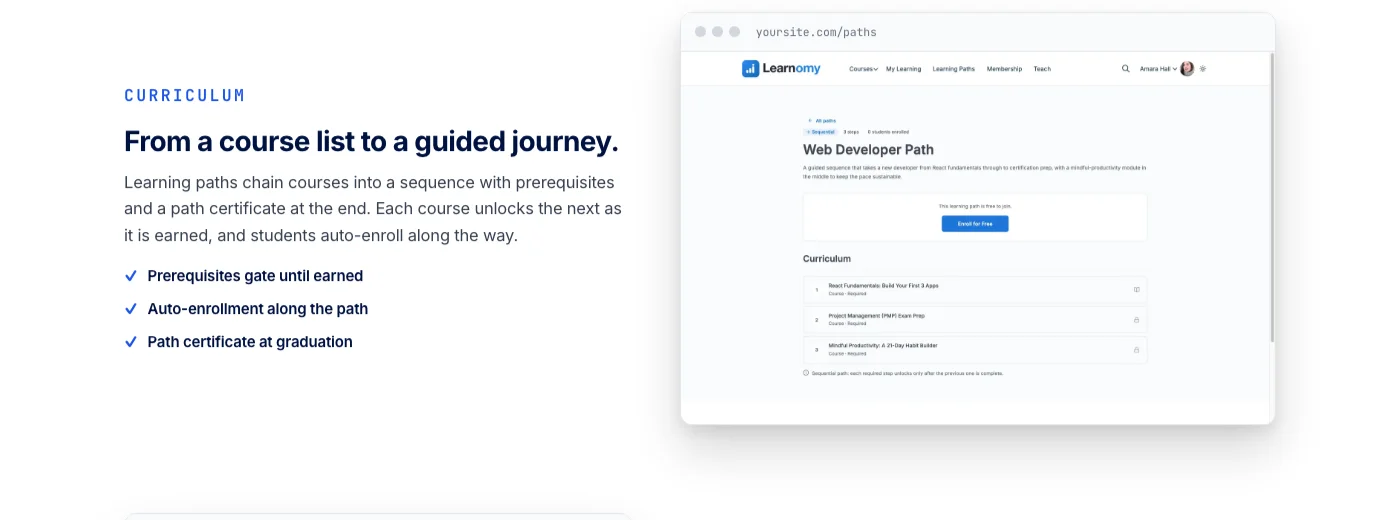
You can build all five on a WordPress site you actually own, which matters more for a cohort than for almost any other kind of content. You are selling fewer seats at a higher price, and every amount a platform takes out of a high-ticket seat is money that reflects your actual hours in that room, not a passive download.
There is a full breakdown of what that fee structure looks like on a rented course platform in this piece on course platform fees. The short version is that per-seat and revenue-share fees bite hardest on exactly the kind of high-ticket, low-volume selling a cohort is.
The mechanics of selling access and gating content behind a paid enrolment, so only people who paid for this specific run can see this specific space, are the same mechanics that power any paid community. If you have not set up gated access before, this walkthrough on membership sites covers how the access control actually works, in plain terms.
On the community and course-facing side specifically, Reign gives you the theme layer, your branding, your layouts, your private group space and discussion threads, while a complete learning platform underneath handles the course mechanics: paid enrolment with a real close date, lessons that release on a schedule instead of all at once, and a built-in checkout with no platform fee sitting on top of a seat you priced for your time. Content drip and a dedicated cohort structure are built into the platform rather than something you assemble from a scheduling plugin and a hope. That combination, theme plus learning platform, is worth knowing about before you decide whether you need three separate tools stitched together or one connected setup. If you are building the membership and pricing architecture around the cohort rather than a single run, our guide on creating a paid online course community covers tiers and access control in more depth.
Enrolment needs an actual close
An evergreen course benefits from staying open forever. A cohort does not, and treating enrolment like a permanently open cart is one of the fastest ways to drain the energy out of the format before it starts.
A cohort needs a real open date and a real close date, publicly stated, held to. This does three things for you. It gives people a reason to decide now instead of “maybe next month,” which is where most course sales actually die.
It lets you plan your own week around a known group size instead of an unknown, growing one. And it protects the experience of the people who already committed, because nobody wants to post an introduction in week one only to watch new strangers trickle in through week four.
The question you will get, every single time, is from someone who discovers the programme in week three and asks to join late. Decide your policy before this happens, because in the moment you will be tempted to say yes to the sale and regret it when that person is three weeks behind and asking questions the group already answered.
Three honest options, none of them wrong:
- No late joins, full stop. Point them to the waitlist for the next run. This is the cleanest option and it protects the group’s cohesion completely.
- Late join with a clear catch-up path. You allow it, but you are explicit that they are joining behind, and you point them at the recordings and past threads to close the gap themselves.
- A short, defined grace window. The door stays open for the first few days after the official start, then closes hard.
The waitlist is the honest answer to the always-open instinct. It lets you keep collecting interested people between cohorts without pretending your six-week programme is a product anyone can buy on any random Tuesday.
When you open the next cohort, the waitlist is your warmest audience and your easiest sale, because they already raised their hand once.
The first week decides who finishes
If you want to predict who finishes your cohort, look at who posted something in the first week. That single signal tells you more than anything else you could measure.
People who engage early build a habit and a small sense of obligation to the group. People who stay silent in week one tend to stay silent, then quietly disappear by week three, and you rarely hear from them again until a refund request or nothing at all.
This is not only an instinct from running programmes. An analysis of 221 massive open online courses found completion rates ranging from 0.7% to 52.1%, with a median of 12.6%, and that the first and second weeks are the critical window for engagement, after which the proportion of active students levels out. Self-paced courses lose most people early, and they lose them quietly.
That means your job in the first week is not “deliver great content.” It is “get everyone to participate at least once, in something low-stakes, as early as possible.” Four things do most of the work:
- A kickoff live session. Even if the rest of the programme is async, put a face and a voice in front of the group on day one. It turns “a course I bought” into “a room I am in.”
- An introduction thread everyone posts in. Ask a specific question, not “introduce yourself,” because a specific prompt gets specific answers and specific answers are what other members actually respond to. “What is the one thing you want to be different by the end of this” works better than “tell us about you.”
- A first assignment small enough that everyone completes it. Not the hardest thing in the programme. The easiest thing that still counts as real progress. Completing something in week one builds the habit that carries someone through week six.
- Pairing or small groups. A cohort of thirty people posting into one big thread is intimidating for a quiet member. Split into pairs or groups of four and everyone gets a smaller, safer room to speak up in first.
None of this is complicated. It is also the part most first-time cohort runners skip, because they spend their prep time polishing lesson five instead of designing the first forty-eight hours. Polish the first forty-eight hours first.
Running it week to week
Once the cohort is live, your job shifts from builder to host. This is a different kind of work than making the course, and it is worth planning your week around it rather than discovering, halfway through, that you are spending twelve unplanned hours a week keeping up.
A predictable release schedule matters more than a clever one. If lessons drop every Monday morning, people build a habit around that. If they drop whenever you get around to it, people stop checking, and once they stop checking, they stop participating. Same day, same time, every week, for the whole run.
| When | What happens | What you are doing |
|---|---|---|
| Monday | New lesson releases | Post a short note in the group flagging what is new and why it matters this week |
| Tuesday | Discussion prompt goes up | Ask a specific question tied to the lesson, not a generic “thoughts?” |
| Wednesday | Office hours or open questions | Show up live, answer what came up in the thread, take new questions |
| Thursday to Friday | Assignment due | Review submissions, reply individually where it counts, highlight one or two publicly |
| Sunday | Weekly wrap-up | Short recap post: what happened, what is next, quiet encouragement to anyone who went dark |
Notice that most of this is not teaching. It is moderating a live conversation. You are reading what people post, responding to some of it publicly and some privately, and noticing who has gone quiet before it becomes a pattern.
This is the actual work of running a cohort, and it is the work an evergreen course never asks of you, because nobody is waiting on your reply in an evergreen course.
Office hours specifically earn their place on the calendar even in a mostly-async cohort. A live, unscripted hour where people can ask what they are actually stuck on, rather than what they thought to write down three days ago, surfaces problems the async thread never will.
It also reminds everyone that there is a real person running this, which does more for retention than any single piece of content you could produce.
What to do about the people who fall behind
They will exist in every cohort you ever run. Someone gets busy at work in week two. Someone’s child gets sick in week four. Someone signs up with the best intentions and does not have the week they thought they would have.
This is not a sign you did something wrong. It is what happens when you put a fixed schedule in front of real adult lives. What matters is that you have a plan before it happens, so you are not improvising a response to a discouraged, embarrassed member in real time. That starts with actually seeing which specific members have gone quiet before it becomes a pattern, rather than waiting for a refund request to tell you.
| Situation | Bad response | Better response |
|---|---|---|
| Missed week one entirely | Ignore it and hope they catch up on their own | A short personal check-in, pointing them at the recording and the easiest way back in |
| Gone silent since week three | Nothing, until they ask for a refund | A no-pressure message: “no need to explain, here is where things are if you want back in” |
| Asks to join in week three | Say yes without telling them what they missed | Say yes only with a clear catch-up path, or point them to the next run’s waitlist |
| Wants a refund mid-programme | Take it personally or argue the value of what is left | Honour your stated policy calmly, and ask what happened, because it might be fixable |
| Finished, but wants to stay in the space | Let the group go quiet and let them wonder if it is still open | Tell them explicitly where alumni go next |
Build a catch-up week into the schedule if the programme is long enough to warrant it, an explicit pause where no new material drops and the whole cohort uses the time to close gaps.
Give people permission to lurk without shame. Not everyone processes a programme by posting constantly, and making silent participation feel acceptable keeps people from quietly unsubscribing out of guilt.
Let access continue after the official end date so someone who fell behind in week four can finish the material in their own time. And always offer a seat in the next run as the fallback, because someone who did not finish this time is often your best prospect for the next cohort, not a lost cause.
Be honest with yourself: some people will not finish. That is normal in any structured programme. The goal is not a perfect completion rate. The goal is that the people who do finish had a genuinely good experience, and the people who did not finish do not feel abandoned or embarrassed enough to never come back.
The end, and what happens to the group
Here is the biggest mistake in cohort-based teaching: the programme ends, the calls stop, the final lesson drops, and the group evaporates. Six weeks of real relationships, real momentum and real trust, gone in a week, because nobody planned for what happens after the last live session.
Think about what you actually built during those six or eight weeks. Not just a course. A group of people who went through something together, who know each other’s names, who watched each other struggle and succeed.
That is worth more than the lessons themselves, and it is exactly the thing most cohort creators throw away by treating the end date as a hard stop for everything, including the relationships.
You have a few honest options instead:
- An alumni space that persists across every cohort you run. Everyone who finishes any cohort lands in one ongoing space, so the relationships built in cohort one do not disappear when cohort two starts, and the group grows richer with each run instead of resetting to zero.
- Alumni as helpers in the next run. Someone who finished six months ago and had a great experience is often glad to answer a beginner’s question in the new cohort. It costs you nothing, gives alumni a reason to stay engaged, and gives new members proof that people actually finish this thing.
- A lighter ongoing membership. Not the full intensity of the cohort, but a standing space with occasional content, occasional calls, and continued access to each other.
This is the point where a single cohort turns into an actual business rather than a one-off event you run once and never repeat. The alumni network is not a bonus feature bolted onto the end. It is the mechanism that turns “I ran a six-week programme” into “I run a growing community with a paid entry point,” which is a more durable thing to have built.
The mechanics of building that kind of persistent alumni network, separate from any single course run, are covered in this piece on alumni networks. It is worth reading before your first cohort ends, not after.
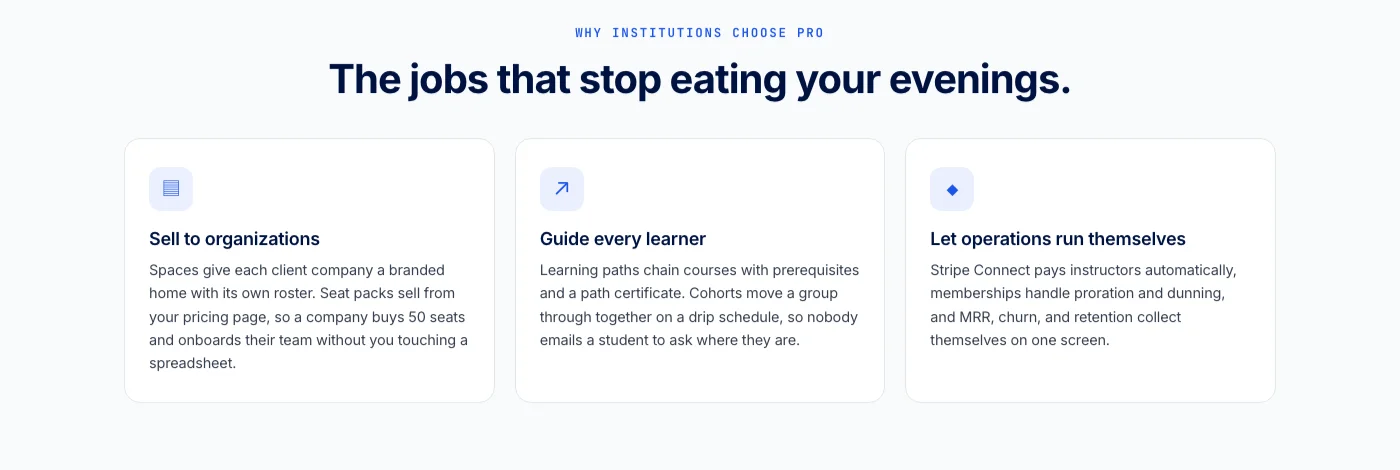
A finished cohort is also a natural moment to hand out something people can point to. A learning platform that issues verifiable certificates, checkable through a public verify page and shareable to LinkedIn, gives your graduates proof that the six weeks actually happened and that they finished it, which matters more for a cohort than for a self-paced course precisely because a cohort asked so much more of them. A credential graduates actually want to show off does more for your next launch than any amount of ad spend.
Pricing and the economics of a cohort programme
Do not treat cohort pricing like evergreen course pricing. The two products cost you completely different amounts of time, and the price should reflect that difference honestly.
A cohort can charge meaningfully more than an evergreen version of the same material, because the price is not just for the content. It is for your live attention, your feedback, your presence in the room for six or eight weeks.
People pay for that specifically, and they know they are paying for it, which is why a cohort seat priced well above a self-paced course covering the same core material is not unusual and not exploitative. You are selling something the self-paced version genuinely does not include.
The constraint that follows is important to accept early: your time is the ceiling on how many people you can take. There is no version of this where you add more buyers the way you would for a downloadable file.
Every seat you sell is a seat you personally have to show up for, week after week. Decide your real capacity honestly, based on how much attention you can give each person, not on how much revenue a bigger number would produce on paper.
Running two or three cohorts a year is a different business than running one continuously. Continuous cohorts, back to back with no gap, burn you out fast because there is never a week where you are not either running one or launching the next.
Two or three well-spaced runs a year gives you room to rest, improve the material between runs based on what you learned, and market properly instead of scrambling.
| What you are choosing | Cohort | Evergreen |
|---|---|---|
| How people finish | Peer pressure and a shared deadline drive completion | Self-discipline alone, which is why completion tends to be lower |
| Your time commitment | Fixed weekly hours for the whole run: live sessions, moderation, feedback | Front-loaded once, then mostly passive after launch |
| How it scales | Capped by your personal attention, not by the software | Scales by adding buyers with little added work per sale |
| Price you can charge | Higher, because it includes your live time | Lower, because it is a one-time content purchase |
| Only a few people buy | The cohort feels thin and the group energy never arrives | Still works fine, buyers experience it individually anyway |
| Cost of the second run | Far lower: material exists, you are refining and hosting, not building from zero | Near zero: mostly keeping the existing product live |
That last row matters more than it looks. Your first cohort is expensive to produce because you are building the lessons, the schedule and the whole structure from nothing while also running it live for the first time.
Your second cohort reuses almost all of that. You are refining, not rebuilding, which is exactly why running a cohort as a repeating format, rather than a one-time launch, is where the real payoff shows up.
This pricing logic is also why platform fees hurt a cohort more than they hurt a low-priced digital download. When you are selling twenty seats at a meaningfully higher price instead of thousands of copies of a cheap file, a percentage cut on every sale adds up fast against a much smaller number of transactions, and against a price you set specifically to reflect real hours of your time.
You can see what that actually costs you across different rented platforms in this comparison of what you keep versus what a platform takes, and it is a useful read before you settle on a per-seat price. If your cohort runs on LearnDash rather than a connected platform, our breakdown of the best LearnDash theme for course communities covers the community layer that makes a cohort group feel like a room instead of a spreadsheet.
Where cohort programmes actually go wrong
Cohorts fail in a small number of predictable ways. Knowing them in advance is most of the protection you get, because you can plan around a known risk far more easily than you can improvise a response to a surprise.
Not enough people in the first cohort. This is the most common failure. You launch with six people instead of the twenty you hoped for, and the group energy that makes a cohort work never materialises, because six scattered people rarely reach the point where the conversation sustains itself.
The fix is not to lower your standards for what counts as enough. It is to be realistic about your audience size before you commit to a date, and to consider a smaller, more intimate format, or a longer runway to fill seats, rather than launching underfilled and hoping it works out.
You burn out from the live sessions. Weekly calls, daily moderation and constant availability for six to eight weeks is demanding, and first-time cohort runners consistently underestimate it because they compare it to the effort of recording an evergreen course once.
Build recovery time into your calendar between runs. Do not schedule your next cohort’s launch for the week after this one ends.
The community goes quiet mid-programme. Usually around week three or four, after the initial excitement fades and before the finish line is close enough to feel motivating. This is exactly why the office hours and the weekly wrap-up post exist. They are not optional flourishes, they are the mechanism that keeps the room from going silent during the sag.
The cohort finishes with nowhere for people to go. Covered above, but it deserves repeating as a failure mode in its own right: a great six weeks that simply ends, with no alumni space and no next step, is a wasted opportunity to turn a one-time sale into a repeat one.
None of these are exotic problems. They are the same handful of issues showing up in slightly different clothes across almost every cohort that struggles. Plan for all four before you open enrolment and you will likely avoid the worst version of each.
Key takeaways
- A cohort is a group experience with a start date and a deadline, not a course with a calendar bolted on.
- Decide the shape (length, live sessions, group size, sync or async, late joins) before you shop for software.
- The first week predicts who finishes: get everyone posting once, in something low-stakes, as early as possible.
- Plan for the end of the programme before it starts. An alumni space turns one cohort into a repeatable business.
- A complete learning platform with content drip, a real enrolment close date, and built-in checkout removes the per-seat fee that bites hardest on high-ticket, low-volume cohort pricing.
A format that suits certain kinds of teaching especially well
Cohorts are not the right shape for every programme. But there are formats where the group-moving-together structure is not just a nice option, it is close to the natural shape of the thing you are teaching.
Coaching that involves progress over time, where week four genuinely builds on week one and everyone benefits from comparing notes on how they are doing, fits this shape well.
Fitness and habit-based coaching is a clear example. A group that starts a programme together, checks in together and holds each other accountable tends to outperform the same content delivered as a solo, self-paced product, for the same reasons a cohort outperforms an evergreen course generally.
If that sounds like the kind of coaching you run, this piece on building a fitness coaching community goes into how that structure works in practice, and much of it applies directly to a cohort model.
The broader point is this: before you build your first cohort, ask honestly whether your material actually benefits from a group moving through it together, or whether you are choosing the format because it sounds more exciting than an evergreen course.
Some material genuinely wants an audience of one, working at their own pace. Other material comes alive specifically because a room full of people is wrestling with it at the same time. Know which one you are building before you commit six weeks of your life and your reputation to running it live.
Start small if this is your first run. A tight group of a dozen people who finish and love it, and who become your first alumni and your loudest advocates for the next one, is worth more than a large launch that overpromises and cannot deliver the room energy the format depends on.
Get the shape right, keep ownership of your own site and your own list, and the second cohort will be easier than the first in every way that matters.
Run the cohort without renting the room.
Paid enrolment with a real close date, scheduled content drip, and checkout with no per-seat platform cut, all in one connected learning platform.