
The number on the pricing page is never the number you keep
Every hosted membership platform leads with one number. Patreon says 10%. Substack says 10%. Circle says as low as 0.5% on its top plan. You plan your pricing around that headline figure, then get surprised when the deposit lands short of what the math promised.
The gap is payment processing. Stripe (or the processor a platform routes through) takes its own cut before the platform fee is even applied, and on recurring subscriptions there is often a second, smaller surcharge for the billing infrastructure that renews the charge every month automatically.
None of the three platforms in this article hide that second layer. Each one documents it on their own help pages, linked below so you can check for yourself. The confusion isn’t deception, it’s that two fees compound where you expect to see one.
We have written two earlier pieces in this fee-math series: one on marketplace fees versus owning your store, and one on what course platforms actually take versus owning the platform.
This one does the same exercise for paid community and membership: Patreon, Substack, Circle, and running it yourself. The math changes with every platform, but the questions you should actually ask stay the same across all three pieces.
We checked every rate directly against Patreon, Substack and Circle’s own live pages on 30 July 2026, and computed every dollar total ourselves from those published rates. We didn’t copy anyone’s marketing math. Where a number depends on an assumption, such as hosting cost, we say so plainly and label it an assumption, not a quote.
This matters because your membership business, whether it runs on percentage fees or on fixed costs, behaves differently as your revenue changes. The platform that makes sense on day one, with a handful of paying members, isn’t automatically the platform that makes sense two years later with a few hundred. Working through both shapes side by side, honestly, is the point of this article.
Patreon fees: the real math
Patreon changed its fee structure for new creators on 4 August 2025. If your page went up after that date, you’re on the standard plan: a flat 10% platform fee on the amount a patron pays.
If your page went live on or before 4 August 2025, you can still be on a legacy plan. Founders is 5%, but it has been closed to new creators since 7 May 2019, so almost nobody is signing up for it today. Pro is 8%. Pro plus Merch is 11%.
On top of whichever platform fee applies to you, Patreon charges standard payment processing. For USD payouts: card and Apple Pay are 2.9% + $0.30 in any location. PayPal and Venmo are 2.9% + $0.30 for US patrons, and 3.9% + $0.30 for non-US patrons.
Patreon is explicit that its published fee applies to successfully processed payments and excludes payment processing, currency conversion, payout fees and taxes, which is exactly the distinction that trips you up when you compare the headline number to your actual deposit.
One honest detail worth flagging if you’re on a legacy plan: unpublishing your page loses that legacy pricing. Republish it and you’re moved to the standard 10% plan, not restored to Founders or Pro. That’s a one-way door, and it matters if you ever consider pausing your page rather than leaving it live.
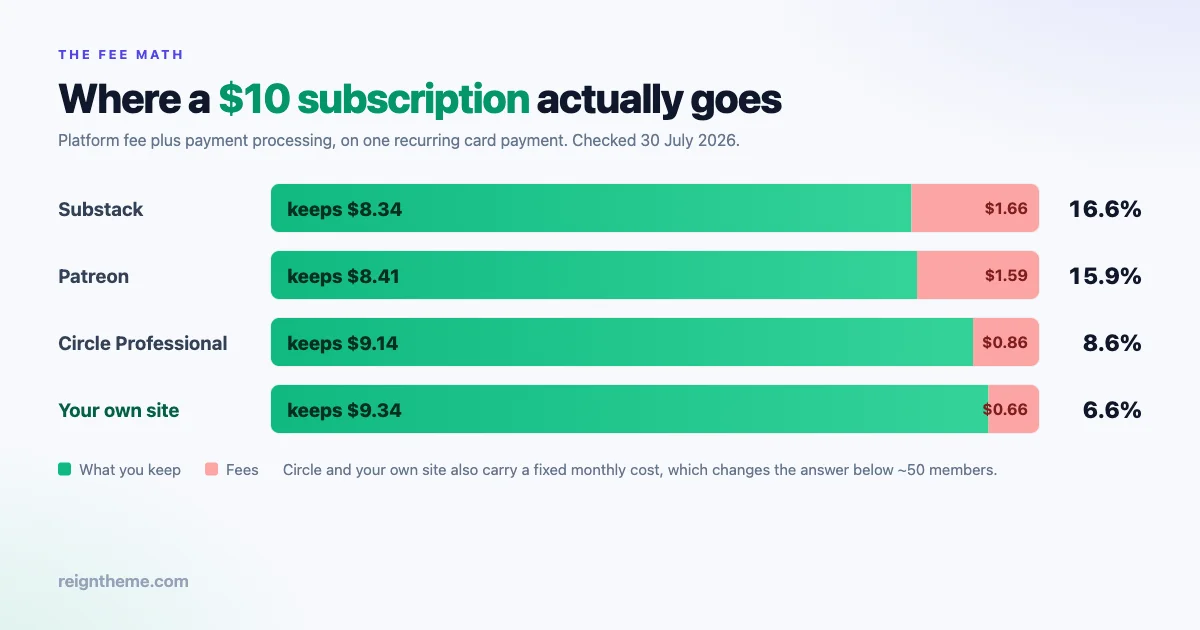
On a standard $10 monthly pledge paid by card, the platform fee plus processing works out to $1.59, leaving you $8.41. Full detail is on Patreon’s own Creator fees overview, and you should check current rates there before deciding anything, since fee structures do change.
Substack fees: the real math
Substack’s structure is the simplest of the three to describe. Publishing free content, to any number of subscribers, costs nothing. There’s no floor, no tier, no point at which your growing free newsletter starts owing Substack money.
Paid subscriptions are where Substack earns. It takes 10% of each transaction, a flat rate that doesn’t change whether you have ten paying subscribers or ten thousand.
Stripe processing sits on top of that 10%: 2.9% + $0.30 per transaction, plus a Stripe Billing fee of 0.7% on recurring payments. That 0.7% billing rate has applied since July 2024. If you had payments enabled before 10 July 2024, you kept an older, lower 0.5% billing fee, but only as a grandfathered rate that expired on 30 June 2025. Every paid Substack now runs on the same 10% + 2.9% + $0.30 + 0.7% stack.
On a $10 monthly subscription, that stack works out to a $1.66 fee, leaving you $8.34. The full breakdown is on Substack’s own page, How much does Substack cost, which we checked on 30 July 2026 alongside every other figure in this article.
Circle fees: the real math
Circle is priced differently from Patreon and Substack in a way that matters a lot for the math later in this article: it charges a real monthly software fee, then a much smaller percentage on top of that for paywalled content.
On annual billing, in USD and excluding tax, Circle’s published plans are Professional at $89/month, Business at $199/month, and Circle Plus at custom pricing for larger operations. Circle says plainly that monthly billing costs more than these annual figures, so check which billing cycle you’re being quoted.
Circle’s paywall transaction fee, charged on top of your monthly plan, is 2% on Professional, 1% on Business, and 0.5% on Circle Plus. Stripe processing adds its usual 2.9% + $0.30, plus 0.7% Stripe Billing on subscription pricing.
Circle’s own documentation includes a worked example that matches our approach: a Business-plan community running a paywall subscription pays 1% to Circle, 2.9% + $0.30 to Stripe, and 0.7% Stripe Billing. We used that same combination to compute the totals in this article.
Circle also sells an Email Hub add-on at $99/month for 10,000 contacts, which is a separate cost from the paywall fee and worth knowing about if outbound email is part of how you plan to reach your members.
On a $10 monthly membership, Professional’s transaction math alone comes to $0.86 in fees, leaving you $9.14 before the monthly plan cost. Business comes to $0.76 in fees, leaving you $9.24 before the monthly plan cost.
The full transaction fee table is on Circle’s help page, Paywall transaction fees, last updated May 2026 and re-checked by us on 30 July 2026. If you’re weighing Circle against a plan tier, bookmark that page directly, since transaction rates are the kind of detail that changes between plan updates.
Running it yourself: what a self-hosted setup actually costs
The self-hosted comparison in this article uses WordPress with Reign, a community theme built for BuddyPress and BuddyBoss-style membership sites, as one representative option among several you could choose for running paid community on WordPress. It starts at $99/year, or $249 as a one-time lifetime licence.
Official add-ons that style specific third-party plugins run $39/year each, and BuddyX Pro, a companion theme product, is $79/year. None of that is required to self-host; it’s simply the licence cost for this particular option.
Payment processing on a self-hosted site typically runs through Stripe directly: 2.9% + $0.30 per transaction. Whether the additional 0.7% Stripe Billing fee applies depends on whether the membership plugin you choose uses Stripe’s own subscription billing infrastructure or builds recurring charges a different way. That’s a real variable, not a rounding error, and it’s worth confirming with whichever plugin you choose before you commit to a number.
Hosting is the other real cost, and it varies by host, traffic and how much of the stack (caching, CDN, backups) is bundled in. We aren’t quoting a specific host’s price. We used three assumptions, $15, $25 and $40 a month, and labeled them clearly as assumptions throughout this article, not as a quote from any provider.
For a fuller picture of what running paid membership on WordPress actually involves, day to day, we wrote a dedicated piece on building a WordPress membership site with Reign and Paid Memberships Pro. It covers the setup work this article’s math assumes is already done.
None of the totals below assume a particular membership plugin choice, since several exist for WordPress and they price and bill differently from each other. What they share is the same underlying processor cost: Stripe’s 2.9% + $0.30, with the 0.7% Billing surcharge applying only when the plugin routes recurring charges through Stripe’s subscription product specifically.
The four tables: what each option costs as you grow
With all four rate structures stated plainly, here’s where they land in dollars. All figures below are our own calculations from the published rates above, using a $10 monthly subscription as the common unit so every platform is compared on the same transaction.
| Platform | What the headline says | What actually comes out | You keep |
|---|---|---|---|
| Patreon (standard) | 10% platform fee | $1.59 | $8.41 |
| Substack | 10% platform fee | $1.66 | $8.34 |
| Circle Professional | 2% paywall fee | $0.86 | $9.14 (before plan cost) |
| Circle Business | 1% paywall fee | $0.76 | $9.24 (before plan cost) |
| Self-hosted (Stripe + Billing) | no platform fee | $0.66 | $9.34 (before fixed costs) |
That table alone makes Circle and self-hosting look like the clear winners on a per-transaction basis. But per-transaction is only half the picture, because Circle and self-hosting both carry a fixed monthly cost that Patreon and Substack don’t. The next table shows what happens once that fixed cost enters the math, at $10/member and using our self-hosted assumption of a $99/year theme licence plus $25/month hosting, a fixed cost of $33.25/month.
| Members (at $10) | Gross | Substack | Patreon | Circle Professional | Self-hosted |
|---|---|---|---|---|---|
| 25 | $250 | $41.50 | $39.75 | $110.50 | $49.75 |
| 50 | $500 | $83.00 | $79.50 | $132.00 | $66.25 |
| 100 | $1,000 | $166.00 | $159.00 | $175.00 | $99.25 |
| 250 | $2,500 | $415.00 | $397.50 | $304.00 | $198.25 |
| 500 | $5,000 | $830.00 | $795.00 | $519.00 | $363.25 |
The pattern is visible immediately. Substack and Patreon’s total dollar cost grows in a straight line with your membership, because they’re pure percentages. Circle’s fixed plan cost dominates at low member counts and fades in relative weight as you grow. Self-hosting has the smallest fixed cost of the two fixed-cost options, so it crosses over earlier.
Looking at cost as a share of gross revenue, rather than in dollars, makes the shape even clearer:
| Members (at $10) | Substack | Patreon | Circle Professional | Self-hosted |
|---|---|---|---|---|
| 25 | 16.6% | 15.9% | 44.2% | 19.9% |
| 50 | 16.6% | 15.9% | 26.4% | 13.2% |
| 100 | 16.6% | 15.9% | 17.5% | 9.9% |
| 250 | 16.6% | 15.9% | 12.2% | 7.9% |
| 500 | 16.6% | 15.9% | 10.4% | 7.3% |
Substack and Patreon sit dead flat, 16.6% and 15.9% of gross respectively, no matter your community’s size. Circle and self-hosting both fall as you grow, because a fixed monthly cost gets divided across more paying members. That flat-versus-falling shape is the actual decision, more than any single number in isolation.
Two different cost shapes, and why the shape matters more than the headline rate
Patreon and Substack are percentage pricing. The platform earns nothing when you earn nothing, and it earns proportionally more only as you earn more. There’s no month where the fee is a burden relative to your revenue, because it’s always the same fraction of whatever came in.
Circle and self-hosting are fixed-cost pricing, with a small percentage layered on. The monthly plan fee, or the hosting and licence cost, is owed whether you have five paying members or five hundred. That’s a real liability in a slow month, and it’s the honest tradeoff for a lower percentage rate once you have the volume to absorb it.
Neither shape is objectively better. A percentage model protects you in a bad month at the cost of taking a larger constant share in a good one. A fixed-cost model rewards scale and punishes a slow start. Which one wins depends entirely on where you sit on the membership curve, not on which platform has better values.
The crossover points, from our calculations above, are concrete. Circle Professional costs less than Substack above roughly 111 members at $10 each, about $1,113 a month in gross revenue. Circle Business overtakes Substack at roughly 221 members, about $2,211 a month gross. Self-hosting’s crossover point, because its fixed cost is lower, arrives much earlier, and we work through exactly where in the next section.
There’s also a predictability angle that a break-even table alone doesn’t capture. A percentage fee is easy to forecast because it moves in lockstep with revenue you can already see coming. A fixed monthly cost is easy to forecast in a different sense: it’s the same number in January and July, which some of you will find easier to budget around than a fee that rises and falls with a subscriber count you can’t fully control.
- Percentage platforms (Patreon, Substack): cost scales with revenue, flat share at any size, no fixed liability in a slow month.
- Fixed-cost platforms (Circle, self-hosted): a real monthly cost owed regardless of revenue, offset by a much lower transaction rate once volume arrives.
- Circle sits between the two extremes: someone else’s platform, but priced closer to the fixed-cost shape than the pure-percentage one.
The honest case for staying exactly where you are
This is the section we think matters most, and we want to be direct about it: for many of you, the right answer is to stay on Patreon, Substack or Circle, not to move.
Under roughly 25 to 50 paying members, the dollar difference between platforms is genuinely small. Looking at our own table above, the gap between Substack and self-hosting at 25 members is about $8 a month; at 50 members it’s around $17. That’s not a number worth a migration project over, even before you count the time a migration takes.
Percentage pricing has a real virtue that a pure cost table can undersell: it costs you nothing when you earn nothing. If your paid tier is new, seasonal, or simply slow some months, Patreon and Substack’s fee shrinks right along with your revenue. A fixed monthly plan or hosting bill doesn’t shrink. It’s owed in the bad month exactly as much as the good one.
Patreon and Substack also bring you something a fee table can’t price: discovery. Both platforms have existing audience networks, recommendation systems, and a public directory where you can be found. A brand-new WordPress site brings you none of that on day one. Leaving a platform means trading a built-in audience channel for full control, and that trade has a real cost that doesn’t show up in any of the tables above.
Self-hosting also carries costs that never appear on an invoice: keeping your site updated, backing it up, watching for security issues, and being the person who fixes checkout when it breaks at 2am on a Saturday because a payment plugin conflicted with an update. Running a site is a job, even a small one, and it takes real time.
If your time is worth more spent making the thing people are actually paying for, rather than administering a server, the platform fee can be the better deal at any size, not just below some threshold. That’s a legitimate, business-minded reason to stay put, and it has nothing to do with the fee percentage being unreasonable.
Circle occupies a genuinely different middle position worth naming on its own. It charges a real monthly fee, so it isn’t free at zero revenue the way Patreon and Substack are. But its transaction rate is much lower than either, so it scales better as your community grows, while still being someone else’s platform with someone else’s uptime, support queue and terms of service.
Put plainly, stay put if most of the following are true for you:
- Your paid membership is under roughly 25 to 50 members, or your revenue is still inconsistent month to month.
- Discovery from the platform’s existing audience is still bringing in a meaningful share of your new paying members.
- Nobody on your team has the time, or the interest, to own updates, backups, security and support.
- Your current platform’s support team is doing real work resolving billing and access issues today.
What owning it actually costs beyond money
If you do cross the threshold where self-hosting is worth the money, it’s worth being precise about what “owning it” actually requires, because none of the following show up in a monthly fee comparison.
- Choosing and configuring a membership plugin that handles recurring billing, access restriction and member management, and keeping it updated.
- Choosing a theme and design system for your community, which is where a product like Reign fits, since it provides the community-specific templates, layouts and member-facing pages a generic WordPress theme doesn’t.
- Setting up and monitoring backups, so a bad update or a hosting incident doesn’t mean losing your members’ data.
- Handling security: keeping core, plugins and themes patched, and having a plan for what happens if something is compromised.
- Being the support desk when a payment fails, a login breaks, or a member can’t access content they paid for, since there’s no platform support team to escalate to.
- Building, from scratch, whatever discovery you previously got from being listed on someone else’s platform.
None of this is a reason to avoid self-hosting. It’s a reason to go in with your eyes open about what the licence fee and hosting bill don’t include. If you underestimate this list, you’ll find the “savings” from lower fees eaten by hours spent on admin you didn’t budget time for.
It’s also worth adding that paid community membership isn’t only a creator-and-fans shape. Associations, alumni networks and membership organizations run a structurally similar model: dues in exchange for access, but with an organization running it rather than one person.
We cover that version of the decision separately in building an association or alumni network on Reign, since the ownership tradeoffs are the same even though the audience and goals differ.
If you’re running an alumni association weighing dues software against a self-hosted directory, you’re working through almost exactly this same fee-versus-fixed-cost calculation, just with a board instead of a single decision-maker.
What you’re actually assembling if you self-host
If you decide to move, you’re not just picking a fee structure, you’re assembling a stack: a membership plugin for billing and access, a design layer for the community itself, hosting, and a plan for support. Reign is one option for that design layer, not a requirement for self-hosting in general.
What a community theme like Reign specifically provides is the member-facing layer: profiles, activity streams, groups and forums styling built to work with BuddyPress and compatible membership plugins, so you’re not assembling that experience from generic page-builder blocks yourself.
Its licence cost is a small line item next to hosting and payment processing in every table above. The bigger decision isn’t which theme, it’s whether the fixed-cost shape of self-hosting suits your membership size and your appetite for running infrastructure at all.
If you want to see the full landscape of hosted alternatives before deciding on either direction, self-hosted or a different hosted platform entirely, we put together a broader roundup at the best Patreon alternatives, which compares platform options rather than the fee math this article focuses on.
The break-even point, and what you should do next
Bringing the self-hosted numbers back to a single, practical question: at what membership size does self-hosting start costing you less than staying on a percentage platform? The answer depends entirely on your hosting assumption, so we ran it three ways.
| Hosting assumption | Fixed monthly cost | Self-hosting costs less above |
|---|---|---|
| $15/month hosting | $23.25/month | About 23 members ($233/month gross) |
| $25/month hosting | $33.25/month | About 33 members ($333/month gross) |
| $40/month hosting | $48.25/month | About 48 members ($483/month gross) |
Every one of those thresholds is measured against Substack. Patreon’s standard fee is slightly lower than Substack’s, so your break-even point against self-hosting sits a little higher than the figures above, though still in the same general range.
Here’s what follows directly from this table, and from the honest-case section above: if your paid membership is below roughly 25 to 50 members, the fee difference is small money, discovery still matters more than margin, and staying on Patreon, Substack or Circle is very likely the right call for you. Below that line, the platform is doing real work for the fee it charges.
Above that line, and specifically once your gross revenue clears roughly $300 to $500 a month depending on your actual hosting cost, the math starts to favor ownership, provided you’re willing to take on the non-money costs of running a site: updates, backups, security, and being your own support desk. That willingness matters as much as the dollar figure.
Before you act on any of this, ask yourself three questions in order:
- Where does your current gross revenue sit against the break-even row that matches your realistic hosting cost?
- How much of your current growth still comes from the platform’s own discovery, rather than your own channels?
- Who, specifically, will own updates, backups, security and support if you move the site in-house?
Rates change. Every figure in this article came from Patreon, Substack and Circle’s own published pages as they stood on 30 July 2026, linked above at each platform’s section, and you should check those same pages directly before making a decision, since pricing on any of these platforms can and does move.