
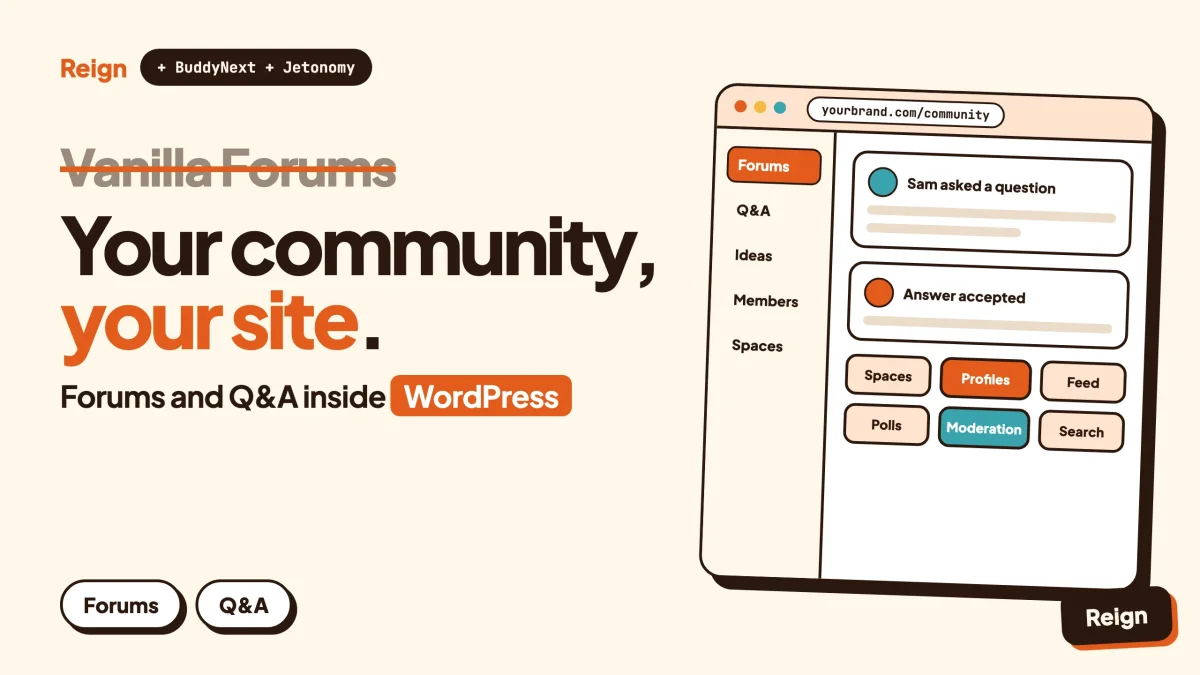
The best Vanilla Forums alternative for a site that already runs on WordPress is a stack: BuddyNext for profiles, spaces and the activity feed, Jetonomy for forums, Q&A and an ideas board, and the Reign theme for design. Higher Logic Vanilla, as Vanilla Forums is now called, remains the better pick for a company with a support team, a ticketing system to connect and compliance paperwork to hand over. Wbcom Designs makes BuddyNext, Jetonomy and Reign, so read this as a vendor view.
Most people who search for a Vanilla Forums alternative are not unhappy with forums. They are unhappy with the arrangement around them.
The community lives on a hosted platform, sold through a demo call, behind a separate login. Your content, your shop and your newsletter live somewhere else. This post covers what Vanilla is today, who should stay, why others leave, how its features map to a WordPress stack (including the gaps), and how to move without losing the archive of answers your customers rely on.
What is Vanilla Forums today?
Vanilla Forums is now Higher Logic Vanilla, a hosted customer community product sold by Higher Logic. Its own FAQ says Vanilla Forums was founded in 2009 in Montreal, Quebec, and was acquired by Higher Logic in 2021, then rebranded.
That history matters because the name on the search box and the product on the website have drifted apart. Someone typing “vanilla forums alternative” may be thinking of a small forum they installed years ago. The product Higher Logic sells today is aimed at companies, and its page is titled “B2B/B2C Customer Community Software”.
Here is what the public pages at higherlogic.com/vanilla say it includes, as of November 2026.
- Self-service and support tools. Q&A and discussions, a knowledge base, and federated search that pulls content from other platforms into the community search bar.
- Layout and moderation tools. A drag-and-drop layout editor, a widget library, and moderation features such as locking, moving, merging and splitting threads.
- Engagement features. Badges, points and leaderboards, polls, and a product feedback process.
- Automation and AI. Automation rules, AI-powered insights, and a connection that lets ChatGPT, Claude and Cursor talk to the community through MCP.
- Analytics. Pre-built and custom reports, and data downloads.
- Admin and security. Roles and permissions, profiles with privacy settings, and bot protection.
It also lists integrations, including Zendesk, Salesforce, Jira, GitHub, Slack through Zapier, and WordPress. We come back to that last one in the migration section, because it changes how you can move.
Higher Logic also sells a separate product called Thrive, aimed at associations. This post is about the Vanilla side only. If you want the review angle, with a look at its packages and features, read our Vanilla by Higher Logic review.
When is Vanilla the better pick?
Vanilla is the better pick when you are a company that wants a hosted, supported community and has a team whose job is to run it. Several things on its pages are hard for a self-hosted WordPress stack to match out of the box.
You want a vendor to carry the compliance paperwork
Higher Logic’s “Why Vanilla” page lists ISO 27001, ISO 27701, SOC 2 Type 2, GDPR and CCPA compliance. If your procurement team asks for those certificates before signing, a vendor that holds them saves weeks. A WordPress stack can be run securely, but the certificates would be yours to earn, based on your host and your processes.
You want a managed migration and a success manager
The same page says Higher Logic runs fully managed migrations and that your Success Manager is a former community manager. It also states that technical support responds in under six hours on average. Those are vendor statements, but they describe a service model: people on the other end whose job is your community. With a plugin stack, support comes from the plugin makers and your own developer or host.
Your support workflow runs through Zendesk or Salesforce
Vanilla’s support page describes a two-way Zendesk sync, where replies and statuses in Zendesk show up in the community thread and updates sync back. It also describes auto-escalation of unanswered posts to tickets, and search connectors for Zendesk Guide and Salesforce CRM. If that loop is central to how your team works, test it against whatever you plan to build before deciding.
You want enterprise structure and AI tooling now
The packages page lists subcommunities, audit logs, analytics history, a dedicated cluster on higher tiers and an AI search assistant at the top tier. The page also says more than 300 organisations partner with Higher Logic Vanilla (as of November 2026, from its own packages page). That is a vendor figure, not an independent one, but it shows who the product is built for.
If this list describes you, stay. A fair guide should say so. The rest of this post is for the other group.
Why do people look for a Vanilla Forums alternative?
People look for an alternative when the forum has become one part of a larger site, or when a sales-led hosted product no longer fits the size or budget of the project. None of these reasons is a defect in Vanilla.
The community is separate from the rest of your site
A hosted community has its own accounts, its own design system and its own address. Your articles, your documentation, your shop and your course may sit on WordPress. Members then have two logins, or you maintain single sign-on, and search results never quite cover everything. Vanilla itself acknowledges this by offering a WordPress integration, which says the two worlds need joining.
The buying process is built for companies
The packages page shows three named packages, Corporate, Enterprise and Enterprise Plus, each with a “Book Demo” button. It states no prices. For a team with a budget and a procurement process, a demo call is normal. For a solo founder, a small nonprofit or a hobby community, it is a wall.
You want a social layer, not only threads
Vanilla is a customer community product: Q&A, discussions, a knowledge base, feedback. If your community is also about people knowing each other, with profile fields, member directories, groups, an activity feed and posts that are not questions, you may want a platform built around members first. That is what BuddyNext does.
You want to own the data and the code path
On a self-hosted stack, the database lives on your server and a developer can read it. You can move host, back it up your way and connect any system with a REST API. With a hosted product you work through the vendor’s export options and its integrations list. Neither is wrong. They suit different risk appetites.
What does a WordPress stack look like in its place?
The stack is three products that work together: BuddyNext as the community engine, Jetonomy for forums and Q&A, and Reign as the design layer. Each runs on its own, so you can adopt them one at a time.
BuddyNext: the community engine
BuddyNext provides spaces that are public, private or secret, with nested sub-spaces, roles, auto-join and invite links. Members get profiles with custom fields, member types, a member directory, field-level privacy and an onboarding wizard. The feed has hashtags, reactions, threaded comments, @mentions, polls, pinned posts and space announcements.
Moderation covers reports, strikes, suspensions, appeals, banned words, content warnings and a front-end queue. It also includes search, a PWA, a REST API, and tools to export and erase personal data. Direct messages are powered by WPMediaVerse, and a mobile app is in development.
Be precise about the feed. By default it checks for updates by polling every few seconds. Instant delivery over WebSockets needs a paid add-on and your own server. Memberships, billing, email broadcasts and push notifications are also paid add-ons, so check the product page for licence details. You can try the BuddyNext live demo.
Jetonomy: forums, Q&A and ideas
Jetonomy is the forum layer. Its site describes a forum, Q&A with accepted answers, an ideas board where members vote and you set the status, and a show-and-tell feed, with trust levels, reputation and moderation. Spaces can nest. It keeps its data in its own tables rather than in the WordPress posts table, and exposes a REST API plus a template override system and CSS custom properties for theming.
To decide between the three formats, read forum vs Q&A vs ideas board. For the Q&A side in particular, see how to build a Q&A site with accepted answers.
Reign: the design layer
Reign is the theme. It has a dark mode toggle, RTL stylesheets, a mobile drawer menu, 27 block patterns, 8 style variations and a demo library with an installer. It styles BuddyNext, BuddyPress and BuddyBoss Platform. Vanilla sells a layout editor for the same job; on WordPress you use blocks, patterns and a theme you already understand. Our note on Reign and Jetonomy for block-based forums shows what that looks like, and Reign and BuddyNext covers the community side.
Add-ons for the rest of the job
Because it is all WordPress, you can add other Wbcom products as the community grows. WB Gamification adds points, badges and ranks from member activity. MediaVerse handles photo and video uploads. Learnomy runs courses, which matters if your customers also need training. Eventonomy runs events and RSVPs. None of these requires BuddyNext, and for licence details on each, check the product page.
How do Vanilla’s features map to the WordPress stack?
Most of Vanilla’s community features have a direct counterpart in the stack, but a few do not, and a fair comparison names them. The table below lists what Vanilla’s public pages describe and what the WordPress side offers, based on the product sites and our own verified feature lists. Check each product page for the current detail.
| Need | Higher Logic Vanilla (its pages) | BuddyNext, Jetonomy and Reign |
|---|---|---|
| Q&A with best answers | Best answers pinned and styled; AI-suggested answers; status tracking | Jetonomy Q&A with accepted answers and voting. No AI-suggested answers claimed here |
| Discussions and forums | Discussions, subcommunities | Jetonomy forum spaces that can nest; BuddyNext spaces and sub-spaces |
| Product feedback | Feedback process, voting, send to a product tool | Jetonomy ideas board with voting and status. See building a feature request board |
| Knowledge base | Built-in, multi-language, shareable across bases | Use WordPress pages or posts with your own structure; no dedicated knowledge base product claimed here |
| Federated search | Search connectors, including Zendesk Guide and Salesforce | Site search on the community; connectors to outside systems would be custom work |
| Gamification | Badges, points, leaderboards, ranks | WB Gamification for points, badges and ranks; Jetonomy trust levels and reputation |
| Moderation | Inline moderation, workflows, role-based permissions | Moderation queue in Jetonomy; BuddyNext reports, strikes, suspensions and appeals. See the moderation guide |
| Design and layout | Layout editor, 50+ widgets, custom React components | WordPress blocks, Reign patterns and style variations, theme override files |
| Member profiles and social layer | Profiles with privacy settings and ranks | BuddyNext profiles with custom fields, directory, feed, hashtags, polls, direct messages |
| Ticket escalation | Native links to Zendesk, Jira, ServiceNow, Freshdesk | REST API and webhooks give you a way in; ready-made helpdesk links are not claimed here |
| Analytics | Pre-built and custom reports, data downloads | Check the Jetonomy product page for analytics; see which community metrics to track |
| AI features | Insights, sentiment, AI tool connection through MCP, search assistant on top tier | Optional AI moderation exists on the product pages; check each page for detail |
| Compliance certificates | ISO 27001, ISO 27701, SOC 2 Type 2, GDPR and CCPA listed | Not a vendor certificate; depends on your hosting and processes. BuddyNext includes data export and erase tools |
| Delivery model | Hosted, sold by demo, three packages | Self-hosted on WordPress; licence details on each product page |
Read the table the way a buyer would. The wins on the WordPress side are the social layer, the design freedom and ownership. The wins on the Vanilla side are the connectors, the AI tooling, the certificates and the managed service. If your list of must-haves sits mostly in the right-hand column of those rows, you have your answer.
Can the stack run a customer support community?
Yes, for the core job of letting customers help each other and surfacing answers, the stack can do it. What it does not give you out of the box is a two-way sync with a helpdesk. Plan around that gap deliberately.
Here is a practical setup for a product company moving a support forum from Vanilla.
- Create one Q&A space per product or topic. In Jetonomy, a Q&A space lets the asker mark an accepted answer and lets members vote. To confirm it worked, post a test question from a customer-role account and accept a reply from the asker account.
- Add an ideas space for feature requests. Members vote and you set the status. To confirm it worked, submit an idea as a member and change its status as an admin; the member should see the new status.
- Keep announcements in a BuddyNext space. Release notes and maintenance notices can go into a space with pinned announcements, so they stay visible above routine chatter. To confirm it worked, pin a post and check it from a logged-out and a logged-in view.
- Set trust and moderation rules before launch. Use trust levels and the moderation queue so new accounts cannot flood the board. To confirm it worked, register a brand new account and see what it can and cannot do.
- Decide how a thread becomes a ticket. If your agents work in a helpdesk, agree on a manual step first: a link to the thread in the ticket. Add automation later through the REST API or a custom hook once you see the volume.
Our post on building a customer support community on WordPress goes deeper on the support loop and on measuring deflection honestly.
One more honest point. Vanilla describes AI-suggested answers while a person waits for a reply. If answer deflection through AI is your main goal, look at what you can wire in through your own provider, and treat that as a project, not a switch.
What changes about ownership and cost?
The model changes from renting a service to running software. With a hosted product, the vendor runs servers, upgrades and uptime and you pay under a contract negotiated through sales. With a WordPress stack, you run those parts yourself or buy them from a host, and the plugin and theme licences are a separate line.
We will not put numbers here. Vanilla’s packages page states none, and our own licence details belong on the product pages, which change. Instead, ask the same questions of both routes.
- What do you pay when the member count doubles? Vanilla’s packages list unlimited users and page views. For the WordPress side, check the product pages for how licences are counted, and expect hosting to grow with traffic.
- Who handles updates and security patches? Vendor on one side, you or your host on the other.
- What does leaving cost? Ask both for export formats in writing.
- Who do you call at 2 a.m.? Vanilla describes support and a success manager. For the stack, read the support terms on each product page, and have a host or developer you trust.
The size of the WordPress pool is one practical point. W3Techs reports that WordPress powers roughly four in ten of all websites (as of 5 November 2026, w3techs.com). That does not make any plugin better, but it does mean a deep supply of hosts, freelancers and agencies who can help. If you are sizing a server for a growing community, read our note on hosting for community websites.
How do you move from Vanilla to WordPress?
Move in stages, keep the old community running until the new one is tested, and map every old address to a new one. The sequence below works whether you have a few hundred threads or tens of thousands.
Step 1: Find out what you can export
Vanilla’s pages describe exporting community data for marketing campaigns or analysis. They state no complete forum-content export format, so ask Higher Logic in writing what you can take out: discussions, comments, accepted answers, users, categories, attachments and badges. Get the answer before you sign or cancel anything.
To confirm it worked, you should end this step with a file sample and a list of fields you can inspect.
Step 2: Build the destination first
Install Reign, import a demo with the installer, then add BuddyNext and Jetonomy on a staging site. Create a space for each Vanilla category you intend to keep. Leaving dead categories behind is a good moment to simplify.
To confirm it worked, post a test thread in every space as a member and as a moderator.
Step 3: Load a sample of content
Jetonomy’s site lists importers for bbPress, wpForo and Asgaros, and Vanilla is not on that list. So a Vanilla move is a custom import: a developer maps your export to the destination and runs it on staging first. If you are also deciding whether a bbPress route could serve as an intermediate format, our bbPress migration guide explains how importing into Jetonomy works for that source, and you can ask a developer whether it suits your data.
To confirm it worked, spot check 20 threads by hand: author, date, replies, accepted answer and attachments.
Step 4: Keep both running and connect them if you need time
Higher Logic lists a WordPress integration, available as a native integration or through its federated search connector, meant to give a continuous experience between a WordPress site and the community. That suggests an in-between option: keep Vanilla live while your WordPress pages link into it, and move section by section. The cost is two logins until the move finishes.
To confirm it worked, click through from a WordPress page to the community and back, as a logged-in member.
Step 5: Map redirects before the cut-over
List every old thread address and map it to its new one, then test a sample after launch. Search engines treat a clean redirect as a move, not a loss, but expect rankings to wobble for a short time. Watch the 404 report for a month.
To confirm it worked, request ten old addresses and check each one lands on the matching new thread.
Step 6: Tell your members, then switch
Members need to know that accounts moved and how to reset a password if the import could not carry it over. Send one plain email and pin one announcement. Then switch the live address, keep the old community read-only for a while, and retire it once the 404 report is quiet.
To confirm it worked, log in as a real, non-admin member who was on the old platform.
Which route should you pick?
Pick Vanilla if the community is a company function with a team, a helpdesk, procurement requirements and a budget set by contract. Pick the WordPress stack if the community belongs next to your content and commerce, you want to own the data, and you are comfortable with a self-hosted site.
Three quick tests help.
- Where does the revenue or the audience live? If it lives in WordPress, a community on the same install removes a whole class of friction.
- Who runs it day to day? A dedicated community manager and a support lead suit the hosted model. A solo owner or a small team may prefer the control of one site.
- What happens if you outgrow it? Ask both routes how you would leave. The honest answers tell you a lot.
If you are still weighing other forum engines, compare them in our posts on a XenForo alternative, a Discourse alternative and bbPress alternatives. For the wider field, see self-hosted community platforms and WordPress forum plugins.
Questions people ask
Is Vanilla Forums still open source?
Higher Logic’s current Vanilla pages describe a hosted customer community product sold through demos and packages, and they say nothing about a self-install edition. If you run an older self-hosted Vanilla install, check the project’s own repositories and your licence before planning, and keep a full backup before any move.
Can I import a Vanilla forum into Jetonomy?
Not with a built-in importer. Jetonomy’s site lists importers for bbPress, wpForo and Asgaros. A Vanilla move needs an export from Higher Logic, or from your own database if you self-host, plus a developer to map it. Run it on staging first.
Is there a WordPress plugin that matches Vanilla’s knowledge base?
Vanilla’s knowledge base is a built-in product feature with multi-language support and article sharing. On WordPress you would build a help section with pages or posts, and use Jetonomy Q&A for community answers. Treat a like-for-like knowledge base as a separate decision and compare options before you commit.
Do I need BuddyNext to use Jetonomy?
No. Each Wbcom plugin runs on its own. BuddyNext adds profiles, spaces and a feed around the forum if you want a social layer. Reign styles both.
Will I lose my search rankings if I move?
Not if the redirects are right. Map each old thread address to the matching new thread, test a sample, and watch 404 errors after launch. Expect a short wobble even with good redirects.
Related reading
- Vanilla by Higher Logic review
- A XenForo alternative on WordPress
- A Discourse alternative on WordPress
- How to create a forum website
- Customer support community on WordPress
- Points, badges and leaderboards with Reign
If the WordPress route fits, start with the design layer: see the Reign theme, install a demo, and add BuddyNext and Jetonomy one at a time.