
If you teach, coach, write, organise or sell expertise, something uncomfortable happened over the last two years.
The thing you were selling got cheap.
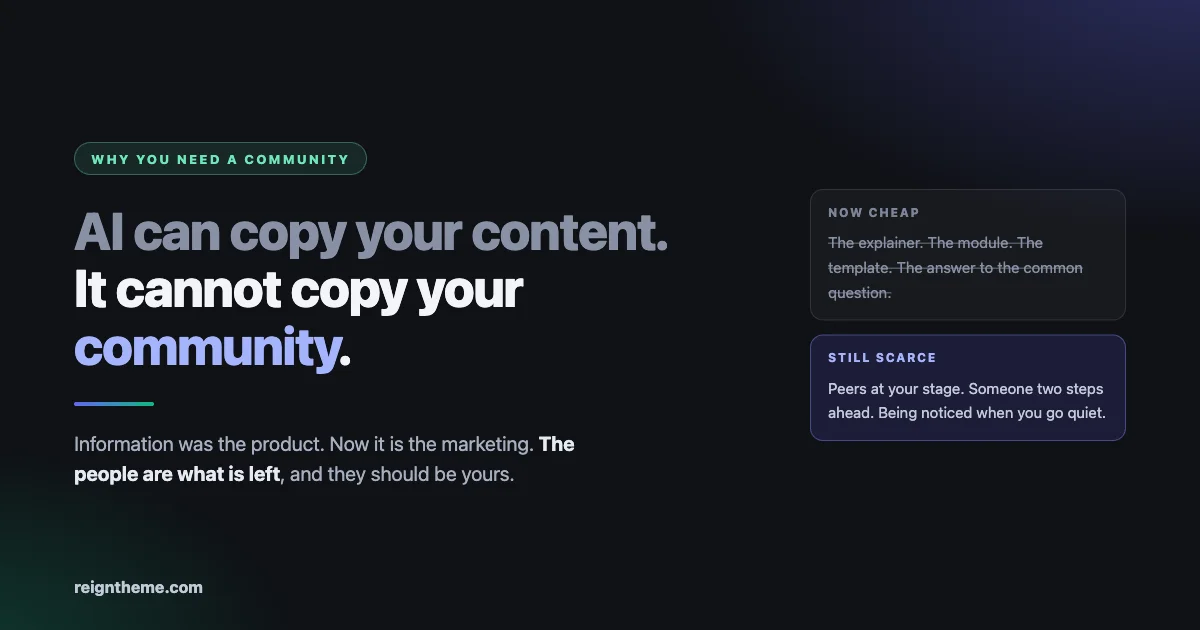
Not worthless, cheap. The explainer video, the course module, the template, the written guide, the answer to the common question. All of it can now be produced in minutes by anyone with a subscription, at a quality that is genuinely good enough for a lot of people. Somebody who would have bought your introductory course last year can now get a serviceable version of it for free, in a chat window, tailored to their exact situation, at two in the morning.
That is the real disruption, and it is not really about content. It is that the reason people used to pay you has quietly moved.
They are not going to keep paying for information. They are going to pay to not be alone while they use it.
That is what a community is, and it is why you need one now in a way you did not five years ago.
What actually got automated
Be precise about what changed, because the panic version of this is wrong.
What got cheap is the transfer of information. Explaining a concept, structuring a syllabus, answering a question that has a known answer. Those were a large share of what expertise businesses sold, and their price is falling towards zero.
What did not get cheap, and shows no sign of getting cheap:
- Somebody noticing you have not shown up for two weeks
- Being in a room with eleven other people at your exact stage, with your exact problem
- A person who has done the thing telling you which part of the advice to ignore
- The specific accountability of knowing somebody will ask you on Thursday whether you did it
- Belonging somewhere while you change
None of that is information. All of it is other people. And it is the part that actually determines whether somebody finishes what they started, which means it is the part that determines whether they got value from you at all.
Anyone who has run a course knows the uncomfortable statistic: most people who buy a self-paced course never finish it. That was true before AI and it will stay true. The content was never the bottleneck. The isolation was.
Information was the product. Now it is the marketing.
Here is the shift stated plainly.
The thing you used to sell has become the thing you give away to demonstrate that you know what you are talking about. The thing you used to give away, access to you and to each other, has become the thing worth paying for.
Most people are still running the old arrangement. They gate the content and offer the community as a bonus. The world has inverted underneath them, and the gated content is now competing with a free tool that is available instantly and never gets tired of the question.
The businesses that will be fine are the ones where the answer to “why not just ask an AI” is obvious to the buyer. And the only durable answer to that question is: because the other people are here.
Not because your explanation is better. It might be. That is not defensible.
What people are actually buying
It helps to name what a community delivers, because it is easy to talk about it in vague terms and vague things do not get built well.
Peers at the same stage. The single most valuable thing you can hand someone is eleven other people with the same problem, right now. That is genuinely hard to assemble and it cannot be generated.
Proof it is possible. Somebody two steps ahead who was where they are last year. That does more for completion rates than any amount of instructional design.
Being noticed. Progress happens when somebody would notice its absence. That is the entire mechanism behind cohorts, gyms, study groups and every other structure humans invented to make themselves do things.
Answers with judgment attached. Not the textbook answer, the one that accounts for the fact that they have a job, two children and eleven hours a week. Context-aware advice from someone who has lived the constraint.
Somewhere to be known. People want to be a person somewhere, not an anonymous account. That is not a soft benefit, it is most of why anyone renews anything.
Look at that list and notice that you cannot produce any of it alone. You can only convene it. Which is the job now.
The mistake: building a feed
When people decide to build a community, most build the wrong shape, and then conclude communities do not work.
They build a feed. A timeline where people post. It looks like social software, so it feels correct. Six months later it is quiet, and the lesson taken away is “my audience just is not the community type.”
The feed was the problem. A feed serves an audience and it forgets. Something posted on Tuesday is invisible by Friday, so the group’s accumulated knowledge never accumulates. A new member arrives, sees an empty room and three posts from a week ago, and concludes correctly that nothing is happening here.
Two things make a community work, and neither of them is a feed.
A directory people search with intent. Not a list of names. Real profiles, filterable by what someone does, where they are, what stage they are at, whether they will mentor. The moment one member can find the right other member, you have delivered the thing an audience can never deliver. Until then you are broadcasting with extra steps.
Somewhere that remembers. A good question answered once should still be findable in a year. This is what turns a community from a chat into an asset: it gets more valuable while you sleep, because the answers stay. Feeds are built to forget. Topic spaces are not.
Get those two right and the feed becomes a pleasant surface over something with actual substance underneath.
AI belongs inside your community, not outside it
Nothing above is an argument against the tools. Treating AI as the enemy of your business is the fastest way to build something that feels dated in a year.
The useful framing is that AI is very good at the layer you are no longer charging for, which means you should hand that layer to it enthusiastically and stop defending it.
Let it answer the repeated beginner question at two in the morning, because a person asking at two in the morning was never going to wait for you. Let it summarise a long thread for somebody catching up. Let it draft the first version of a resource so you spend your time editing rather than starting. Let it handle the part of onboarding that is genuinely just information transfer.
What you keep is everything that requires being a person: noticing who has gone quiet, making the introduction between two members who should know each other, saying the thing that is true but awkward, deciding what the group is for.
The communities that struggle are the ones trying to compete with AI on information. The ones that work use it to clear the information away so the human part gets more room.
There is a version of this that goes wrong, worth naming. If members feel they are talking to a bot where they expected a person, trust drops immediately and does not recover easily. The rule is simple enough: automate the answers, never automate the relationship. Nobody minds an instant answer to a factual question. Everybody minds discovering that the encouragement they received was generated.
Why owning it is not a detail
You could rent this. A hosted community platform will give you a room this afternoon, and for some people that is the correct trade.
Understand what the trade is.
Your members cannot be found by you. On most rented platforms you can see a member count and not much else. You cannot ask which of your people work in a given field, which are in a given city, which have gone quiet. The data exists and you have no query on it.
The relationship is renegotiated without you. Pricing changes, rules change, and what your members see is decided by someone else’s product decisions. If the platform raises its per-member fee, your costs move and you were not consulted.
The connections do not travel. If you leave, you might export a list of email addresses. The thing that made it valuable, those people knowing each other through you, does not come with you. You would be rebuilding from zero, and the second time is harder because people already gave you their attention once.
That last one is the real risk and it is invisible until the day it matters. A member list is portable. A community is not. Which is a strong argument for it living somewhere that cannot ask you to leave.
What this actually takes now
The reassuring part is that this stopped being a technical project a while ago.
You need a place at your own domain that does four things: gives every member a profile worth reading, makes those profiles searchable, provides somewhere to talk that does not forget, and lets you decide who sees what.
Reign is the theme, and this is less cosmetic than it sounds. A community that looks like a generic forum tells people it is a side project, and people do not invest in side projects. It should look like a place that will still exist next year.
BuddyNext is the connective layer: profiles, a searchable member directory, connections between members, private messaging, and a feed that sits on top rather than underneath.
Jetonomy is the part that remembers. Question-and-answer spaces where good answers stay findable, so what your members know accumulates rather than scrolling away. Spaces can be gated to a membership tier, so a paid inner circle has somewhere the general membership does not.
WPMediaVerse carries media and conversations, for communities where people share work rather than only discuss it.
Learnomy is there for when the community wants to learn together, which most eventually do. Courses, cohorts and payments, without adding a separate platform, a separate login and a separate export.
They come from one vendor and are built as one system, which matters more than any individual feature. The person in the directory is the same person answering in a space, taking the course and holding the membership. Assemble the equivalent from five vendors and you will spend your time on the seams between them rather than on your members.
That single-system point deserves one concrete example, because it sounds abstract until it bites. Say a member upgrades to a paid tier. In an owned stack, that one event can change what they see in Reign, open the gated spaces in Jetonomy, enrol them in the cohort in Learnomy, and update their badge in the directory, because all of those read the same membership state. Stitch it together from separate vendors and that becomes four integrations, each with its own failure mode, and you will find out about the broken one from an annoyed member rather than from a log.
Reign matters here beyond appearance for the same reason. Because it is built for this stack rather than adapted to it, the member directory, the group spaces, the course pages and the profile all inherit one design and one set of controls. A community assembled from parts that each style themselves differently reads as improvised, and members treat improvised places as temporary.
If you want the configuration mechanics for a specific structure, member states, privacy tiers, dues and lapse handling, the guide to building an association or alumni network covers that step by step. This piece is the case for doing it at all.
The cost, honestly
Owning it means paying for hosting and spending some setup time, against a hosted platform’s monthly fee that usually rises with member count.
We have done that arithmetic in detail on what marketplaces keep and on what course platforms take from what you earn, and past a modest size it generally favours owning.
But leading with the fee undersells this. The fee is the smaller half. What you are buying is that the connections between your people belong to you, and no monthly comparison captures the cost of rebuilding a community from scratch because somebody else changed their terms.
Where to start, if you are starting
Not a launch plan. Four steps, and the first two need no software at all.
Ask why they would come back. If the honest answer is “for my content,” you have a problem, because that is now the cheapest thing on the internet. If the answer involves other people, you have a community worth building.
Start with twenty, not two thousand. An empty room is fatal and a small full room is not. Bring the people who already know you. Twenty people who talk beat two thousand who watch.
Make it remember from day one. The first good question that gets asked, answer it somewhere it will still be findable next year. That single habit is what turns a chat into something that compounds.
Introduce people to each other, constantly. This is the whole job and it is the part nobody outsources. Your value is not being the smartest person in the room. It is being the reason the room exists.
One sequencing note, because getting it backwards wastes months. Set up the profiles and the directory before you invite anybody. A member who arrives, fills in a profile and immediately finds three people worth talking to has understood the point within a minute. A member who arrives to a feed with four posts has to be told what the point is, and being told is much weaker than seeing it.
The objections worth answering
Four things come up every time, and three of them are reasonable.
“I do not have time to run a community.” This is the real one. A community that depends on you posting daily will fail, and you are right to refuse it. The answer is structural rather than heroic: build for member-to-member value instead of host-to-member broadcast. A directory people search, spaces where they answer each other, and one reliable weekly ritual from you. The ritual can be a single question. What kills hosts is trying to be the entertainment, which is also the model that produces nothing durable.
“My audience is too small.” Small is the correct starting condition. Twenty people who talk is a community; two thousand who watch is a mailing list. Communities fail from emptiness far more often than from being too small, and an empty room with a big invite list is the worst outcome available. Start with the people who already reply to you.
“They are already in a WhatsApp group.” Then you already have proof the demand exists, which is more than most people start with. What you do not have is anything durable: nothing is findable after a week, nobody has a profile, new members cannot see what happened before them, and you cannot search it. Chat is excellent for talking and useless for accumulating. Keep the chat if people like it. Put the things worth keeping somewhere they survive.
“What if nobody posts?” They will not, at first, and planning for that is the difference between a community that survives month two and one that does not. Seed it. Ask five people privately to answer the first question. Post the first ten questions yourself. Introduce two members a week by name. A room becomes self-sustaining somewhere between twenty and fifty active people, and everything before that threshold is you doing it manually. That is not failure, it is the job.
What it looks like when it is working
Some signals worth watching for, because they arrive in a fairly predictable order.
The first is members answering each other before you get there. That usually happens once the same question has been asked three or four times and somebody recognises it.
The second is somebody referencing an old thread. That is the moment the memory starts paying, and it only happens if you built somewhere that remembers rather than somewhere that scrolls.
The third is two members doing something together that has nothing to do with you. A collaboration, a hire, a project. This is the point where the community has value independent of your attention, and it is also the point where retention stops being your problem.
The fourth, which is the one that changes your business, is somebody joining and saying they came because a member told them to. Communities that reach that stage grow without advertising, because the product and the marketing became the same thing.
None of those milestones is about content. All of them are about whether people can find and reach each other, which is exactly what a directory and durable spaces are for, and exactly what a feed alone will never produce.
The short version
The information business is being repriced towards zero, and there is no strategy that reverses that. Explaining things well is no longer scarce.
What is scarce, and getting more so, is other people. Peers at the same stage, someone slightly ahead, and somewhere you are known rather than counted. That is the thing people will keep paying for, because it is the thing that actually determines whether they finish what they started.
You cannot generate that. You can only convene it. And having gone to the trouble of convening it, it should live somewhere that belongs to you rather than somewhere that can change the rules on a Tuesday.
The window for this is open now and it will not stay open indefinitely. Every month, more of the people you would want in a room are joining somebody else’s. Communities consolidate, because nobody has the appetite to belong to nine of them, and the ones that formed early are the ones that still have the members.
AI made your content cheap. That is only bad news if content was all you had.