
You have an idea for a site that is yours. Maybe it is a place for your people to gather, maybe a shop where others sell and you take a cut, maybe an academy, a directory, or a board where the right jobs meet the right people. The instinct is often to go rent that on someone else’s platform, because it is quick. The better long game is to own it, on your own WordPress site, so the audience, the revenue, and the rules stay with you. The question then becomes which kind of site to build, and whether one foundation can carry it. With a multipurpose WordPress theme like Reign, one foundation can, and this is a plain tour of the different sites you can build on it and where to go deeper on each.
Think of this as a map rather than a manual. For each kind of site, you will see what it is, what you can actually build and run, and a link to a full walkthrough when you are ready. The point is not to pick the fanciest option. It is to see that the community, the marketplace, the academy, and the rest are not separate products you have to stitch together from scratch. They are different shapes of the same owned platform, built on one theme you learn once.
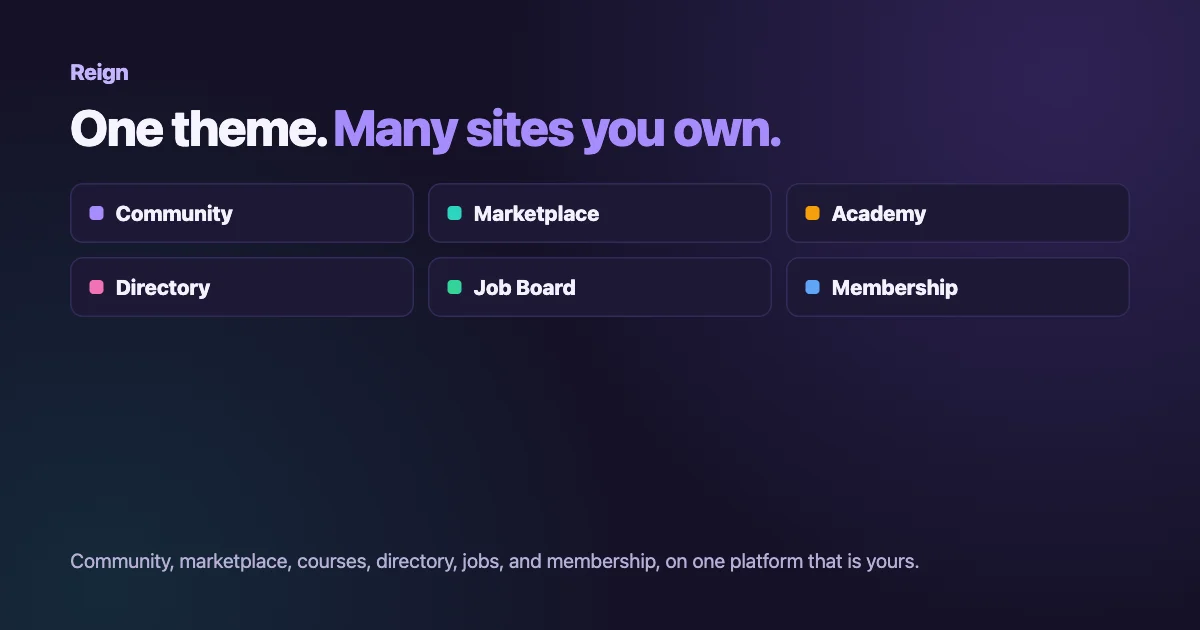
In short, one foundation lets you build and own any of these, and combine them freely:
- A community where members have profiles, join groups, and talk to each other.
- A marketplace where other people sell and you take a commission.
- An academy where you sell and deliver courses that feel like a real school.
- A directory or classifieds site where members list and find each other.
- A job board where employers post roles and candidates apply.
- A membership site that charges for access to any of the above.
Why a multipurpose WordPress theme beats renting five platforms
Before the tour, the reason this matters. If you build each part of your idea on a different rented service, a community here, a course platform there, a marketplace somewhere else, you end up paying several rents, learning several tools, and owning none of it. Your members, your content, and your income live on platforms that can change their terms whenever they like.
Building on one WordPress theme flips that. You own the site. You pay for your own hosting and tools rather than a cut of every sale forever. You learn one system, and the pieces you add later, the courses, the marketplace, the directory, plug into the same familiar foundation instead of being yet another separate account. That is the quiet advantage under everything below: not that any single feature is unique, but that all of them can live together, on a platform that is yours.
The value is not any one feature. It is that a community, a marketplace, an academy, a directory, and a job board can all run on one theme you own, instead of five platforms you rent.
What owning it saves you over renting
It helps to be plain about the money, because that is the real reason this choice matters over time. A rented platform charges you every month no matter what, and the good ones also take a percentage of what you earn, a cut of every course sale, every marketplace order, every membership. That percentage feels small at the start and grows exactly as you succeed, so the more your idea works, the more you pay someone else for the privilege of your own audience.
Owning the platform changes the shape of that cost. You pay for your own hosting and the tools you use, which is a mostly fixed cost that does not rise every time you make a sale. As you grow, the gap between the fixed cost of owning and the growing cut of renting widens in your favor.
The contrast, stated simply:
- Renting: cheap to start, then a monthly fee plus a percentage of everything you earn, and an audience you do not own.
- Owning: a little more effort to set up, a mostly fixed cost that does not rise with your sales, and an audience and revenue that stay yours.
We put real numbers to that comparison in our look at what you actually keep on Patreon, Substack, and Circle versus self-hosting. The short version is that renting is cheaper to start and quietly more expensive forever.
Build a community you own
The heart of it is the community. If what you want is a place where people with something in common can have profiles, join groups, post, and get to know each other, that is what a community theme is for. On Reign, built on BuddyPress, you can give members real profiles, run public or private groups, show an activity feed, and let people connect and message each other, all on your own site rather than in a Facebook group you do not control.
This is the piece everything else plugs into. A course feels warmer when the students are also a community. A marketplace is stickier when the buyers and sellers know each other. So even if your real goal is one of the sites below, the community layer is often what makes it work, and it is the thing a community-first theme does first. It is also the one thing a competitor cannot easily copy, because your content can be reproduced but the relationships between your members cannot. We made that case in full in our piece on why AI can copy your content but not your community.
Run your own marketplace
If your idea is to be the place where other people sell and you take a commission, an Etsy or an Amazon but yours, that is a marketplace, and it is one of the strongest things you can own. With a marketplace theme setup on Reign, using a multivendor plugin like Dokan or WCFM, vendors get their own stores, buyers shop across them, and you set and collect the commission on every sale.
The reason to own this rather than build on a big platform is simple: on a marketplace you own, you keep the commission and the customer relationship instead of handing both to someone else. We walked through the whole setup, vendor stores, commissions, and the edge cases, in our guide to building a multivendor marketplace on WordPress you own. And because it sits on the same community foundation, your vendors and buyers can also be members, which most standalone marketplaces cannot offer.
Launch an academy for your courses
If you teach, your idea is probably an academy: a place to sell and deliver courses that feels like a real school rather than a folder of videos. With a LearnDash theme setup on Reign, your courses get a proper home, students get a dashboard and a sense of progress, and the whole thing looks like your brand instead of raw plugin pages. You own the courses, the students, and the revenue, rather than renting a course platform that takes a slice of every sale.
The look and feel matters more here than people expect, because a course site that feels like a serious academy earns trust and justifies its price. We covered exactly how to get that right in our piece on making your LearnDash course site look like a real academy. And once again, the academy is stronger when it sits on a community, because students who learn alongside peers are the ones who finish and come back.
Start a directory or classifieds site
If your people keep asking each other the same questions, who does good work, what is for sale, where to find a thing, you can turn that into a directory or a classifieds site that you own. With a directory theme approach on Reign, using a plugin like GeoDirectory, members or businesses create listings, visitors search and browse them, and you can charge for featured spots or paid listings.
This is one of the most durable owned assets there is, because a good directory becomes the place people check first, and that habit is hard to dislodge. We wrote a full walkthrough on building a classifieds or directory site on WordPress that you own, and a companion piece on how to launch a directory your members pay to be listed in. Both sit on the same foundation as your community, so the directory is not a separate island; it is one more room in a platform your members already live in.
Open a job board for your niche
If you sit at the center of an industry or a community, a niche job board can be quietly valuable, because the right jobs and the right people already trust you to connect them. With a job board setup on Reign, using a plugin like WP Job Manager, employers post roles, candidates browse and apply, and you can charge for postings or featured listings. A focused board for one niche often beats a giant general site, because the audience is exactly the people employers want to reach.
Like everything here, it works best when it is not alone. A job board attached to a community means the candidates are already your members and the employers are already part of your world, which is something the big job sites cannot offer. It is the same foundation, pointed at a different job to be done.
Run a membership site
If your plan is to charge for access, to content, to a community, to courses, then what you are building is a membership site, and it can wrap around any of the above. On Reign, with a membership setup, you can gate what members get by tier, take recurring payments, and give paying members a private space that feels like belonging rather than a paywall. You keep the revenue and own the member list, instead of renting your audience from a subscription platform that takes a cut and holds your relationships.
Membership is less a separate kind of site than a way to monetize the others: a paid community, a paid academy, a paid directory. Because it lives on the same foundation, you can start free and add paid tiers later without moving anything, which is exactly the flexibility a rented platform will not give you.
Who builds each of these
It helps to see real people behind the options, because the right starting point is usually obvious once you picture who it is for.
A coach or a creator with an audience usually starts with a community and an academy: a place for their people to belong, and courses to sell them. A professional association or a hobbyist who sits at the center of a niche often starts with a directory or a job board, because their value is connecting the right people to the right listings. Someone with a supply of makers or sellers, a craft scene, a local food network, a group of freelancers, is a natural marketplace, where they host the sellers and take a small cut. And almost anyone with something worth paying for eventually adds a membership layer on top, turning a free community or a public directory into recurring revenue.
None of these personas is locked in. The coach adds a marketplace when their members start selling to each other. The directory owner adds a community when the listings start a conversation. Because it is one multipurpose WordPress theme underneath, the starting point is just that, a start, and the site grows into whatever your people pull it toward.
The common thread is that every one of these people already had an audience or a group before they had a platform. That is the honest prerequisite: this foundation gives a gathering of people a home and a way to earn, but it does not create the gathering for you. If you have the people, or are building them, one owned platform is how you keep them. If you do not yet, start with the community and grow the people first; the rest can wait until they are there.
How the pieces actually connect
It is worth understanding why these fit together rather than just sitting side by side, because that is the part that makes a multipurpose WordPress theme different from bolting five tools onto one site. On this foundation, a member is one person with one account across everything. The same profile that joined the community also owns the vendor store, is enrolled in the course, and holds the membership. There is one login, one identity, one place a person belongs.
One member, one profile, one login, across your community, your courses, your marketplace, and your directory. That single shared identity is what turns five features into one platform.
That shared identity is what makes the combinations feel like one platform instead of a pile of plugins. When a student finishes a course, they are already in the community to talk about it. When a community member starts selling, their store lives on the profile people already know. You are not syncing accounts between services or asking people to sign up five times. You manage one member list, and every part of your site draws from it. That is a hard thing to build on a rented stack and a natural thing to build when it is all one owned foundation.
A real path from a small community to a whole platform
To make this concrete, picture how it tends to grow, because almost nobody builds all of it on day one. Someone starts with a small free community around a shared interest, just profiles and a few groups, because that is the thing their people asked for first. It stays free for a while, and it grows because the conversation is good.
After a few months, members keep asking the same how-to questions, so the founder records a course and sells it. Because the academy sits on the same site, the students are already in the community, and the course does better for it. Then a few members mention they offer services, so the founder adds a directory where members can list what they do, and later a marketplace where they can sell to each other, taking a small commission. Finally, with all of that running, the founder puts the best of it behind a membership tier, so the whole thing earns recurring revenue.
At no point did any of that require moving to a new platform or rebuilding from scratch. Each step plugged into the same foundation the community started on. That is the path a multipurpose WordPress theme is built to support: start with the one thing your people need, and let it grow into a real platform over time, on a site you owned the whole way through.
The real power is mixing them
Here is where owning one foundation genuinely pays off, and it is something no single rented platform can match. Because all of these live on the same theme, you do not have to choose just one. You can run a community that is also an academy, where members take your courses and discuss them together. You can add a marketplace so those same members can sell to each other, and a directory so they can find each other’s services, and a membership layer so the whole thing has paying tiers.
None of that requires stitching five separate services together, because they are already the same site. A member has one profile across the community, the courses, the marketplace, and the directory. You manage one platform, not five accounts. And you own all of it. That combination, several kinds of owned site sharing one community foundation, is the thing a multipurpose WordPress theme like Reign is actually for, and it is why people outgrow the single-purpose rented tools and come home to a site of their own.
Where to start
With that many options, the honest advice is to start with the one thing your people need most right now, not all of it at once. Because it is all one foundation, whatever you start with, the others are waiting when you are ready, with no migration and no second platform to learn.
A quick way to choose what to build first:
- Do your people mainly want to gather and talk? Start with the community.
- Are they ready to buy and sell to each other? Start with the marketplace.
- Do you teach something they want to learn? Start with the academy.
- Do they keep searching for each other or for listings? Start with the directory.
- Do you already have something worth charging for? Add the membership layer.
If you want the deeper detail on the pieces that make each of these work, our guide to the Reign theme addons covers the eLearning, marketplace, job board, and directory pieces and when to use each. But you do not need to read it to begin. You need to pick the one site your people are asking for, and build that first.
Own the platform, not the rent
The thread through all of this is ownership. A community, a marketplace, an academy, a directory, a job board, a membership: each of them can be rented from a platform that will take a cut and hold your audience, or owned on a site of your own that keeps both. The rented version is faster to start and quietly more expensive forever, because you never stop paying and you never actually own the thing you built.
Building on one multipurpose WordPress theme is the other path. It asks a little more at the start and gives you a platform that is genuinely yours, that can grow from one kind of site into several without you moving off it, and that keeps your people and your revenue where they belong. If you want help working out which of these to build first and how to set it up, that is exactly the kind of thing we are here to talk through.