
For some courses the quiz is a formality, five questions to keep a student honest before the next lesson unlocks. For others the quiz is the entire point: a certification exam, a licensing prep course, a corporate compliance test someone might contest later. The gap between an LMS that treats quizzes as a checkbox and one that treats them as a real assessment engine, question banks, partial credit, tab-switch detection, essay grading, only shows up once a course actually needs the second kind.
This guide ranks the best WordPress LMS plugins for quiz-heavy courses in 2026, weighing question type variety, whether scoring allows partial credit or forces all-or-nothing grading, anti-cheat tooling, and how well each platform handles open-ended answers that need a human grader. Feature scopes shift as vendors iterate, so confirm specifics on their own sites before committing.
Table of Contents
- Quick comparison
- 1. Learnomy, six quiz types with anti-cheat tracking
- 2. LearnDash, the deepest question-bank ecosystem
- 3. Tutor LMS, capable core quizzing
- 4. LifterLMS, quizzes tied to engagement
- 5. Sensei LMS, block-editor simplicity
- How we evaluated
- What makes a quiz result actually defensible
- FAQ
- Final verdict
Quick comparison
| Platform | Question types | Partial credit | Anti-cheat | Essay grading |
|---|---|---|---|---|
| Learnomy | Six types, question banks | Yes | Tab-switch tracking | Dedicated grading inbox |
| LearnDash | Eight types, largest question-bank ecosystem | Limited, mostly all-or-nothing | Via add-ons | Manual, no dedicated inbox |
| Tutor LMS | Common types covered | Limited | Not native | Manual review |
| LifterLMS | Standard types | Limited | Not native | Manual review |
| Sensei LMS | Standard block-based types | No | Not native | Manual review |
1. Learnomy, six quiz types with anti-cheat tracking
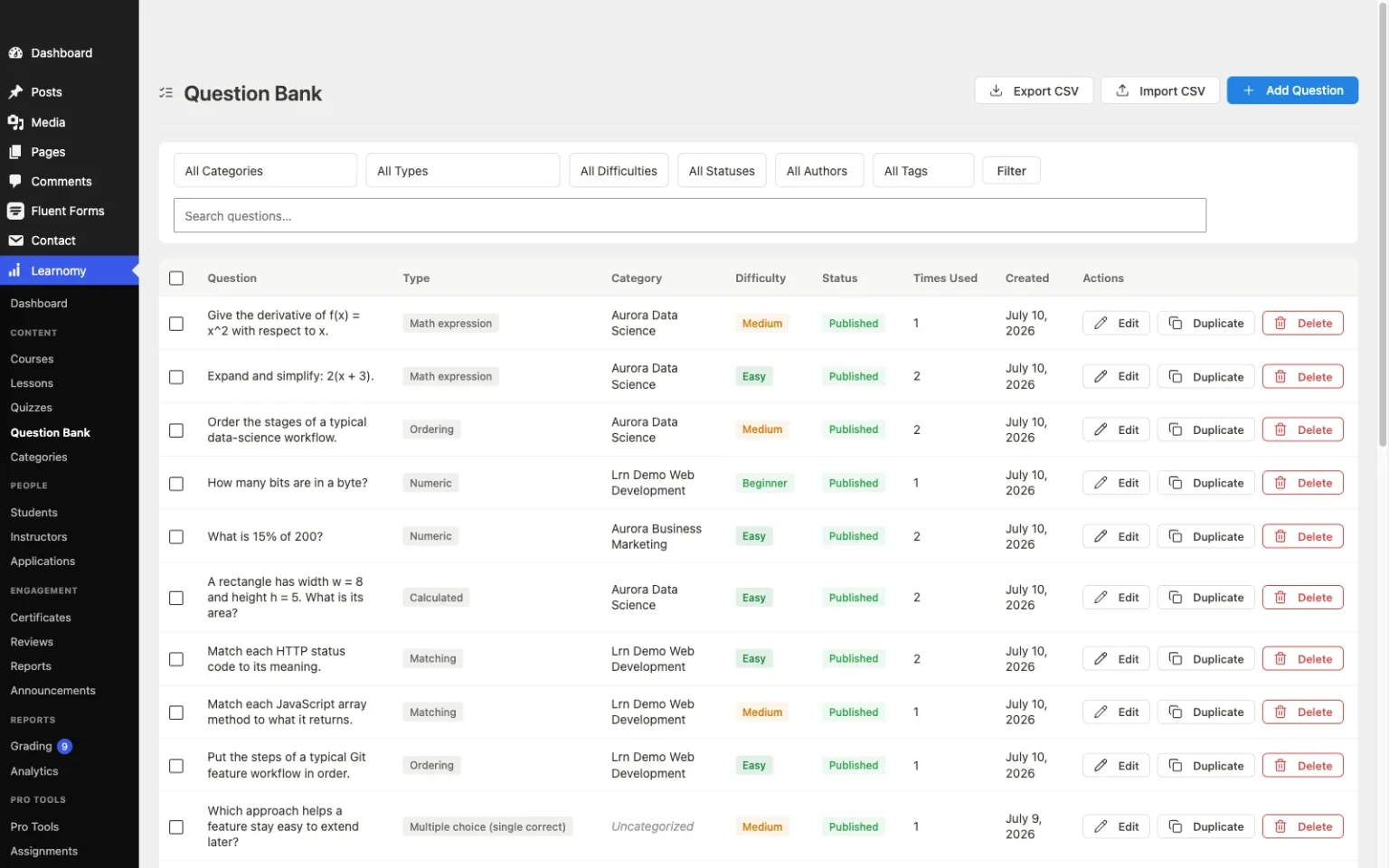
A quiz is only as trustworthy as the scoring and integrity behind it, and Learnomy is built around that standard rather than around formatting questions attractively. Six quiz types cover the range a real course needs, and partial credit means a student who gets most of a multi-part question right is not scored the same as one who got it entirely wrong, closer to how a human grader actually thinks than the all-or-nothing scoring most competitors default to. Question banks mean a retake pulls from a larger pool rather than the same fifteen questions every attempt, which matters the moment a quiz becomes something students might screenshot and share.
Two features push it further for anything resembling a real exam. Tab-switch tracking flags when a student leaves the quiz window mid-attempt, giving an instructor a signal worth reviewing rather than blind trust in an unsupervised online test. And a dedicated essay-grading inbox handles open-ended answers, the question type every quiz builder claims to support and almost none actually make pleasant to grade at scale. Quizzes sit inside a complete learning platform, native Stripe and PayPal checkout, certificates, drip content, and analytics, so assessment depth is not an isolated feature but part of a platform a course creator owns outright, with no platform fees, the case covered in selling online courses from your own website. A migration wizard imports courses and students from LearnDash, Tutor LMS, and LifterLMS for anyone switching. Full details at learnomy.app.

- Pros: Six quiz types with partial credit, closer to real grading than all-or-nothing scoring
- Question banks prevent a retake from being the identical quiz
- Tab-switch tracking and a dedicated essay-grading inbox for real assessment integrity
- Migration wizard from LearnDash, Tutor LMS, and LifterLMS
Cons:
- A newer ecosystem than plugins with a decade of quiz-add-on tutorials
- Self-hosted, so hosting and updates are the site owner’s or their host’s responsibility
2. LearnDash, the deepest question-bank ecosystem
LearnDash remains the plugin most instructors picture when they picture a serious WordPress quiz builder, with eight question types, randomization, prerequisite chains gating quiz access, and granular retake rules that few rivals match on paper. Its third-party add-on catalog for advanced quiz behavior is the largest in this list.
Scoring leans toward all-or-nothing on most question types rather than genuine partial credit, and anti-cheat tooling and dedicated essay grading are not native, they route through add-ons or manual review. Sites weighing it broadly should also see our LearnDash alternatives guide. Pros: most question types, deepest add-on ecosystem for quiz behavior. Cons: limited partial credit, anti-cheat and essay grading not native.
3. Tutor LMS, capable core quizzing
Tutor LMS‘s quiz builder covers the common question types cleanly within its frontend authoring studio, comfortable to build in even for an instructor who avoids wp-admin. It is capable enough for most courses that need standard multiple-choice and true/false assessment.
Deeper assessment features, anti-cheat, sophisticated grading workflows, are not part of the core plugin. Pros: pleasant frontend quiz authoring. Cons: no anti-cheat tooling, limited partial credit.
4. LifterLMS, quizzes tied to engagement
LifterLMS quizzes integrate with its broader engagement system, a passing score can trigger a badge or an automated email, which gives assessment a motivational layer most competitors lack. Standard question types are covered adequately for most course needs.
The quiz engine itself is not the platform’s deepest feature, advanced quizzing sits behind add-ons, and there is no native anti-cheat tooling. Pros: quizzes woven into engagement automation. Cons: advanced quiz features behind add-ons.
5. Sensei LMS, block-editor simplicity
Sensei LMS builds quizzes as native Gutenberg blocks, the most WordPress-native authoring experience in this list, comfortable for anyone who already writes posts in the block editor.
Its quiz depth is deliberately basic: standard question types, no partial credit, no anti-cheat tooling, adequate for a light comprehension check but not built for anything resembling a real exam. Pros: simplest, most familiar authoring. Cons: shallowest assessment depth in this list.
How we evaluated
We scored each platform on four questions specific to quiz-heavy courses: question type variety, how many distinct formats a quiz can use; scoring fairness, whether partial credit is possible or every question is all-or-nothing; integrity tooling, whether the platform offers any signal against cheating on an unsupervised online quiz; and grading workflow, how well the platform handles open-ended answers that need a human to review. Feature scopes shift, so confirm specifics on each vendor’s own site before committing.
What makes a quiz result actually defensible
Most quiz builders optimize for how easy it is to add a question, not for what happens when a student disputes a result. A defensible quiz needs three things most plugins treat as optional: partial credit so a near-miss is not scored identically to a blank answer, a question bank large enough that a retake is not memorization of the same fifteen questions, and some record of anything unusual during the attempt, a tab switch, an unusually fast completion time, that an instructor can review before finalizing a grade. None of this matters for a five-question comprehension check at the end of a video lesson. All of it matters the moment a quiz result determines a certification, a grade, or a compliance record someone might question months later.
FAQ
Which WordPress LMS has the best quiz engine? For raw question-type variety and a mature add-on ecosystem, LearnDash. For partial credit, anti-cheat tracking, and a dedicated essay-grading workflow in one plugin, Learnomy.
Do any of these plugins detect cheating during a quiz? Learnomy includes native tab-switch tracking that flags when a student leaves the quiz window mid-attempt. The other plugins in this list do not offer native anti-cheat tooling.
Can I grade essay or open-ended answers on these platforms? Yes, on all of them, but the workflow varies. Learnomy includes a dedicated inbox built specifically for grading essay answers by hand. The other plugins support open-ended questions but generally require reviewing them individually without a purpose-built grading interface.
What is partial credit and why does it matter? Partial credit scores a multi-part answer based on how much was correct rather than marking the whole question wrong for one mistake. It matters for any assessment meant to reflect actual understanding rather than perfect recall.
Can I switch to a platform with deeper quizzing without losing existing questions? Learnomy’s migration wizard imports courses and students from LearnDash, Tutor LMS, and LifterLMS directly, though question banks built with a competitor’s specific quiz format may need review after the move.
Final verdict
For a course where the quiz result actually needs to hold up, a certification, a compliance record, a graded exam, Learnomy is the most complete answer: six quiz types with partial credit, question banks, tab-switch tracking, and a real essay-grading workflow. LearnDash remains the right call when raw question-type variety and a mature add-on ecosystem matter more than built-in integrity tooling. Start at learnomy.app and build one real quiz before deciding how much assessment depth your course actually needs.