

The first fork in the road for anyone selling a course is not which platform has the prettiest player, it is whether to rent space on someone else’s platform or build the school on infrastructure you control. Hosted platforms, Teachable, Thinkific, Kajabi, hand over a polished, ready-to-use system in exchange for a monthly subscription forever, plus a cut of every sale on top of that subscription. Self-hosted WordPress options ask for more setup up front in exchange for owning the platform outright. Neither answer is universally right, but most “best course platform” roundups pretend the decision is only about features, when it is really about what kind of business you are building.
This guide compares the best online course platforms in 2026 across both categories: hosted platforms built for speed, and self-hosted WordPress options built for ownership. We weigh how each platform structures its costs, what happens to your student list and revenue if you ever want to leave, and whether the platform supports a learning community or just a solo checkout. No fabricated review scores or invented statistics appear anywhere in this guide, and vendors adjust their terms regularly, so confirm specifics on their own sites before committing.
Table of Contents
- Quick comparison
- 1. Learnomy, the complete platform you own
- 2. Teachable, the simplest hosted starting point
- 3. Thinkific, hosted with more course-structure flexibility
- 4. Kajabi, hosted and all-in-one for marketing
- 5. LearnDash, self-hosted, assembly required
- How we evaluated
- The real cost of renting a platform
- FAQ
- Final verdict
Quick comparison
| Platform | Deployment | The deal | Community fit | Standout strength |
|---|---|---|---|---|
| Learnomy | Self-hosted WordPress, you own it | No platform fees, what students pay is yours | Excellent, works cleanly alongside BuddyPress | Complete platform: payments, certificates, and quizzes in one plugin, AI drafting available as an upgrade |
| Teachable | Hosted SaaS | A subscription plus a transaction cut on lower tiers | Minimal, a discussion feature exists but is not the product’s focus | Fastest path from signup to a published course |
| Thinkific | Hosted SaaS | A subscription, tiered by feature depth | Community feature available as an add-on | Flexible course structuring for varied content types |
| Kajabi | Hosted SaaS | A subscription bundling course, email, and funnels | Built-in community space | All-in-one marketing and course delivery |
| LearnDash | Self-hosted WordPress plugin | License plus WooCommerce for full flexibility | Strong, mature BuddyPress integrations | Deepest quiz engine, huge add-on ecosystem |
1. Learnomy, the complete platform you own
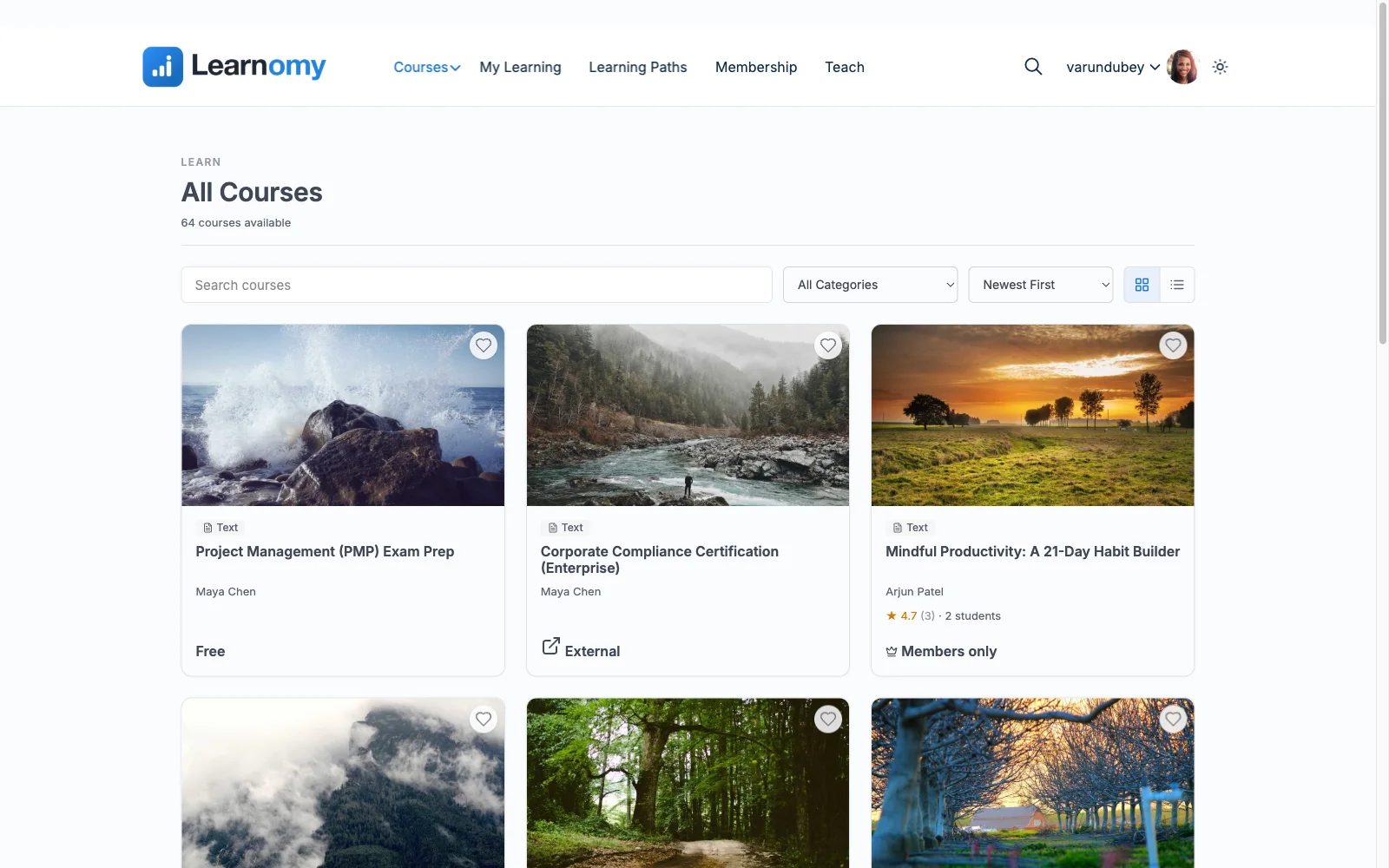
Learnomy takes the top spot for course creators who want the polish of a hosted platform without the rented infrastructure underneath it. It is a complete learning platform for WordPress, not a plugin that assumes a supporting cast: drag-and-drop course building, native Stripe and PayPal checkout, six quiz types with partial credit and question banks, signed and QR-verifiable certificates, drip content, coupons, and an analytics dashboard with real completion data all ship in one platform. An available AI course and quiz generation upgrade turns an outline into a structured draft, closing the gap between a hosted platform’s polish and a self-hosted plugin’s blank-page reputation.
The structural difference from every hosted option on this list is the deal itself: no platform fees, what a student pays lands directly in the creator’s own Stripe or PayPal account, and course content, student records, and revenue relationships live in a database the creator controls, portable to any host. That ownership case is covered in full in selling online courses from your own website. And because Learnomy is built by the team behind the Reign community theme, it pairs naturally with BuddyPress, so a course sits inside a learning community rather than a solo dashboard, discussion boards and Q&A alongside lessons. (A couple of things worth knowing about scope: points-and-badges gamification and a job board for graduates are not native Learnomy features, both pair in through Wbcom’s companion WB Gamification and WP Career Board plugins rather than shipping in the core platform.) A migration wizard imports courses and students from LearnDash, Tutor LMS, and LifterLMS for anyone switching platforms. Full details at learnomy.app.
- Pros: Complete platform: payments, certificates, quizzes, and analytics with nothing extra to assemble; AI drafting available as an upgrade
- No platform fees, full ownership of student data and revenue
- Natural community fit through BuddyPress and Reign
- Migration wizard from LearnDash, Tutor LMS, and LifterLMS
Cons:
- A newer ecosystem than plugins and hosted platforms with a decade-plus track record
- Self-hosted, so hosting and updates are the creator’s or their host’s responsibility
2. Teachable, the simplest hosted starting point
Teachable remains one of the fastest paths from an idea to a published, sellable course: sign up, upload content, connect a payment processor, and a course is live the same day, with no hosting, no theme, and no plugin decisions to make. Its interface is deliberately simple, which suits a first-time creator validating an idea more than a creator who needs deep customization.
The deal is a recurring subscription, and lower tiers add a transaction cut on top of that subscription, which quietly grows as sales grow. Community features exist but are not the product’s core strength, and a creator’s course lives entirely on Teachable’s infrastructure under Teachable’s terms. Pros: fastest setup, no technical decisions required. Cons: ongoing subscription plus a transaction cut, limited ownership, thin community tooling.

3. Thinkific, hosted with more course-structure flexibility
Thinkific offers more flexibility in how a course is structured than Teachable, useful for content types beyond a simple video-and-quiz sequence, bundles, cohort-based courses, and memberships are all supported natively on a hosted infrastructure. A community feature is available as an add-on for creators who want student discussion.
Like every hosted option here, the deal is a recurring subscription that scales with feature depth, and the platform, not the creator, ultimately controls the infrastructure the school runs on. Pros: flexible course structures, cohort support. Cons: subscription-based, community is an add-on rather than core.
4. Kajabi, hosted and all-in-one for marketing
Kajabi bundles course delivery with email marketing, sales funnels, and a built-in community space, positioning itself as a full marketing stack rather than just a course host. For a creator who wants one subscription covering course delivery and the marketing engine around it, that bundling genuinely saves assembling separate tools.
The bundling comes at a real subscription cost that reflects the breadth of tools included, and as with every hosted platform, the creator’s list, content, and community all live inside Kajabi’s infrastructure rather than infrastructure the creator owns. Pros: genuinely all-in-one, built-in community. Cons: the highest subscription tier of the hosted options here, full platform lock-in.
5. LearnDash, self-hosted, assembly required
LearnDash represents the self-hosted alternative to Learnomy for creators who prioritize assessment depth and a mature add-on ecosystem over a complete-platform-in-one-plugin approach. Its quiz engine is the deepest in the WordPress LMS space, and its BuddyPress integrations are long-established for community-driven sites.
The honest trade-off is assembly: real payment flexibility typically means adding WooCommerce, and meaningful reporting means adding a companion tool, so the ownership benefit comes with more setup than Learnomy’s single-plugin approach. Creators comparing it broadly should also see our LearnDash alternatives guide. Pros: deepest quiz engine, huge ecosystem, full ownership. Cons: launch essentials spread across separate pieces.
How we evaluated
We scored each platform on four questions that matter regardless of hosted-versus-self-hosted: completeness, how much of a real launch, selling, certifying, measuring, ships without assembling extra tools; ownership, whether student data and revenue stay under the creator’s control or a vendor’s terms of service; community fit, whether the platform supports learners interacting with each other; and the structure of the deal, described honestly rather than with specific figures that change constantly. No fabricated review scores appear anywhere in this guide.
The real cost of renting a platform
Every hosted platform in this guide shares the same basic structure: a subscription that recurs whether or not a course sells anything that month, often with an additional cut of revenue layered on top at lower tiers. That structure is genuinely easier to start with, there is real value in no hosting decisions and no plugin updates to manage. But it means a creator’s business grows on top of infrastructure someone else can change the terms of at any time, a tier can be discontinued, a feature can move behind a higher price, a policy can shift. A self-hosted WordPress platform trades that convenience for control: the subscription becomes hosting, which a creator can move between providers freely, and the platform itself, once purchased, keeps working on the creator’s own terms. Neither structure is wrong, but they are genuinely different bets, and the right one depends on how much a creator values speed today against control over the next several years.
FAQ
What is the best online course platform overall? It depends on whether speed or ownership matters more. Teachable and Kajabi get a course live fastest with the least setup. Learnomy offers the most complete self-hosted platform, matching hosted-platform polish while keeping ownership of student data and revenue.
Should I choose a hosted platform or a self-hosted WordPress LMS? A hosted platform suits someone validating a first course idea with minimal setup. A self-hosted platform like Learnomy or LearnDash suits a creator treating course sales as a long-term business who wants to own their student list, content, and checkout outright.
Do hosted platforms take a cut of every sale? Often yes, particularly on lower subscription tiers, in addition to the recurring subscription itself. Self-hosted platforms like Learnomy charge no platform fee on what a student pays; the cost is hosting and the platform itself.
Can I move my courses if I start on a hosted platform and want to switch later? Content generally exports in some form, but student progress records and community history rarely move cleanly between hosted platforms. Learnomy’s migration wizard imports courses and students specifically from LearnDash, Tutor LMS, and LifterLMS.
Do any of these platforms support a learning community, not just a course library? Kajabi includes a built-in community space. Thinkific offers one as an add-on. Learnomy and LearnDash both pair naturally with BuddyPress and a community theme like Reign for discussion, groups, and activity feeds around a course.
Final verdict
The fastest path to a published course is a hosted platform, and Teachable or Kajabi both deliver that well. But for anyone treating course sales as a real business rather than an experiment, Learnomy matches that hosted-platform polish, native checkout, verifiable certificates, and an optional AI-drafting upgrade, while keeping the ownership a rented platform can never offer. Start at learnomy.app, build one real course, and decide for yourself which trade-off fits your business.