
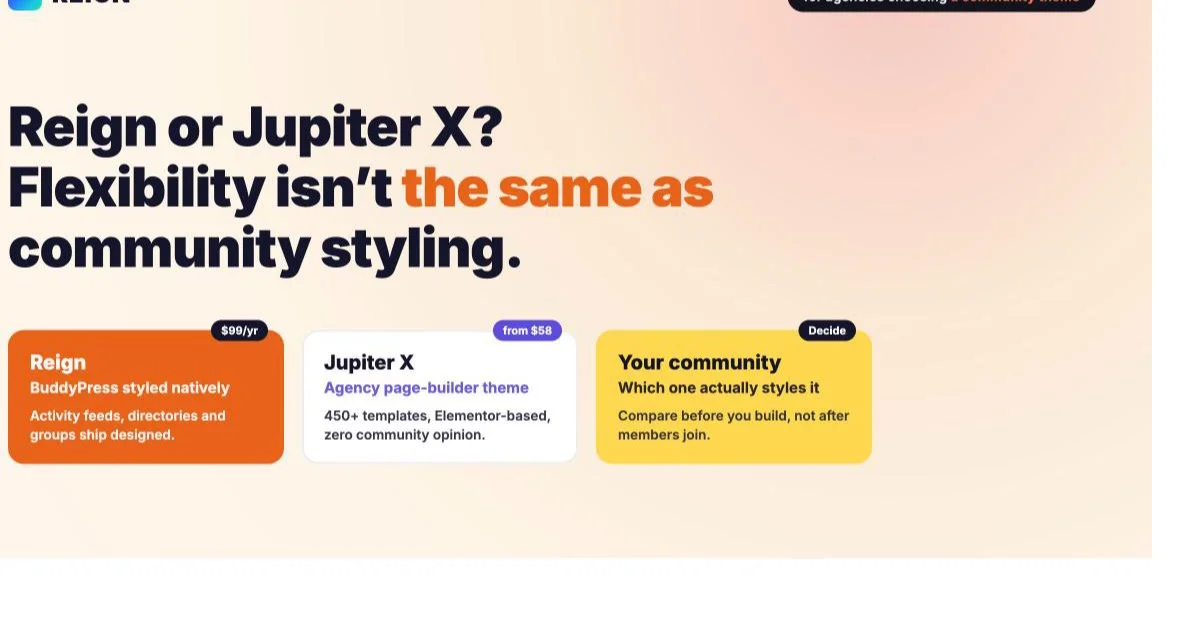
A quick note before we start: this comparison is a thinner one than our Astra and GeneratePress or Blocksy write-ups, and it’s worth saying so upfront instead of pretending otherwise. Those three themes are page-builder-agnostic generalists with roughly the same audience BuddyPress site owners are drawn from, people picking a lightweight, flexible foundation and adding whatever plugin layer they need. Jupiter X is a different kind of product. It’s an all-in-one, Elementor-based website builder aimed squarely at agencies and freelancers who ship many different client sites, restaurants, portfolios, real estate, SaaS landing pages, from one big template library. Its actual audience overlap with “I’m building a BuddyPress community” is smaller than Astra’s or Blocksy’s. We’re writing this comparison anyway because Jupiter X is popular enough, and marketed broadly enough as “build any website,” that the question does come up. We just won’t force an equivalence that isn’t there.
Where the comparison does hold is architectural, not audience-based. Jupiter X’s entire pitch is breadth: one theme, one page builder, 450+ ready-made sites covering nearly every industry, so an agency never has to leave its toolchain. Reign’s pitch is depth in one direction: a theme that ships knowing exactly what a BuddyPress activity feed, a member directory, and a group page are supposed to look like, because that’s the only kind of site it builds. Those are opposite bets on what a theme should be for, and the trade-offs that follow from each bet are what this post is actually about.
What’s in this comparison
- Reign vs Jupiter X at a glance
- Reign: purpose-built for BuddyPress communities
- Jupiter X: the agency builder with 450+ templates and no community opinion
- General-purpose builder vs purpose-built theme: the actual argument
- The scenario: an agency builds a BuddyPress community in Jupiter X
- The bottom line
- FAQs
- Choosing between them
Reign vs Jupiter X at a glance
Pricing below is current as checked directly on jupiterx.com and reigntheme.com rather than pulled from an older roundup, because Jupiter X moved off a pure ThemeForest single-license model to its own bulk-licensing store at jupiterx.com, sold “via Artbees,” and the per-site math changed shape as a result.
| Theme | Built for | BuddyPress styling | Pricing (single site) | Multi-site option |
|---|---|---|---|---|
| Reign | BuddyPress, BuddyBoss Platform, PeepSo communities | Native: activity feed, member directory, groups, profiles ship styled | Yearly licence or one-time lifetime licence | 5 sites or 20 sites, each yearly or lifetime |
| Jupiter X | Any site type; agency/freelancer multipurpose builder on Elementor | None. Generic “membership widgets” (login, signup, social login, password reset) only; no community starter site in the 450+ library | One-time purchase, lifetime updates, 6-month support | 10 sites one-time (1-year support); 100 sites one-time (unlimited support) |
Two things are worth sitting with in that table. First, Jupiter X is entirely one-time pricing with lifetime updates, no yearly renewal at all, which is a genuinely different commercial model from Reign’s year-or-lifetime split. Second, Jupiter X’s per-site cost drops fast at scale, with bulk tiers for 10 and 100 sites. For an agency running dozens of unrelated client sites, that math is hard to beat with any per-site community theme, Reign included. None of that changes what either theme ships out of the box for a BuddyPress community specifically, which is the actual question this post answers.
Reign: purpose-built for BuddyPress communities
Reign starts from one question: what does a community actually look like once real members are posting, forming groups, and building profiles in it. The answer is native, designed templates for everything BuddyPress, BuddyBoss Platform, and PeepSo generate automatically, activity streams, member directories, group pages, profile tabs, notifications, private messaging. Install the plugin and Reign already has an opinion about how to present its markup. No builder, no custom CSS, no hunting for a matching starter site required to make it look finished.
That’s a stronger claim than “BuddyPress compatible,” which is the ceiling most general-purpose themes, Jupiter X included, actually offer. Compatible means the plugin won’t throw a fatal error. Reign’s activity feed, directory grid, group header, and profile layout are designed to match the rest of the theme’s visual language with zero custom work, which is a different promise entirely. BuddyPress’s own default templates are functional but dated by design, the plugin focuses on the data layer, not the presentation layer, and leaves styling to the theme on purpose.
Current pricing, confirmed on reigntheme.com the same week this post went up, is a yearly licence for a single site or a one-time lifetime licence, both with identical features. A 5-site license and a 20-site license are also sold, each yearly or lifetime; see the pricing page. Every tier includes BuddyPress, BuddyBoss Platform, and PeepSo support, 30+ one-click demo imports, five header layouts, dark mode, and a 30-day money-back guarantee. There’s no separate “community module” to buy later; the community styling is the whole point of the purchase.
On the page-building side, Reign supports Gutenberg and Elementor for general layout work, which is worth flagging directly since Jupiter X is also Elementor-based: switching to Reign for the community layer doesn’t mean an agency has to abandon Elementor skills or client workflows built around it. The difference isn’t the builder underneath; it’s what happens the moment BuddyPress-generated markup hits the page, which Elementor itself has no opinion about either way.
The honest limitation is the one we repeat in every comparison in this series: Reign is a specialist. A restaurant site, a law firm’s marketing page, or a single-product SaaS landing page gains nothing from BuddyPress styling it will never use, and a broad multipurpose builder will do that job faster and for less per site. Reign earns its price the moment BuddyPress, BuddyBoss Platform, or PeepSo becomes part of the actual plan, and not a minute before that.
Jupiter X: the agency builder with 450+ templates and no community opinion
Jupiter X, built by Artbees, is one of the longer-running names on ThemeForest, reviewers on its own pricing page reference using it “since 2014” and “nearly a decade,” and the current site brands itself Jupiter X4. The pitch has stayed consistent across that run: one theme, built on top of Elementor, that unlocks a large set of Pro-style widgets, builders, and templates without requiring a separate Elementor Pro subscription. That’s a real selling point we confirmed directly on jupiterx.com rather than assuming, the pricing page’s own headline reads “No Need for Elementor Pro,” and the feature set backs it up: 100+ widgets, a shop builder with 60+ storefront designs, a header builder, a form builder, a popup builder, motion effects, and a full layout builder, all stacked on free Elementor.
The headline number is the template library: 450+ ready-made websites, one-click install, spanning what the site itself describes as designers, developers, marketers, shops, bloggers, and creatives. WooCommerce gets particular depth, 20+ dedicated shop widgets, custom cart and checkout building, readymade shop templates, advanced product filters and variation swatches, and SellKit bundled in for conversion-focused store features. For an agency building a new client site every few weeks across unrelated industries, that breadth is the entire value proposition, and it’s a legitimate one.

Jupiter X’s own homepage, screenshotted directly from jupiterx.com. The product is framed entirely around the page-builder canvas and template breadth, not around any specific content type like a community feed.
Pricing moved to a bulk-license model sold directly through jupiterx.com (“via Artbees”), checked live rather than assumed from older posts: one site with 6 months of support, ten sites with a year of support, and 100 sites with unlimited support, with the per-site cost falling at each step. All three tiers are one-time purchases with lifetime updates, no annual renewal. Jupiter X is also still listed on ThemeForest under the standard Envato single-site regular license model, though the jupiterx.com bulk tiers are what the company now leads with on its own pricing page.

Jupiter X’s current bulk-license pricing, screenshotted directly from jupiterx.com/pricing. All three tiers are one-time purchases with lifetime updates; support duration is the variable that scales with tier, not the feature set.
What Jupiter X does not have, anywhere in that feature list, is a community opinion. Its “membership widgets,” per its own site copy, cover sign-up and login forms, social login, and password reset, useful, generic account-management building blocks, and genuinely well-built ones. They are not an activity feed, a member directory, a group page, or a profile layout. Scan the 450+ template library’s category filters and there is no “Community” or “Membership” option among them; the closest fits are generic Business or Nonprofit templates built around selling or fundraising, not members interacting with each other. That’s not a flaw in Jupiter X, it’s simply outside the brief a multipurpose agency theme sets for itself, the same way it’s outside Astra’s and GeneratePress’s or Blocksy’s brief in our earlier comparisons.
General-purpose builder vs purpose-built theme: the actual argument
It’s worth slowing down on why “general-purpose” and “purpose-built for BuddyPress” pull in genuinely different directions at the architecture level, not just the marketing level, because that’s the real substance of this comparison once the audience-overlap caveat is out of the way.
A page builder like the one inside Jupiter X is, by design, a blank-canvas tool. Its entire value is that it has no opinion about what you’re building: a widget is a widget, a section is a section, and the builder’s job is to let a human assemble those primitives into whatever layout a project needs, one page at a time, by hand. That’s exactly right for the kind of site Jupiter X optimizes for, a marketing page, a portfolio, a storefront, because each of those is fundamentally a fixed, finite set of pages a designer lays out once and ships.
A BuddyPress community isn’t that. An activity feed, a member directory, and a group list are not pages a human designs once in a builder; they’re templates that render dynamically, once per visitor, once per member, populated by data nobody designed in advance. Elementor, Brizy, Beaver Builder, Gutenberg, none of them reach into that rendering path by default, because none of them were built to. That’s not a missing feature; it’s the honest boundary of what a page-builder plugin’s job description includes. The theme sitting underneath is the only layer positioned to catch that markup and decide what it looks like, and a theme built to stay generic, on purpose, for builder flexibility, has nothing in reserve to spend on that decision. Jupiter X’s own pitch, maximum flexibility, zero assumptions about content type, is the same design choice that leaves BuddyPress’s default templates to render unstyled.
Reign inverts the bet entirely. Instead of staying generic to cover the widest possible range of projects, it narrows to one content type and goes deep: it ships knowing, specifically, what an activity feed’s card layout should be, what a member directory grid should look like at three different breakpoints, how a group header should present cover photos and member counts. That’s a worse trade for the restaurant site or the portfolio Jupiter X is built for, Reign has nothing extra to offer there either, and a much better one for the one content type neither a blank-canvas builder nor a builder-agnostic generalist theme was ever going to solve by default.
The scenario: an agency builds a BuddyPress community in Jupiter X
Here’s how that architecture gap plays out on an actual project, and it’s a realistic one: a marketing agency picks up a client who wants a members-only professional community, profiles, groups, an activity feed for posts and discussion. The agency already has a Jupiter X bulk license from client work, their designers already know the Elementor-based builder, and the 450+ template library has gotten them to a finished-looking site fast on the last dozen projects. Reaching for Jupiter X again is the obvious, reasonable first move.
They open the template library looking for a head start on the community pages specifically. The filters run across the usual multipurpose categories: Business, Ecommerce, Blog, Portfolio, Nonprofit, and similar. Nothing says Community. Nothing says Membership, Social Network, or Member Directory. The closest available starting point is a generic Business or Nonprofit layout, built for selling a service or collecting donations, not for members posting to each other. That gets imported as the site shell, because it’s the best option on offer, and it genuinely looks sharp, that part of Jupiter X’s job is done well.
Then BuddyPress goes in to build the actual community layer the client asked for: profiles, groups, the activity feed. None of Jupiter X’s page-builder work from the previous step reaches any of it, because BuddyPress’s generated markup was never part of what that starter template, or any Jupiter X starter template, was designed around. The activity feed renders with BuddyPress’s own stock styling sitting directly beneath a hero section and header that were polished to the pixel using 100+ Elementor widgets an hour earlier in the same build. The visual seam between “page a human designed in the builder” and “feed BuddyPress generated” is immediate and obvious.
From here the agency is assembling community features from scratch, piece by piece, the same custom work this whole comparison series keeps landing on: template overrides for the activity feed markup, custom CSS to make the member directory grid match the rest of the site, a styled group header built by hand, ongoing maintenance every time BuddyPress or Jupiter X ships an update that touches those template files. None of that work is free, and unlike the one-time theme license, it’s ongoing. The cheaper version of this story starts with picking a theme that already understands BuddyPress before the community layer gets built on top of a theme that doesn’t, which is exactly the decision our guide to the hidden costs of changing WordPress themes walks through for anyone who’s already committed the other way.
The bottom line
Jupiter X is not a weak product losing this comparison on merit. For what it’s actually built to do, get an agency from zero to a polished, varied client site fast, on one Elementor-based toolchain, without paying for Elementor Pro separately, it’s a strong, long-running, well-reviewed theme with a genuinely deep template library and attractive bulk-license economics at scale. Nothing in this post changes that for the restaurant site, the portfolio, or the SaaS landing page it was designed around.
The honest framing, which we said upfront and it’s worth repeating at the end: this is a narrower, more marginal comparison than Reign against Astra, GeneratePress, or Blocksy, because Jupiter X’s actual buyer, an agency assembling many unrelated client sites, overlaps less with “I need a BuddyPress community styled” than a general-purpose theme buyer does. Most Jupiter X customers will never hit the gap this post describes, because most of their projects aren’t communities. The comparison only matters for the specific slice of Jupiter X’s audience that is building one, and for that slice, the gap is real and the custom-development cost that follows from it is real too.
- Pick Reign if the project includes BuddyPress, BuddyBoss Platform, or PeepSo, confirmed or clearly likely, and you want the activity feed, directory, and group pages styled without commissioning custom template work.
- Pick Jupiter X if the work is varied, multipurpose client sites across different industries with no community layer, you want one Elementor-based toolchain and a deep template library, and bulk per-site pricing matters more than any single content type.
FAQs
Can I just install BuddyPress on Jupiter X and style it with Elementor?
Technically yes, and it won’t break anything, Jupiter X is a clean, actively maintained theme. But Elementor’s page builder only controls pages you build by hand with it; BuddyPress’s activity feed, member directory, and group pages render through their own template files, which the Elementor canvas doesn’t reach by default. You’d need custom template overrides and CSS to make them match the rest of a Jupiter X build, the same work required on any general-purpose Elementor theme.
Does Jupiter X’s “no Elementor Pro needed” claim matter for a community site?
It matters for general page building, it’s a genuine cost saver if the alternative was buying Elementor Pro separately for Pro-style widgets. It doesn’t touch the community gap at all, since Elementor Pro doesn’t style BuddyPress templates either. The widget savings and the community-styling gap are two unrelated parts of the comparison.
Is Jupiter X’s 450+ template library really missing anything for a community?
As far as we found checking jupiterx.com directly, yes. The category filters run across the standard multipurpose set, business, ecommerce, blog, portfolio, nonprofit, and similar industry verticals, with no Community, Membership, or Social Network option among them. The closest fits are generic Business or Nonprofit layouts, which solve a different design brief than a member feed.
If I’m not sure yet whether the site needs BuddyPress, should I still pick Reign?
If community features are a real possibility rather than a firm no, starting on Reign is the lower-risk choice: it works fine as a general theme if BuddyPress never gets added, and switching themes after a community already has active members and content is far more disruptive than switching before one exists. If community is a confirmed no for this specific project, Jupiter X’s breadth and bulk pricing are the better fit.
Can an agency keep using Jupiter X for its other client sites and just use Reign for community projects?
Yes, and that’s a reasonable way to run a mixed agency portfolio. Nothing about using Reign for community builds requires giving up a Jupiter X license for everything else; they solve different briefs and there’s no conflict running both across different client projects.
Does Reign cost more per site than Jupiter X at scale?
At high site counts with no community features, yes clearly, Jupiter X’s per-site rate at 100 sites is hard for any per-site theme to match. The comparison only changes once a specific site in that batch needs BuddyPress styled; at that point the relevant comparison isn’t Reign’s price against Jupiter X’s per-site rate, it’s Reign’s price against Jupiter X’s per-site rate plus the custom development a community build on Jupiter X would still need.
Is Jupiter X’s page builder fundamentally different from Elementor itself?
No, Jupiter X runs on the free Elementor plugin and extends it with its own Pro-style widgets, builders, and templates, rather than replacing it with a separate system. If a team already knows Elementor, the learning curve for Jupiter X’s additions is small, and that knowledge carries over directly to Reign, since Reign also supports Elementor for general page building.
Does this comparison apply to Dokan or WooCommerce marketplace builds too?
Partially, and worth separating out. Jupiter X has genuinely strong native WooCommerce tooling, 20+ shop widgets, custom checkout, SellKit, that stands on its own merit for a pure online store with no community layer. Reign’s advantage specifically covers BuddyPress, BuddyBoss Platform, and PeepSo, plus marketplace plugins like Dokan and WC Vendors layered on top of a community base. A WooCommerce-only marketplace with zero community features is a fair fight Jupiter X can win on its own strengths; the moment BuddyPress enters that build alongside it, the same styling gap described above applies.
Choosing between them
If the project in front of you is the kind of site Jupiter X was built for, a varied, multipurpose client build with no community layer, this comparison has little to add to its long track record and deep template library. That’s most of what an agency running Jupiter X actually ships, and nothing here argues against it for that work. If BuddyPress, BuddyBoss Platform, or PeepSo is part of the plan, the calculation changes, for the same structural reason it changes against Astra, GeneratePress, and Blocksy: a theme built to stay generic across hundreds of templates has no opinion left over for one specific, dynamically rendered content type, and building that opinion by hand is the real cost a sticker price doesn’t show.
Once a community is running on Reign, the same logic extends past the theme. A community needs more than a styled activity feed and profile grid to feel complete: forums for discussion that isn’t a single scrolling stream, and events for the moments a community gathers off the feed entirely. Wbcom Designs builds Jetonomy for forum and Q&A discussion and Eventonomy for event management, both free plugins built to sit inside a Reign community styled rather than bolted on, the same design philosophy applied past the theme layer.