

Type “lightweight WordPress theme” into Google and Blocksy shows up on page one, a climb Astra and GeneratePress have owned for most of the last decade. It earned the spot honestly: a free theme that tops most speed tests, a header and footer builder that rivals paid plugins, and a starter-site library running close to fifty polished designs you can import in one click. For a portfolio, an agency site, or a WooCommerce store, Blocksy is one of the strongest free themes on WordPress.org right now, with 300,000+ active installations and a clean five-star rating across its reviews.
None of that was built with a BuddyPress community in mind. Blocksy’s entire pitch is page-builder-agnostic flexibility: it stays out of the way so Gutenberg, Elementor, Brizy, or Beaver Builder can do the designing. A community site needs close to the opposite of “out of the way.” It needs a theme with opinions about what an activity feed, a member directory, and a group header should look like, because BuddyPress does not ship that styling itself. That is a narrower, more specific job, and it is the one job Reign exists to do.
This is not an argument that Blocksy is weak. It is one of the better general-purpose themes on WordPress.org, full stop. The argument is that “general-purpose, builder-agnostic, starter-site-first” and “built to style a BuddyPress community” are two different design briefs, and a theme optimized for the first one has nothing left over for the second. We checked Blocksy’s current pricing and starter-site library directly on creativethemes.com rather than trusting older roundups, because Blocksy’s plan structure has changed since most of those were written.
What’s in this comparison
- Reign vs Blocksy at a glance
- Reign: built for BuddyPress, not retrofitted
- Blocksy: the fastest builder-agnostic theme, with no community opinion at all
- What “page-builder-agnostic” actually means for a community site
- The scenario: a membership community in Blocksy’s starter-site library
- The bottom line
- FAQs
- Choosing between them
Reign vs Blocksy at a glance
Pricing below is what Creative Themes and Wbcom Designs charge today, checked directly against their pricing pages rather than pulled from memory, because Blocksy’s tier structure does not match what a lot of older “best WordPress theme” posts describe.
| Theme | Built for | BuddyPress styling | Pricing (single site) | Lifetime option |
|---|---|---|---|---|
| Reign | BuddyPress, BuddyBoss Platform, PeepSo communities | Native: activity feed, member directory, groups, profiles ship styled | One licence, yearly or lifetime | One-time lifetime licence |
| Blocksy | Any site type; speed and page-builder flexibility (Gutenberg, Elementor, Brizy, Beaver Builder) | None. Default BuddyPress templates, no community starter site in the library | Yearly licence (Personal, 1 site) | One-time lifetime licence |
Blocksy’s free theme stays free regardless of which tier you pick; the pricing above is for Blocksy Pro. One thing worth sitting with before we go further: Blocksy’s popular Business tier covers ten sites, while Reign’s yearly licence covers one. Completely different trade: ten generic sites against one site with full community styling included. We come back to that in the bottom line.
Reign: built for BuddyPress, not retrofitted
Reign starts from the opposite question Blocksy asks. Instead of “how do we stay invisible under any page builder,” Reign asks “what does a community actually look like once real members are posting in it.” The answer is native templates for everything BuddyPress, BuddyBoss Platform, and PeepSo generate automatically: activity streams, member directories, group pages, profile tabs, notifications, and private messaging. Install the plugin and Reign already knows what to do with its markup, no builder required to make it presentable.
That distinction matters because BuddyPress’s own default templates are functional but visually dated, and most themes that advertise “BuddyPress compatible” mean only one thing: the theme will not break them. Reign’s claim is bigger than that. The activity feed, directory grid, group header, and profile layout are designed to match the rest of the theme with zero custom CSS, out of the box, which is a different and much stronger promise than simple compatibility.

Reign ships 34 live demos covering BuddyPress, BuddyBoss Platform, and PeepSo, plus LearnDash, Dokan, WC Vendors, and WP Job Manager layered on top of a community base. Each one installs with one click. See our wider roundup of the best BuddyPress themes for 2026 for how Reign compares against other community-first options.
Current pricing, confirmed on reigntheme.com, is a yearly licence for a single site or a one-time lifetime licence, with the same feature set on both terms. A 5-site license and a 20-site license are also sold, each yearly or lifetime; see the pricing page. Every tier includes BuddyPress, BuddyBoss Platform, and PeepSo support, 30+ one-click demo imports, five header layouts, dark mode, and a 30-day money-back guarantee. There is no separate community add-on to buy later; the styling is the product itself.
The honest limitation is the same one that applies against Astra or GeneratePress: Reign is a specialist. A restaurant site or a law firm’s marketing page gains nothing from BuddyPress styling it will never use, and a general-purpose theme, Blocksy very much included, will do that job better and for less. Reign earns its price the moment BuddyPress, BuddyBoss Platform, or PeepSo becomes part of the plan, and not a minute before.
Blocksy: the fastest builder-agnostic theme, with no community opinion at all
Blocksy’s reputation is built on restraint and raw speed, not features piled on top of each other. The free theme, downloadable from WordPress.org, carries 300,000+ active installations and a near-perfect five-star rating across its reviews, 863 five-star reviews out of roughly 870 total as of this writing. It ranks near the top of Google PageSpeed, Pingdom, and GTmetrix tests, which is the headline Blocksy leads with on its own homepage, and the claim holds up under a quick look: this is a lean theme with very little dead weight in the markup.
Its second pitch is page-builder neutrality. Blocksy is built to work equally well with Gutenberg, Elementor, Brizy, and Beaver Builder, so an agency is not locked into one editor across client sites. On top of that sits a drag-and-drop header and footer builder with nine header elements, a global color palette with a dark mode switch, advanced typography controls, and integrated schema markup. For WooCommerce specifically, Blocksy adds quick view, AJAX filtering, variation swatches, and even Dokan multi-vendor compatibility, well beyond what a typical free theme bothers with.
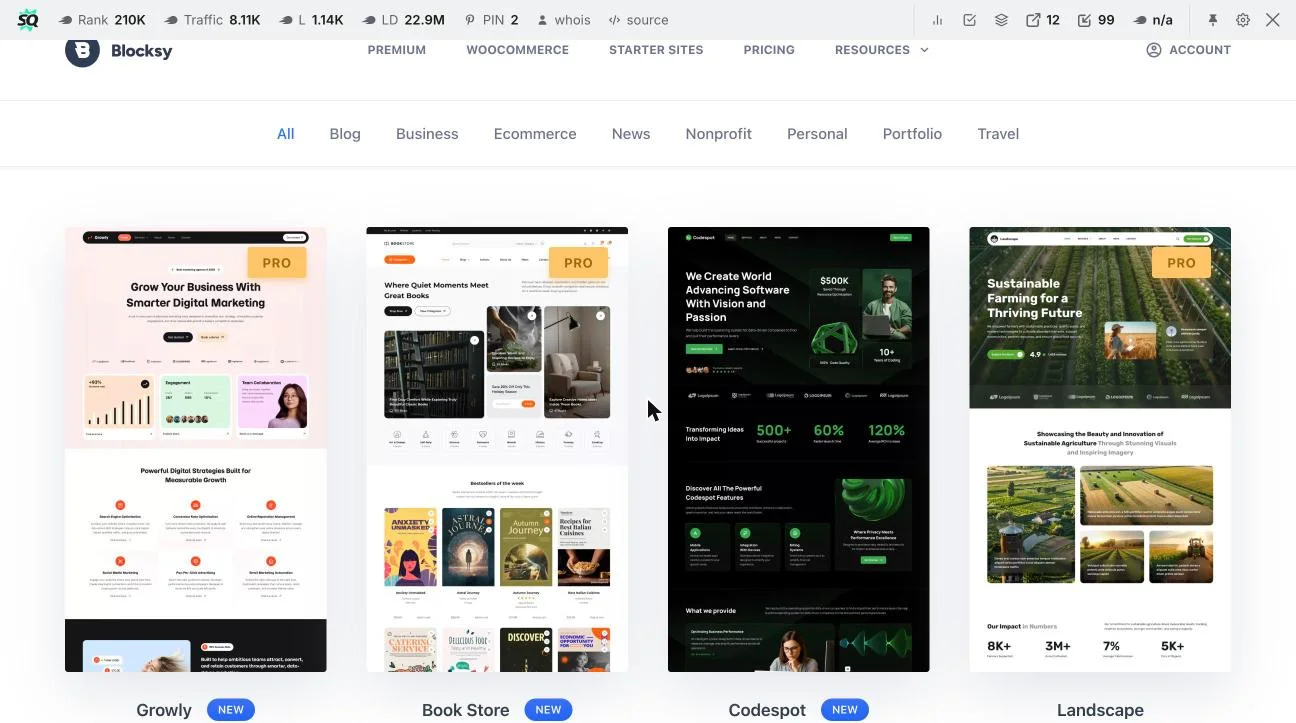
Blocksy’s starter-site library, screenshotted directly from creativethemes.com. The filter row across the top is the whole category list: no Community, no Membership, no option built around a BuddyPress-style feed.
Those filter categories are the whole story in one screenshot. Install BuddyPress on Blocksy and you get BuddyPress’s own stock markup sitting inside Blocksy’s otherwise polished typography and color system, the same way it would sit inside Astra or GeneratePress. Blocksy was never asked to understand what an activity feed is, because understanding specific content types runs against what “builder-agnostic” means by design. The theme does its job by staying generic, and a community feed is about the least generic thing WordPress generates.
Pricing changed shape at Creative Themes the same way it has across this entire market this year. The free theme stays free, full stop, including the free starter sites. Blocksy Pro is sold in three tiers, checked directly against creativethemes.com/blocksy/pricing: Personal for one site, Business for ten sites, marked as the most popular tier, and Agency for unlimited sites, each as a yearly or lifetime licence. Every tier unlocks the identical feature set, including all pro starter sites, the shop extension, post-type extras, and white labeling; the only difference between tiers is how many sites you can activate the license on.
What “page-builder-agnostic” actually means for a community site
“Builder-agnostic” and “BuddyPress compatible” are both marketing phrases that describe an absence rather than a feature, and it is worth separating what they actually promise from what people assume they mean. Builder-agnostic means Blocksy will not fight Elementor, Brizy, Beaver Builder, or Gutenberg for control of a layout. BuddyPress compatible, on any general-purpose theme, means the activity feed will not throw a fatal error and the member list will render without breaking the page. Both are a floor. Neither one promises the result looks like it was designed on purpose.
Run the practical test yourself. Install BuddyPress fresh on Blocksy, go straight to the member directory with no custom CSS added, and look at what renders. It is BuddyPress’s own default grid, wearing none of Blocksy’s design language, because Blocksy’s header builder, color palette, and typography system were built to style pages a human assembles with a page builder, not markup a plugin generates on its own. On Reign, that same directory is a styled grid that matches the rest of the theme from the first page load, because Reign’s templates were written specifically to target that markup.
The scenario: a membership community in Blocksy’s starter-site library
Here is how this plays out in practice, and it runs close to the Astra story with one extra twist, because Blocksy actively encourages you to start from a template. Someone decides to launch a paid membership community and picks Blocksy, reasonably: it is free, fast, five-star rated, and it works with whichever page builder their agency already knows. They open the starter-site library looking for a head start and filter by category: All, Blog, Business, Ecommerce, News, Nonprofit, Personal, Portfolio, Travel. Nothing says Community. Nothing says Membership. The closest fit is Business, or maybe Nonprofit, so that is what gets imported, a one-click site built for selling services or collecting donations, not for members talking to each other.
The content site launches fine. It looks exactly as sharp as the starter-site screenshot promised, because that part of Blocksy’s job is genuinely excellent. Then BuddyPress goes in to add the actual community: profiles, groups, an activity feed. The imported starter site’s header, colors, and typography do not reach into any of it, because BuddyPress’s templates were never part of what that starter site, or any Blocksy starter site, was designed around. The activity feed looks like a BuddyPress demo from a different decade, sitting directly underneath a header that was polished down to the pixel five minutes earlier in the same build.
From here the options are the same three as with any general-purpose theme: pay a developer to build custom BuddyPress template overrides and keep maintaining them through every theme and plugin update, live with the visual mismatch and hope members do not notice, or migrate to a theme built for this before more members and content pile up. None of the three are free, and the first two are ongoing costs rather than one-time ones. The cheapest version of this story starts with picking the right theme before the community layer exists, which is exactly the decision our guide to the hidden costs of changing WordPress themes walks through for anyone who already made the other choice.
The bottom line
Blocksy is not the wrong theme because it is weak. It is the wrong theme for a community build for the same reason Astra and GeneratePress are, covered in our earlier Reign vs Astra vs GeneratePress comparison: community styling was never part of the brief. A fast, builder-agnostic, five-star theme with a deep starter-site library is a genuinely strong pick for the overwhelming majority of WordPress sites, and nothing here changes that for anyone who is not adding BuddyPress.
On price, this comparison runs closer than the Astra one. The honest math depends entirely on how many sites you run and whether any one of them is a community. For a single community build, Reign’s yearly licence already includes what would otherwise be custom development layered on top of any Blocksy tier. For an agency running ten general-purpose client sites with zero community features among them, Blocksy’s Business tier is the better deal by a wide margin, and Reign would be money spent on styling nobody uses.
- Pick Reign if BuddyPress, BuddyBoss Platform, or PeepSo is confirmed or likely, and you want the activity feed, directory, and group pages styled without writing CSS or hunting for a starter site that does not exist.
- Pick Blocksy if speed and page-builder flexibility matter more than any single content type, you want the widest free starter-site library on WordPress.org, and BuddyPress is not on the roadmap.
FAQs
Can I just install BuddyPress on Blocksy and style it myself?
Yes, technically, the same as on any general-purpose theme. BuddyPress will run without conflicts, since Blocksy is a clean, well-coded theme. You will need custom CSS at minimum, and likely template overrides, to make the activity feed, member directory, and group pages look intentional instead of default. Budget real development time for this, and expect to revisit the overrides after BuddyPress or Blocksy updates.
Is Reign slower than Blocksy, since Blocksy is built for speed?
Blocksy’s whole pitch is raw speed, and it earns its PageSpeed scores on a general-purpose site. Reign ships more out of the box because it styles features Blocksy does not touch at all, which makes it heavier at a raw file-size level. In exchange, you skip the custom CSS and template overrides a community build on Blocksy would need anyway, and those carry their own performance cost. For a site that is actually running BuddyPress, Reign’s built-in templates are typically faster in practice than Blocksy plus hand-rolled community styling.
Does Blocksy’s starter-site library really have nothing for a community site?
Correct, as of this writing. The filter categories are Blog, Business, Ecommerce, News, Nonprofit, Personal, Portfolio, and Travel, and none of the roughly fifty starter sites in that library are built around BuddyPress, a member directory, or a group structure. The closest available options are Business or Nonprofit templates, and neither one is the same brief as a community feed.
What if I’m not sure yet whether I’ll add BuddyPress?
If community features are a genuine maybe rather than a firm no, it is worth starting on Reign anyway. It works fine as a general-purpose theme if BuddyPress never gets installed, and switching themes after a community already has active members is far more disruptive than switching before one exists. If community is a firm no, Blocksy is a strong, cheaper-feeling pick for that use case.
Can I migrate from Blocksy to Reign without losing my site?
Yes. A theme switch does not touch your posts, pages, users, or BuddyPress data, all of which live in the database independent of the theme. What changes is layout and styling, so plan time to rebuild any Elementor, Brizy, or Beaver Builder layouts and recheck widget areas after switching. Our guide to the hidden costs of changing WordPress themes covers what actually breaks during a switch and how to plan around it.
Does Reign support Elementor, Brizy, and Beaver Builder the way Blocksy does?
Reign supports Gutenberg and Elementor for general page building, which covers the large majority of builds. It does not ship native support for Brizy or Beaver Builder the way Blocksy does. If your workflow is locked to one of those two builders specifically, weigh that into the decision; for everyone else, Reign’s page-building options cover the same ground that actually matters for a community site.
Which is cheapest for a single community site?
On sticker price, Blocksy’s Personal tier is the cheapest of the two. That price buys zero BuddyPress styling, so the real cost of a finished single-site community on Blocksy includes custom development on top. Reign includes the BuddyPress, BuddyBoss Platform, and PeepSo styling in its price, which is usually the cheaper total once development time gets counted.
Is Blocksy’s free version enough, or do I need Blocksy Pro?
For a non-community site, Blocksy’s free version on WordPress.org is genuinely capable on its own, which is a large part of why it has 300,000+ active installations. Blocksy Pro adds the header and footer builder’s advanced elements, the full starter-site library, WooCommerce extras, and white labeling. None of that, free or Pro, adds BuddyPress styling, so the free-versus-Pro question does not change anything about this comparison either way.
Does this comparison apply to marketplaces and job boards too, not just social communities?
Yes, with the same caveat as the Astra and GeneratePress comparison. Reign’s native styling extends past core BuddyPress into Dokan and WC Vendors multi-vendor marketplaces, WCFM, and WP Job Manager job boards, all sharing one design language. Blocksy actually lists its own Dokan multi-vendor compatibility among its WooCommerce features, which is worth knowing if a marketplace build is pure WooCommerce with no community layer at all. The moment BuddyPress enters the picture alongside it, the same styling gap applies.
Does Blocksy’s hosting-agnostic, lightweight codebase matter if I add a community anyway?
It matters less than the marketing suggests once BuddyPress enters the build. Blocksy’s speed advantage comes from a lean codebase on the pages it was designed to render, mostly static content and WooCommerce listings. An activity feed is a different kind of page: it loads per-user data, paginates constantly, and depends far more on server-side caching, object caching, and a theme that queries BuddyPress’s own data efficiently than on how light the surrounding header and footer markup is. A community site’s real performance bottleneck sits in the database layer, not in which theme renders the chrome around it, so Blocksy’s raw speed numbers on a marketing page do not carry over one-to-one to a busy member directory.
Choosing between them
If the site in front of you is not a community, a portfolio, an agency site, a WooCommerce store, a blog, Blocksy is a legitimate top pick on WordPress.org and this comparison has little to add to its five-star reputation. If BuddyPress, BuddyBoss Platform, or PeepSo is anywhere on the plan, the calculation changes, because the real cost in that build was never the theme license. It is the custom work needed to make a builder-agnostic theme look like it understands a community. Reign is priced so that custom work becomes unnecessary.
Once a site is running on Reign, the same logic extends to the rest of the stack. A community needs more than profiles and an activity feed to feel alive: forums for discussion that is not a single scrolling feed, and events for the moments the community meets beyond the website. Wbcom Designs builds Jetonomy for forum and Q&A discussion and Eventonomy for event management, both free plugins designed to sit inside a Reign community the same way BuddyPress does, styled rather than bolted on.