


If you’re looking for top tools around “WooCommerce Notifications & Automatic Emails Plugins,” you’ve come to the right place. Here I’ll walk you through what these plugins are, how to use them, and the 10 best options in 2025 that help automate alerts and emails in your Woo store.

What Are WooCommerce Notifications & Automatic Emails Plugins?
WooCommerce Notifications & Automatic Emails Plugins are extensions that push your store’s default transactional emails (like order confirmations, shipping updates) further. They let you customize messages, send them under custom conditions, notify staff or vendors, and ensure reliable delivery.
Rather than relying on WooCommerce’s limited built‑in email system, these plugins let you take control—branding templates, triggering by events, sending to multiple recipients, or delivering via SMS or desktop alerts.
Also Read:How to Create My Own Online Store (WooCommerce vs Easy Digital Downloads)
How to Use WooCommerce Notifications & Automatic Emails Plugins
1. Install and activate the plugin from WordPress admin → Plugins → Add New.
2. Connect via WooCommerce or configure SMTP if needed for delivery.
3. Customize templates: add your logo, colors, and merge tags.
4. Define triggers: new order, low stock, status change, vendor alert, abandoned cart.
5. Set recipients: customer, admin, vendor, warehouse, SMS, etc.
6. Test by placing a dummy order or triggering events.
7. Monitor logs or analytics and refine content or scheduling.
This workflow ensures that your WooCommerce Notifications & Automatic Emails Plugins are configured correctly, delivering reliable and branded communications without manual effort.
List of Top WooCommerce Notifications & Automatic Emails Plugins
Here are the 10 plugins that stand out in 2025 for automating and customizing WooCommerce notifications and emails. Each offers different strengths—custom templates, internal alerts, SMTP reliability, or advanced automation. Choose based on your workflow.
Table of Contents
- Email Customizer for WooCommerce
- YITH WooCommerce Email Templates
- FunnelKit Automations
- AutomateWoo
- MailPoet
- Omnisend
- WP Mail SMTP Pro
- WooCommerce Multiple Email Recipients
- WP Swings Order Status & Email Notification
- Advanced Notifications (WooCommerce official)
1. Email Customizer for WooCommerce

This plugin is built for customizing WooCommerce’s outgoing emails—transactional notifications, order status mails, and more. It includes a drag‑and‑drop builder and live preview.
You get full control over layout, colors, headers/footers, and dynamic placeholders like order ID and customer name. Perfect for branding every automated email your store sends.
Key Features:
- Drag‑and‑drop email builder
- Live preview editing
- Supports default WooCommerce email types
- Dynamic placeholders
- Conditional content per email type
Pricing: Free core version; premium from ~$59/year
2. YITH WooCommerce Email Templates
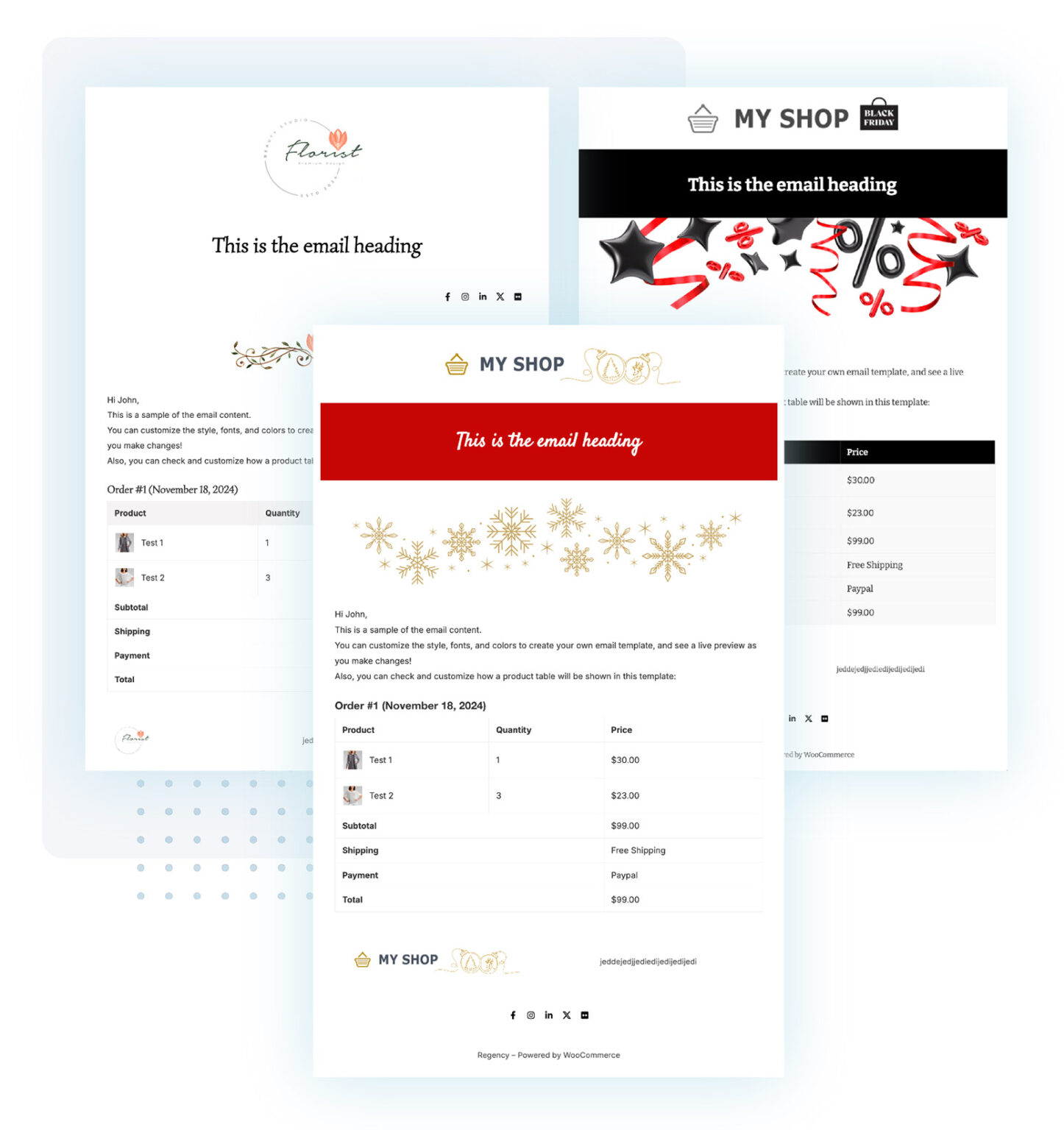
YITH WooCommerce Email Templates offers professionally designed, prebuilt templates for WooCommerce emails that you can style and apply quickly. It simplifies that “generate branded-looking order emails” step.
With just a few clicks, you can apply a template to all default WooCommerce messages. Customize colors, fonts, header/footer globally without designing each message manually.
Key Features:
- Multiple elegant template designs
- Global styling controls
- Compatible with WooCommerce extensions
- Minimal setup required
Pricing: No free version; starts at €79.99/year
3. FunnelKit Automations
FunnelKit Automations (formerly AutomateWoo’s sibling) combines email marketing and WooCommerce notifications in one plugin. You can send broadcasts, abandoned cart flows, thank‑you sequences, and customize transactional messages.
It’s powerful for setting multi-step workflows: tag customers, trigger emails based on behavior, run A/B tests, and monitor results right in your WordPress dashboard. A true “automatic emails” powerhouse.
Key Features:
- Visual automation builder
- Triggered transactional and marketing emails
- A/B testing
- Detailed analytics
- Abandoned cart and upsell workflows
Pricing: Free version exists; pro from ≈$16/month
Also Read:Landing Page Design Best Practices for Higher Conversions
4. AutomateWoo
AutomateWoo is a flagship WooCommerce automation plugin originally offering both notifications and email workflows. While higher-tier, it’s ideal for stores wanting granular triggers—like high‑value orders, loyalty point emails, VIP customer flows.
You get precise control: customizable triggers, branching logic, coupon issuance, and internal staff notifications. Great for stores with complex automation needs.
Key Features:
- Complex workflow automation
- Send admin and customer emails
- Trigger on custom events, cart value, and product categories
- Coupons and dynamic discounts
- Comprehensive logging and scheduling
Pricing: Premium plugin starting ≈$99/year
5. MailPoet
MailPoet is a WordPress-native email marketing plugin that also handles WooCommerce transactional and broadcast emails. You can send newsletters, abandoned cart reminders, and branded order emails all within WordPress.
Its visual builder and list management make it a great “all‑in‑one” for small stores, avoiding external platforms. Includes SMTP delivery and analytics built in.
Key Features:
- Send WooCommerce notifications and newsletters
- Email list management inside WP
- Drag‑and‑drop email editor
- SMTP support and email logging
- Subscriber segmentation
Pricing: Free for up to 500 subscribers; paid plans from ~$10/month
6. Omnisend- WooCommerce Notifications & Automatic Emails Plugins
Omnisend isn’t a WordPress plugin per se, but it integrates seamlessly with WooCommerce and is considered one of the best email marketing tools for WooCommerce. It handles email automation, SMS, and push notifications from one dashboard.
Use it to send welcome series, cart recovery, order follow‑ups, and segmentation‑based campaigns. It’s especially strong in combining email with SMS/push for multi‑channel messaging.
Key Features:
- Deep WooCommerce integration
- Email + SMS + push automation
- Drag‑and‑drop builders and prebuilt templates
- Customer segmentation and behavior triggers
- Reporting and segmentation analytics
Pricing: Free tier exists; paid from ~$30/month
7. WP Mail SMTP Pro- WooCommerce Notifications & Automatic Emails Plugins
Although not a template designer, WP Mail SMTP Pro ensures your WooCommerce notifications and automatic emails actually reach inboxes. It fixes delivery issues by routing through reliable SMTP services.
Great as a companion to any notification plugin—if emails bounce or land in spam, this plugin ensures better deliverability, logs failures, and sends alerts to admins on issues.
Key Features:
- SMTP integration with providers like SendLayer, Gmail, Mailgun
- Email logs and failure alerts
- The setup wizard for the easiest configuration
- Option for white‑glove setup
- Compatibility with WooCommerce transactional emails
Pricing: Free core; Pro starts at ~$49/year
Also Read:Top eCommerce Platforms Which One Is Right for You?
8. WooCommerce Multiple Email Recipients
This plugin fills a specific gap: sending WooCommerce order notifications to additional email addresses. Useful for multi‑seller, vendor setups, or sending copies to the accountant, warehouse, or partner.
You can set product‑level rules, add multiple recipients, and tailor which orders send emails to whom. Simple but powerful for collaborative store environments.
Key Features:
- Order emails to more than one email address
- Recipient rules by product, category, or order
- No coding—easy UI
- Supports admin and customer notifications
Pricing: Premium plugin, price varies (often ~$29–49/year)
9. WP Swings Order Status & Email Notification
This plugin lets you define custom order statuses beyond WooCommerce defaults and send customized email notifications when status changes. It’s great for more detailed order flow control (e.g., processing, quality check, and dispatch).
You gain enhanced visibility and messaging accuracy for customers, admins, or team members throughout multi-stage order processing. Works well in dropshipping or staged fulfillment.
Key Features:
- Create unlimited custom order statuses
- Trigger custom emails for each status
- Bulk actions and status workflows
- Icons/color coding for status tracking
Pricing: Free basic; premium from ~$49/year
10. Advanced Notifications (WooCommerce official)
This official extension from WooCommerce.com focuses on internal notifications: alerting suppliers, warehouse, or staff based on product categories, order status, or shipping methods. Great for back‑end workflows.
Highly configurable recipient rules per event or product. When an order matching certain criteria comes in, the right people get notified—without manual forwarding or checking dashboards.
Key Features:
- Notifications per category, order status, or shipping method
- Multiple recipients and role assignment
- Email templates per rule
- Unlimited recipients and conditions
Pricing: ~$29/year from the official WooCommerce store

Final Thoughts
Choosing the right WooCommerce Notifications & Automatic Emails Plugins depends on your store’s needs. If you want branded outgoing emails, go with Email Customizer or YITH templates. If you need automation flows, FunnelKit or AutomateWoo shine. For internal alerts or delivery reliability, pair Advanced Notifications or WP Mail SMTP Pro with the others.
Across these 10 tools, you’ll find robust solutions to elevate your WooCommerce notifications, improve customer experience, reduce manual effort, and maintain brand consistency. Make use of triggers, templates, and analytics to unlock the full value of automation in your store.
Interesting Reads:
How Does a Web Designer Influence Front-End Architecture in Web Development?
How Web Hosting Impacts Website Speed, Security, and Uptime
A Complete Guide to Using Landing Page Templates